


Fast typists keep their eyes on the screen while their hands work from memory. That single habit accounts for most of the gap between 40 and 80 words per minute (WPM).
Learning how to type faster means rebuilding a few habits you've had since you first sat at a keyboard, then practicing them in a way that sticks.
What is a good typing speed?
A good typing speed is 50 to 60 WPM with at least 95% accuracy, which is sufficient for most office work. Wonderlic puts the average adult at around 40 WPM, while entry-level roles that involve heavy typing often target 60 to 80.
Accurate typing beats fast typing. Fixing constant mistakes slows a fast typist down more than the mistakes of a careful, slightly slower one, since every correction costs a backspace, a re-read, and a break in your thinking. Run a timed test before you start so you have a baseline to measure against.
How to type faster: 8 tips and tricks to increase your WPM
1. Learn to touch type
Touch typing means using all ten fingers from the home row, with each finger responsible for its own keys.
Rest your left fingers on A, S, D, F and your right on J, K, L, and the semicolon. The raised bumps on F and J let you find your position by feel.
Hunt-and-peck typing tends to stall somewhere around 40 WPM, and extra practice rarely pushes it much further. Switching costs a few frustrating weeks, and for most people it's the largest single gain on this list.
2. Stop looking at the keyboard
Every glance down costs you twice: once to find the key, and once to find your place again on the screen. Breaking the habit feels painfully slow at first, so expect your speed to drop before it climbs back up.
Cover your hands with a cloth if you keep peeking, or use a keyboard with blank keycaps. The goal is muscle memory, which only forms when your eyes stop doing your fingers' job.
3. Chase accuracy before speed
Typing fast and sloppily trains the wrong movements, and errors cost more time than slow keystrokes do. Set your target at 95% accuracy or better, then let speed rise on its own as the movements become automatic.
A useful drill is to type at roughly 80% of your maximum for a week, focusing on clean runs.
4. Fix your posture and hand position
Posture and hand position set how long you can type before quality drops. Sit with feet flat, elbows at roughly 90 degrees, wrists floating above the desk, and the screen at eye level to keep your neck neutral.
Curve your fingers and keep your keystrokes light. Fatigue ruins accuracy in the back half of a long session, and by then you're making the mistakes that cost you the time you gained.
5. Drill your weak keys
Most people lose the same seconds in the same places, usually numbers, punctuation, and awkward letter pairs. Generic practice repeats what you already do well, so those weak spots improve slowly.
Note which keys you fumble during a typing test, then drill those sequences on their own. Targeted repetition pays off faster than typing more of the same.
6. Learn keyboard shortcuts
Every reach for the mouse breaks your rhythm and your focus, so learning copy, paste, undo, tab switching, text selection, and delete-by-word (Ctrl+Backspace on Windows, Option+Backspace on Mac) keeps your hands on the keys.
Shortcuts for your own tools pay back fastest, since those are the moves you make hundreds of times a day. It's the same principle behind broader workflow efficiency gains, where small repeated actions add up across a week.
7. Use a keyboard that fits your hands
A poor keyboard caps how far good technique can take you. Key travel, spacing, and resistance all affect how quickly your fingers move, and a cramped laptop board makes clean touch typing harder than a full-size one.
Try before you commit, since an expensive keyboard that doesn't suit your hands is worse than a cheap one that does.
8. Practice daily in short sessions
Focused 15 minutes a day beats two hours on a Sunday, because the movements bed in through frequency. Pick a fixed time, run timed tests on Monkeytype or Keybr, and log both WPM and accuracy so you can see the trend.
Short sessions are also easier to protect from interruption, and practice works only when you're paying attention, which is where the usual tactics for staying focused at work apply.
How long it takes to type faster
Expect 5 to 10 WPM of improvement per month with consistent daily practice, and a dip in the first two weeks if you're switching from hunt-and-peck to touch typing.
Moving from 40 to 60 WPM typically takes two to four months of short daily sessions. Getting past 80 takes longer, because at that point raw finger speed becomes the limit, not technique.
The other way to cut typing time
Typing speed has a ceiling. Most people top out somewhere between 60 and 80 WPM, and the returns thin out the harder you push past it. The other option is typing fewer characters in the first place.
That's what HyperWrite's TypeAhead does. It reads what's open in your other browser tabs, then suggests your next line as you type in any tab, so a sentence you'd have typed out shows up as a suggestion you can accept. Set up a Persona once and TypeAhead writes in your voice across every tab, Google Docs included.
Keep practicing the fundamentals, since fast, accurate typing helps whatever you're writing. Pair it with fewer keystrokes and the drafting speeds up too, which is the point of writing faster.
How much of your day goes to sentences you've already written a hundred times? Try TypeAhead free with the HyperWrite Chrome extension, and see how much of your next draft you never have to type.
Frequently asked questions
How can you type faster?
You type faster by learning touch typing with all ten fingers, keeping your eyes off the keyboard, and prioritizing accuracy over raw speed. Add short daily practice sessions that target your weakest keys, and expect gains of 5 to 10 WPM a month.
What is the average typing speed?
The average adult types around 40 words per minute. Professional typists typically land between 60 and 80 WPM, and roles like transcription or data entry often require 80 or more with high accuracy.
Is 60 WPM a good typing speed?
Yes, 60 WPM is a good typing speed. It sits above the adult average of about 40 and comfortably covers most office work, provided your accuracy stays at 95% or higher. Many employers treat it as a solid benchmark for typing-heavy roles.
How long does it take to learn touch typing?
Learning touch typing takes about two to four weeks of daily practice to feel natural, and two to three months to match or beat your old hunt-and-peck speed. Your speed drops at first, which is a normal part of relearning the movement.
Does typing faster save time?
Yes, typing faster saves meaningful time for anyone who writes regularly. Moving from 40 to 70 WPM nearly halves the time spent entering the same text, which adds up across emails, reports, and messages. Corrections eat the gains, so accuracy has to keep up with speed.
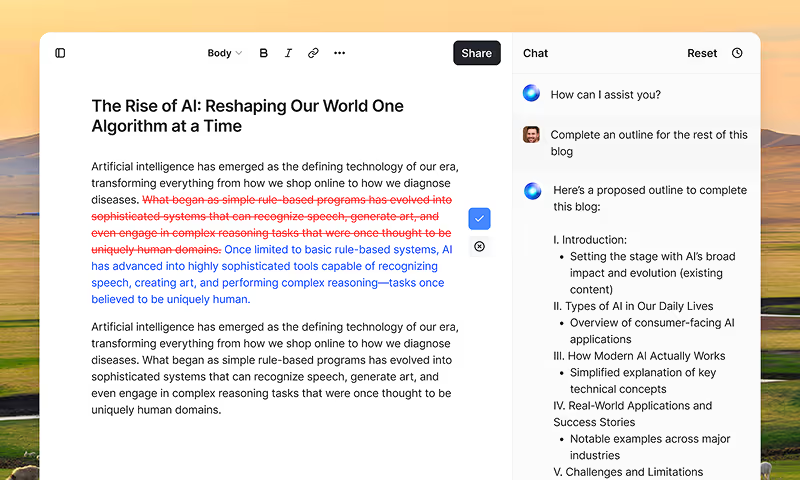
HyperWrite is the AI writing assistant that learns your style. It handles drafting, editing, and researching so you can focus on ideas.
- Autocompletes sentences as you type
- Works inside Google Docs & Gmail
- Adapts to your personal writing style
- 500+ AI tools for any writing task
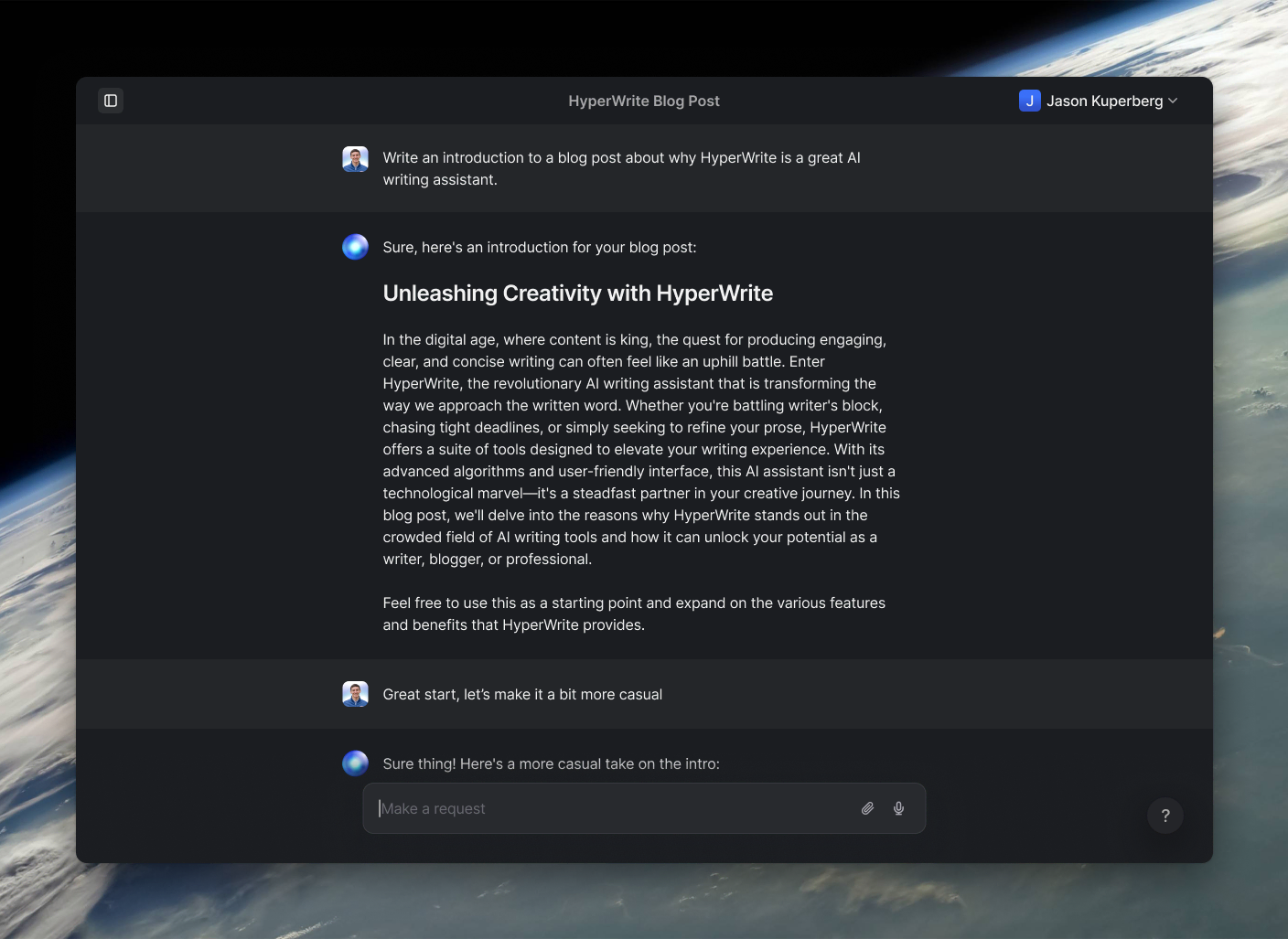
Powerful writing in seconds
Improve your existing writing or create high-quality content in seconds. From catchy headlines to persuasive emails, our tools are tailored to your unique needs.