
How to Write Faster: 5 Proven Methods for Professionals


After rewriting hundreds of emails, proposals, and leadership updates under real deadlines, I found that how to write faster has nothing to do with how fast you type. It comes down to fixing the moments where your workflow stalls.
Why you're still writing slowly
If a 250-word email takes 45 minutes, the problem usually isn't typing speed. It's everything wrapped around the typing. Microsoft's 2023 Work Trend Index found that the average employee spends 57% of their time communicating in meetings, email, and chat, and only 43% actually creating.
Here’s what slows most pros down:
- Starting too cold: There's no clear audience, no angle, no first line.
- Revising while you're still drafting. One paragraph turns into six mini-editing sessions.
- Researching mid-sentence. A quick fact check becomes a dozen open tabs.
- Rewriting familiar language from zero. The same intro, the same recap, over and over.
Before you change your process, check where your time actually goes. Do this once for a blog section, once for an email, and once for an internal doc. You'll usually find one dominant problem, and that's the place to start.
How to write faster with 5 methods
These five methods fix the exact points where writing slows down, so you can move from first sentence to finished draft without stopping every few lines.
Method 1: Build a draft pack before you write
A blank page is slow because it asks for everything at once: the angle, the structure, the first sentence, the tone. A draft pack removes that load before you start.
It consists of five things that fit on one screen:
- Audience: Who this is for
- Outcome: What they need to know, decide, or do
- Core point: One sentence that holds the piece together
- Structure: Section labels or a rough sequence
- Proof: Stats, examples, screenshots, or links you'll need
For a leadership update, that might look like: Executive team, explain pipeline slowdown without sounding defensive, pipeline is down, but qualified demo conversion improved, then snapshot/cause/next move/ask, then a CRM screenshot and last quarter comparison.
Now you're filling in a frame. 5–10 minutes is plenty. If the prep takes longer than the draft, you're procrastinating.
Method 2: Draft first, edit second
Drafting and editing are two different jobs. Doing both at once turns the page into a tug of war. You write three sentences, tweak the first, swap a verb in the second, and realize you haven't moved forward.
Split it into three passes instead.
- Pass 1: Get it down. Push through the full section without polishing. Use placeholders when you hit a gap: [add stat], [find example], [tighten this]. You can fix a hole later. You can't improve a paragraph you never finished.
- Pass 2: Fix structure. Does the strongest point land early? Did you bury the decision in paragraph four?
- Pass 3: Polish language. Trim repetition, sharpen verbs, fix tone. This is easier once the piece has shape.
Most people do the hardest version of writing by polishing sentences before they know whether those sentences belong.
Method 3: Talk through the draft before you type it
Some people know exactly what they mean until they try to write it, then the sentence stiffens up. Speaking fixes this faster than any rewrite. Open a voice note and explain the point like you're talking to a sharp coworker.
2–3 minutes, no polish needed. Just talk through what you're trying to say and why it matters. Use a real example if one comes to mind. It works best on intros that feel too formal, high-stakes emails, and explanations that make sense in your head but not on the page.
The typed version of a tough client follow-up starts: "Thank you for your time today. I wanted to follow up on our previous discussion."
The spoken version goes straight to: "OK, two things came up today: timeline's slipping and ownership isn't clear. Here's what I'd do about both.”
The second version sounds like someone who knows what happened. Speech strips the fake polish and gets you to the real point. Type from that instead of manufacturing clarity from a blinking cursor.
Method 4: Batch the inputs, then write in one lane
Most of the time, the pace of writing is based on interruptions. For example, you're mid-proposal when you need the pricing note, the approved language, or a screenshot. 10 minutes later, you're still "working," but the paragraph hasn't moved.
The solution is to fix the setup. Before you draft, pull everything into one place: notes, links, data, approved copy, and previous versions. Then batch similar tasks together: all your follow-ups in one block and all your recap docs before switching to strategy work.
Templates help too. Weekly updates, outreach emails, proposal sections, and any writing you do repeatedly shouldn't start from a blank page. Templates remove decisions that never needed your best thinking.
Method 5: Cut keystrokes with predictive writing
Professionals who write all day have another lever: reducing how much they type manually. That doesn’t mean handing drafts to AI and hoping they sound human.
Rather, it’s using the right tools for repetitive work so your attention stays on judgment, tone, and specifics.
- Predictive writing helps when you know the message and want to move through familiar phrasing faster: client follow-ups, internal updates, proposal sections, and recruiter outreach. The gain is speed and less mental drag because you’re not rebuilding every sentence from zero.
- Text expansion works for language you type every week. Lines like "here's the version I'd use" or "below is the revised timeline" don't need to be invented every time. Save them, reuse them, edit as needed.
- Dictation works best when the problem is volume, like brain dumps, messy first passes, sections where your ideas are outrunning your fingers. It works poorly when you need to sound exact on the first pass.
Mistakes that make writing slower
A few habits cost more time than anything else. Watch for these:
- Researching while you draft. It feels productive because you're "checking facts," but every tab switch costs you the thread. By the time you find the stat, you've forgotten the sentence you were building around it. Gather inputs first, draft after.
- Rewriting the intro before the middle exists. Most intros only get easier once you know what the piece is actually saying. Writers who polish the first paragraph for 20 minutes usually rewrite it anyway after the body is done. Write a rough opener, move on, fix it last.
- Writing without a clear outcome. When you don't know what the piece needs to do (get a yes, change someone's mind, or deliver bad news), every sentence becomes a debate. Name the outcome in one sentence before you start.
- Trying to sound impressive on the first pass. Reaching for the perfect verb or the clever turn of phrase mid-sentence is what turns a 30-minute email into a 2-hour one. Clear writing gets finished faster than clever writing. You can sharpen language in the polish pass.
- Letting AI replace the thinking. AI speeds up execution. It can't decide what's worth saying or which example actually proves the point. Hand it your draft to tighten or your bullet points to expand, but don't hand it the strategic call. Those are still yours.
- Treating every piece of writing the same way. A Slack message, a board update, and a sales proposal don't need the same prep. Pros calibrate effort to stakes: 30 seconds for Slack, 5 minutes of prep for the update, a draft pack for the proposal. Spending equal time on all three is how the high-stakes writing ends up rushed.
The real fix for slow writing
Most professionals don't need to learn how to write. They need to stop fighting their own workflow. The five methods above each target a different break point: the blank page, the editing-while-drafting trap, the stiff-on-the-page problem, the tab-switching mess, and the retyping you've already done a hundred times.
Pick the one costing you the most time and start there. Give it a week before you stack on a second method. That's enough runway to actually feel the difference.
If retyping is the one eating your day (the same client follow-ups, the same recap intros, or the same proposal language across Gmail, Docs, and Notion), that's where HyperWrite helps most.
HyperWrite’s TypeAhead reads what you have open in your other tabs and suggests sentence completions in the flow of whatever you're writing. It isn't just autocomplete; the suggestions actually pull from the email thread, the doc, or the notes you've already written.
If you pair it with Personas, the suggestions start sounding like you. Writing faster shouldn't mean writing like everyone else.
Still typing the same emails, updates, and proposal lines every day? Try TypeAhead free with the HyperWrite Chrome extension and stop retyping by hand.
Frequently asked questions
How can I write faster without losing quality?
You can write faster without losing quality by splitting drafting from editing. Get the full draft down first, then fix the structure, then polish the language. That keeps momentum high without letting sloppy wording slip into the final version.
Is writing faster mostly about typing speed?
No, writing faster isn't mostly about typing speed. The bigger delays usually come from blank-page hesitation, mid-draft editing, and constant tab switching. Fix those first, and the draft moves much faster.
Should I edit while I write?
No, you shouldn't edit while you write, at least not in any serious way. Light typo fixes are fine, but full editing mid-draft slows you down because you're switching between two different jobs. Finish the section first, then come back with a cleaner eye.
Are writing sprints useful for professional writing?
Yes, writing sprints work well for professional writing, especially for emails, briefs, proposals, and article sections. A short sprint cuts overthinking because the clock pushes you to finish the thought before you judge it.
Can AI help me write faster without making my writing sound generic?
Yes, AI can help you write faster without flattening your voice if you use it for the right parts. Let it handle first-pass phrasing and repeated language, then add your own examples and judgment in the edit. Tools with voice-matching features, like HyperWrite's Personas, train on how you actually write, so the suggestions sound like you.
What's the best first step if I freeze at the blank page?
The best first step if you freeze at a blank page is to build a short draft pack. Write down the audience, the outcome, the core point, and the rough structure before you draft. That usually gives you enough traction to start typing without waiting for the perfect opening line.
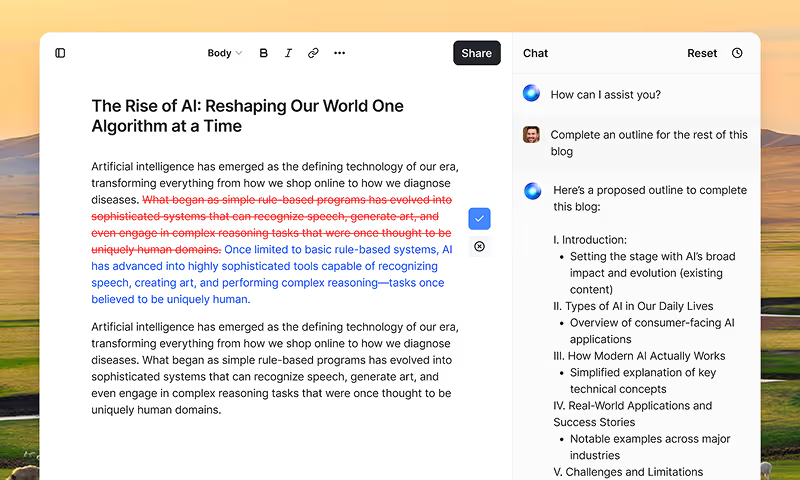
HyperWrite is the AI writing assistant that learns your style. It handles drafting, editing, and researching so you can focus on ideas.
- Autocompletes sentences as you type
- Works inside Google Docs & Gmail
- Adapts to your personal writing style
- 500+ AI tools for any writing task
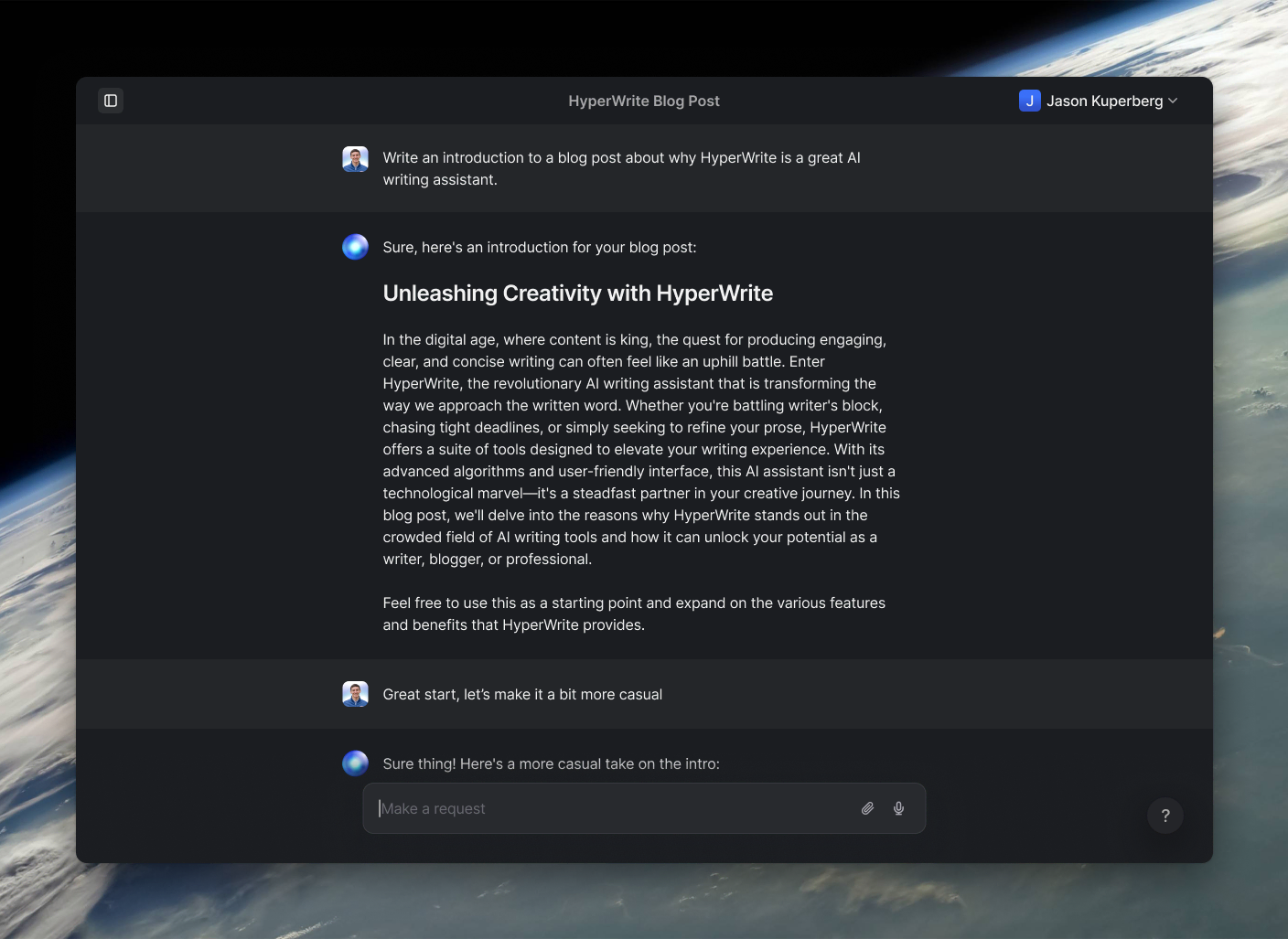
Powerful writing in seconds
Improve your existing writing or create high-quality content in seconds. From catchy headlines to persuasive emails, our tools are tailored to your unique needs.