
How Many Words Can You Write in an Hour? Pace by Type
How many words can you write in an hour? Most people draft 500 to 1,000. See ranges by writing type and how to draft faster at work.


You've got a word-count target and a clock. Maybe it's a 1,500-word report due this afternoon, or a board update you keep putting off. Either way, you're asking the same question: how many words can I write in an hour?
The honest answer is that it depends on what you're writing. Most people draft somewhere between 500 and 1,000 words an hour. Fast drafters push past 1,500 on a well-outlined hour. Add research or heavy editing, and the number drops fast.
Below, you'll find the pace for each kind of writing, what working writers report, and five ways to reach 1,000 words in an hour.
How many words can you write in an hour by writing type
Writing speed comes down to the task in front of you and how fast you can think it through. Here are the average words per hour for the most common kinds of writing.
| Writing Type | Average Words Per Hour | What Slows It Down |
|---|---|---|
| Fiction/creative drafting | ~500–1,000 | Inventing plot, voice, and detail from nothing |
| Blog/content writing | ~500–1,500 | Research; much faster once you've outlined |
| Academic/research-heavy | ~200–500 | Sourcing, citations, and precise claims |
| Editing/revising | ~1,000–2,250 reviewed, ~0 new | Reworking text that already exists |
| Raw typing (copying text) | ~2,000–3,000+ | Nothing; you aren't composing |
| Handwriting (composing) | ~900–1,500 legible | Hand speed and fatigue |
Compare the raw-typing row with the composing rows. You can type 2,000-plus words an hour when you're copying something out, because you aren't inventing anything. Composing new, considered prose is a slower, harder job.
Research and editing collapse the net new-word count hardest. A heavily sourced piece can eat a full hour and leave you with 300 words you'd actually keep. That's normal.
The full job runs slower than drafting alone. Orbit Media's 2026 blogger survey found the average 1,312-word post takes 3 hours and 20 minutes. That's about 400 finished words an hour. Editing covers more ground. In the EFA's 2026 rate survey, professional editors report reviewing roughly 1,000 to 2,250 words an hour.
What real writers report about their hourly pace
Ask working writers what they actually hit, and the answers spread wide. One writer on Reddit's r/writing puts a typical hour at 600 to 700 words, slipping to 400 or 500 on a rough day.
Well-known authors vary just as much, by the hour and by the day.
Anthony Trollope: wrote with his watch in front of him and held himself to 250 words every quarter of an hour, a 1,000-word hour.
Ernest Hemingway: tracked his output on a chart, and his 1958 Paris Review interview lists days from 450 to 1,250 words.
Stephen King: told The Paris Review in 2006 that he'd dropped from 2,000 words a day to about 1,000.
R.L. Stine: told NY1 in 2023 that he writes 2,000 words a day, about 10 pages.
If you're writing a book, a steady daily number matters more than one fast hour, so one good hour a day is a legitimate routine.
A big hourly number is a burst. Most of us can sustain a fast pace for an hour or two before focus fades and the words get worse.
It's also why comparing yourself to someone else's count rarely helps. Their 1,200-word hour might be a first draft they'll gut tomorrow, while your 500 careful words are nearly done. A pace only means something next to the kind of writing you're actually doing.
What writing speed looks like for professionals
Most writing-speed advice assumes long, uninterrupted stretches at the desk. If you work in leadership, HR, marketing, or ops, you rarely get those.
You're writing a performance review between two meetings, or a launch brief while three Slack threads blink at you. The clock is real, and so are the interruptions.
For that kind of work, a realistic net output is roughly 300 to 700 words an hour once you count the thinking and the editing. A short, well-formed email might take five minutes. A one-page strategy memo can eat an hour, because deciding what to say takes longer than writing it down.
The real bottleneck for professionals is usually one of three things:
- Starting cold: the first sentence is the hardest one of the day.
- Context-switching: every jump between tabs and tasks costs you a re-entry tax.
- Editing while drafting: polishing each sentence as you go drags out the whole draft.
Name which one is slowing you down, and the hour gets more productive even if you never type a word faster.
This is also why raw word-count goals can mislead at work. A 400-word update that lands cleanly with your CEO is worth more than a 1,200-word draft nobody finishes. For professionals, the win is getting the right words out in the hour you have, and the fastest way there is to shrink the time you lose before the writing even starts.
Words per hour vs. words per day
Once you know your hourly pace, you can plan a whole project with some confidence. The trap is multiplying your best hour by eight and assuming you'll produce 8,000 words in a workday. You won't.
Focus and quality slip long before the workday ends.
For most writers, a sustainable day lands between 500 and 2,000 words of keep-worthy prose. That's enough to finish a solid blog post, a long email thread, or a real chunk of a report. Spread across a week, it adds up faster than one heroic session you then need days to recover from.
A simple mental model helps here. Your sprint rate is what you hit in a single focused hour. Your daily rate is what you can repeat on a normal week without running yourself down. Plan around the daily rate. If you plan your week around realistic output, deadlines stop surprising you, and a big piece becomes a handful of ordinary sessions.
How to write 1,000 words in an hour
Writing 1,000 words in an hour is realistic when the conditions are right. It mostly comes down to removing the decisions that stall you mid-sentence. Five moves do most of the work:
- Outline first: spend five minutes on five to seven bullets so every paragraph knows its job before you type it.
- Research before you draft: gather your facts and sources first, so you aren't stopping mid-sentence to look things up.
- Draft ugly, polish later: write the worst version in one pass and fix it afterward.
- Protect the block: hold focus for a timed sprint, like a 25-minute Pomodoro, with tabs and notifications closed.
- Start before you're ready: a rough first line beats a blank page every time.
That's the short version. For the full playbook, read our proven methods for writing faster, which goes deep on each tactic.
If the thing slowing you down is getting stuck on a blank page, the fixes for writer's block will help more than any raw speed tip. And if you can't hold focus for a 25-minute sprint, that's the first lever to pull.
How HyperWrite helps you write more in every hour
Most of what eats your hour is the friction around typing: starting cold, switching between tabs, and editing every sentence as you write it.
HyperWrite is a writing co-pilot built for exactly those gaps. It works across the browser tabs you already have open, so you're not copying context back and forth between a chatbot and your draft. Professionals at Google, Netflix, LinkedIn, and Spotify use it to move faster through everyday writing.
With HyperWrite, professionals can:
- Beat the blank page on a board update or job description with AutoWrite and the AI Writing Assistant for a fast first pass.
- Keep every draft in their own voice with Personas, reusable voice profiles they set up once with instructions and writing samples.
- Finish sentences faster with TypeAhead, the autocomplete in HyperWrite for Chrome that pulls context from their open tabs.
- Reuse repeatable formats from a library of prebuilt AI Tools for emails, rewrites, and summaries.
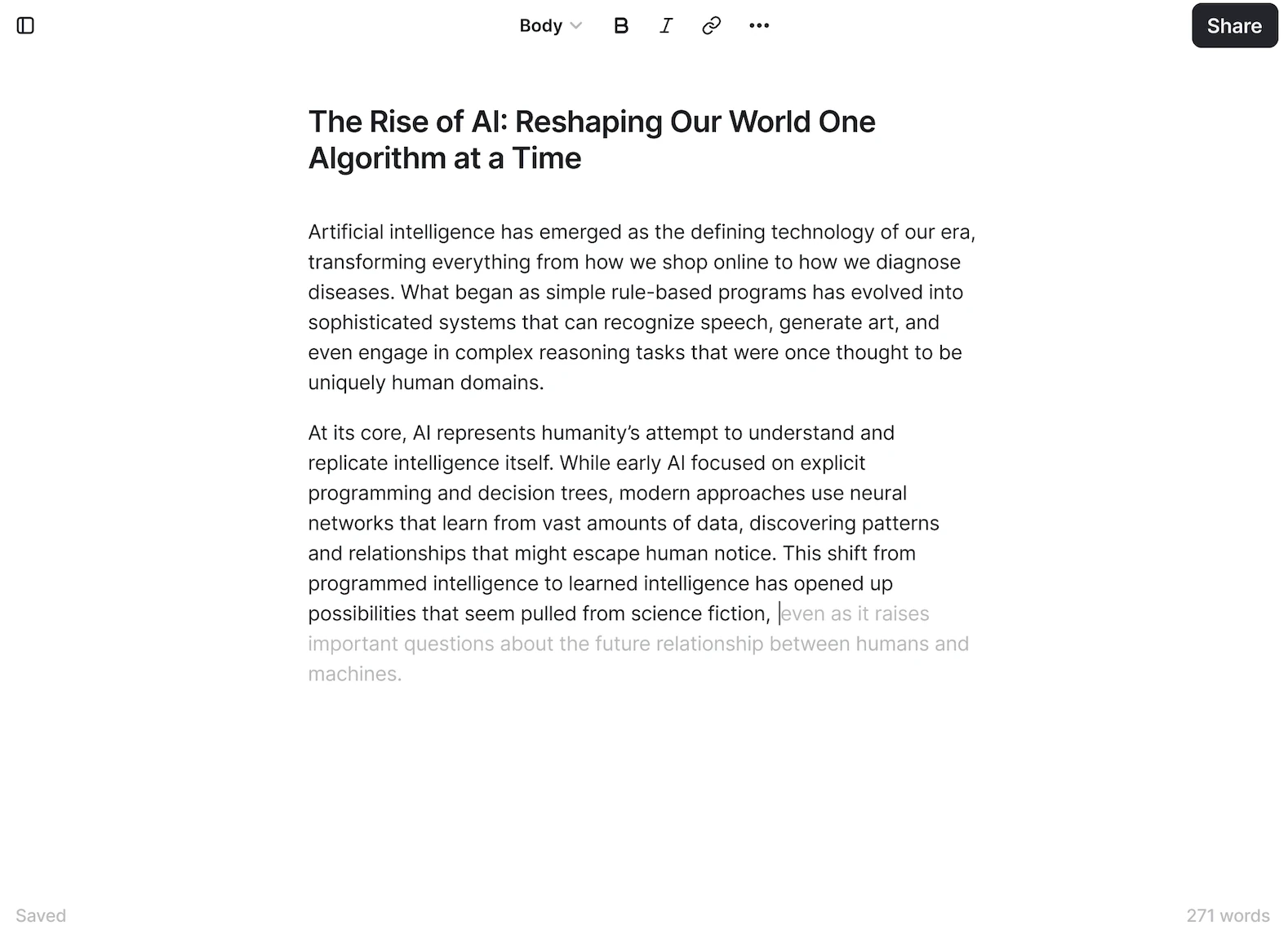
Spend your hour on judgment and let HyperWrite absorb the blank-page friction, so how many words you can write in an hour stops deciding your deadline.
Start your next proposal or investor update in HyperWrite's AI Document Editor with a free account, and add HyperWrite for Chrome for autocomplete in Gmail, Google Docs, and the other sites you write in.
Frequently asked questions
Is it possible to write 3,000 words in 2 hours?
Yes, you can write 3,000 words in two hours, but only in fast-drafting conditions. That pace works out to 1,500 words an hour, which is realistic when you've already outlined and need little research. For research-heavy or heavily edited work, it's unrealistic.
How many words per hour should you write?
A pace of 500 to 1,000 words an hour is solid for most drafting, so a 700-word hour is a reasonable target. Research-heavy writing runs closer to 200 to 500, while an outlined first draft can push toward 1,500.
Can I write 1,500 words in one hour?
Sometimes you can write 1,500 words in one hour, if you have a ready outline and minimal research. Most writers land closer to 500 to 1,000 words an hour once thinking and light editing are counted.
How many words can you write in an hour for an essay or exam?
Typing an essay with your notes ready, you can reach 500 to 1,000 words an hour. For a handwritten exam, a 2020 SASC review of student writing tests found a median of about 17 words a minute, or roughly 1,000 words an hour in short, timed bursts. What usually slows you down is structure, so spend the first five minutes outlining your thesis and main points, and the words come far faster.
How long does it take to write 500 words?
Writing 500 words takes most people about 30 to 60 minutes of drafting. Add research or careful editing, and the same 500 words can stretch to a couple of hours. A short, familiar topic is far quicker than a technical one.
How many words can you write in a day?
You can write roughly 500 to 2,000 words a day sustainably, depending on the type of writing and how much research it needs. A full day doesn't equal your best hour times eight, because focus and quality fade after a few hours of real composing.
Can HyperWrite speed up your writing?
Yes. HyperWrite speeds up the slow parts of the hour. Its Chrome autocomplete finishes whole sentences, AutoWrite drafts a paragraph on any topic in one step, and Personas keep the output sounding like you.
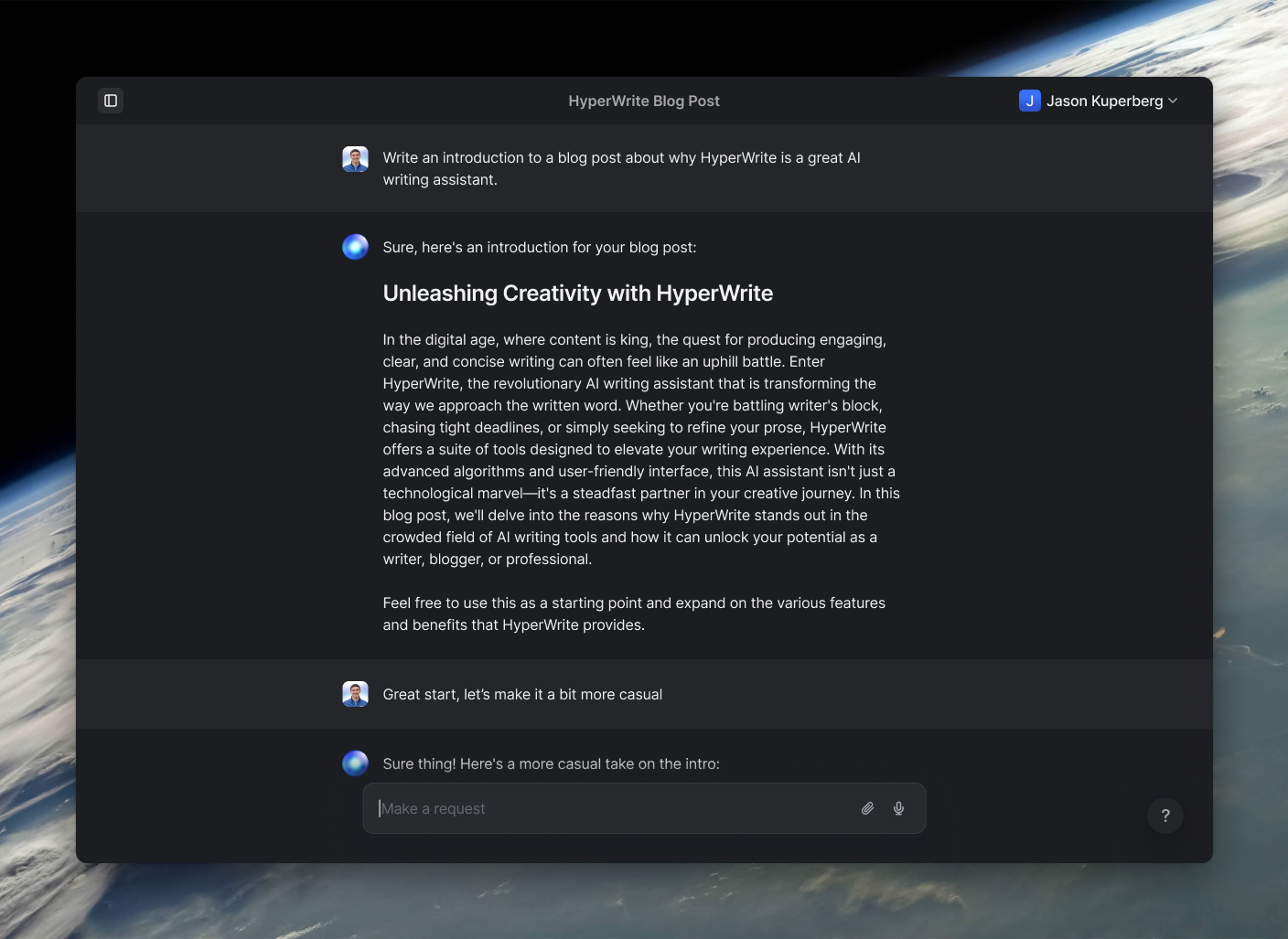
Powerful writing in seconds
Improve your existing writing or create high-quality content in seconds. From catchy headlines to persuasive emails, our tools are tailored to your unique needs.