
How Long to Write a 1,000-Word Essay: 25 Min to 4 Hours


You've got a 1,000-word essay to write and a blank document staring back at you. The short answer to how long it takes to write a 1,000-word essay: usually somewhere between 25 minutes and four hours.
That's a wide range, and most of the gap comes from how much research you have to do. A topic you already know cold? You might finish before your coffee does. A researched academic essay with citations? Block out an afternoon.
The time ranges below come from typing-speed data and published essay-time guides, and the tactics from research on focus and AI-assisted writing. By the end, you'll know which scenario you're in and how to cut your time.
How long it takes to write a 1,000-word essay
So how long does it take to write a 1,000-word essay? If you're just typing out something you already understand, 1,000 words takes about 20 to 30 minutes at the average typing speed of around 40 words per minute.
Add some light research, and you're looking at one to two hours. A research-heavy academic essay, with real sources and citations, usually runs three to four hours.
That shakes out by situation like this:
These numbers assume a roughly average pace and no major distractions. (For shorter pieces, here's how long 500 words takes.) Your real time depends on the stages underneath, so let's split those out.
Time by stage: research, outlining, drafting, and editing
A 1,000-word essay breaks into three jobs: research and outlining, drafting, and editing. Splitting the clock this way shows where your time actually goes (and where to claw some back).
That first row swings the total more than any other. Write about something you already know, and research drops close to zero, which is how a four-hour essay can come in under three hours.
Drafting goes fastest when research and the outline are already done, because every sentence knows what it's for. Editing is the sneaky one. If you polish each sentence as you write it, you're really doing two stages at once, and the total creeps up.
Immerse Education gives a sample split for a 1,000-word essay: 30 minutes of research, 20 minutes of outlining, and an hour of drafting. Add 30 to 60 minutes of editing and that lands between the light-research and research-heavy rows above.
What changes how long your essay takes
Two people can write the same 1,000-word essay in wildly different times. Here's what makes the difference.
Research load. This is the big one. A familiar argument essay needs almost no lookup, while an obscure topic can eat hours before you type a word.
Reading comprehension. The faster you absorb and organize what you read, the faster the research stage ends. Skimmers finish sooner than re-readers.
Planning. A short outline saves time in the draft. Deciding your three main points up front means you're never stuck wondering what comes next.
Typing speed. At 40 words per minute, you can type 1,000 words in about 25 minutes, but that pace drops hard when you're stopping to check a source mid-sentence. If raw speed is the bottleneck, here's how to type faster.
Experience. Seasoned writers can finish the whole essay in under an hour, while beginners can take up to four hours. Practice mostly teaches you to stop second-guessing every line.
Citations. References are a separate job from writing, so an essay "with references" takes longer than the raw word count suggests, especially once you're formatting them.
Essay type. A personal reflection moves quickly, while a research essay needs evidence for every claim. College-level work also expects deeper analysis and better sourcing, which is where the extra time goes.
Distractions and writer's block. A phone that keeps buzzing pulls you out of the essay, and every interruption costs time to get back in. And if you keep stalling out, the usual culprit is writer's block. Protecting a quiet block of time and staying focused does more for your pace than any typing drill.
What 1,000 words actually looks like
When you plan the clock, it helps to picture the thing you're building. A 1,000-word essay is shorter than it sounds.
On the page, 1,000 words is about two pages single-spaced, or four pages double-spaced in a standard 12-point font. That's roughly five or six paragraphs if you follow the layout below.
A clean structure for 1,000 words looks like this:
- Introduction: about 100 to 150 words, ending on your thesis.
- Body: about 700 to 800 words, split across three or four points.
- Conclusion: about 100 to 150 words that tie the points back together.
How to write a 1,000-word essay faster
The typing is the quick part, but most of the time goes to working out your point, finding things again, and fixing the draft, so these seven tactics go after those.
- Give every outline point a word target. Use the structure above (around 200 words per body point) and write the number next to each bullet. Once a paragraph hits its target, it's done, so you stop padding the easy points and shortchanging the hard ones.
- Write in 25-minute sprints. Work in the Pomodoro rhythm, 25 minutes on and 5 off, and aim to finish one body paragraph per sprint. A single paragraph is far easier to start than "write the whole essay."
- Cut off interruptions before they start. UC Irvine researcher Gloria Mark found that people now hold their attention on one screen for about 47 seconds, and that getting back to an interrupted project takes around 25 minutes. She also found we interrupt ourselves about as often as notifications do, so close the tabs you don't need for the essay as well as silencing your phone.
- Draft without editing. The UNC Writing Center points out that editing is what you do after the first draft exists. When you hit a gap, like a missing stat or a word you can't find, type TK and keep going. It’s journalist shorthand for “to come,” and since the letter pair shows up in almost no English words, one search finds every gap later.
- Write the body first. The opening sentence is the hardest one to write, so skip it. Your thesis often sharpens once the evidence is on the page, so an intro written last matches the essay you actually wrote.
- Log the citation with the quote. Paste the quote, the page number, and the full source details together while you read. Rebuilding a citation later means finding the source all over again, usually at 2 a.m.
- Use AI for the rough draft. In an MIT experiment published in Science, 453 professionals finished writing tasks 40% faster with ChatGPT, and independent graders rated their work 18% higher. The researchers add that real-world gains are smaller, since you still write prompts and check facts. HyperWrite's AutoWrite gives you a rough version to edit (the thinking still has to be yours). If it's for a class, check your instructor's AI policy before you start.
For more on this, here are some proven ways to write faster.
Write faster without losing your voice
Outside a classroom, a 1,000-word essay becomes a thought-leadership post, a proposal section, or a quarterly update for your board. The clock runs the same way: most of it goes to figuring out what you think and getting a first version down.
That first version is where HyperWrite helps. It's a writing co-pilot that works across the tabs you already have open, so you spend less time fighting the first sentence.
With HyperWrite, you can:
- Turn notes into paragraphs: Paste an outline point into AutoWrite and get a first paragraph to react to.
- Back up your claims: Scholar AI searches millions of peer-reviewed papers when a piece needs evidence.
- Stay in flow: TypeAhead in HyperWrite for Chrome completes your sentences using context from your other open tabs, in Google Docs, Gmail, or wherever you're drafting.
- Keep your voice: Set up a Persona and suggestions match the way you write.
- Get unstuck: The AI Writing Assistant runs on writing-optimized prompts built from years of A/B testing and answers faster than ChatGPT-style thinking models.
That leaves your hours for the parts only you can do: the argument, the judgment calls, and the final edit.
Start your next draft free in HyperWrite's AI Document Editor, and add HyperWrite for Chrome to keep writing inside Google Docs.
Frequently asked questions
Can you write a 1,000-word essay in a day?
Yes, you can write a 1,000-word essay in a day with room to spare. A research-heavy essay usually takes three to four hours, so a full day leaves plenty of time to research, draft, and edit without rushing.
Can you write a 1,000-word essay in 2 hours?
Yes, you can write a 1,000-word essay in two hours for a familiar topic that needs only light research. It's tight for a heavily researched academic essay, where finding and citing sources can eat most of that time.
Can you write a 1,000-word essay in 1 hour?
You can write a 1,000-word essay in one hour if you know the topic well and skip heavy research. The draft quality will be closer to a solid first pass than a polished, fully cited paper.
Is writing 1,000 words in 30 minutes good?
Writing 1,000 words in 30 minutes is a fast pace for composing, about 33 words per minute while you're also deciding what to say. It works for a first draft on a familiar topic, but plan separate time to edit, since output that quick usually needs cleanup.
What is the 10% rule for essays?
The 10% rule is a common convention, especially at UK universities: you can usually go about 10% over or under an assigned word count without penalty. For a 1,000-word essay, that's roughly 900 to 1,100 words. Check your assignment, since some instructors set stricter limits.

HyperWrite is the AI writing assistant that learns your style. It handles drafting, editing, and researching so you can focus on ideas.
- Autocompletes sentences as you type
- Works inside Google Docs & Gmail
- Adapts to your personal writing style
- 500+ AI tools for any writing task
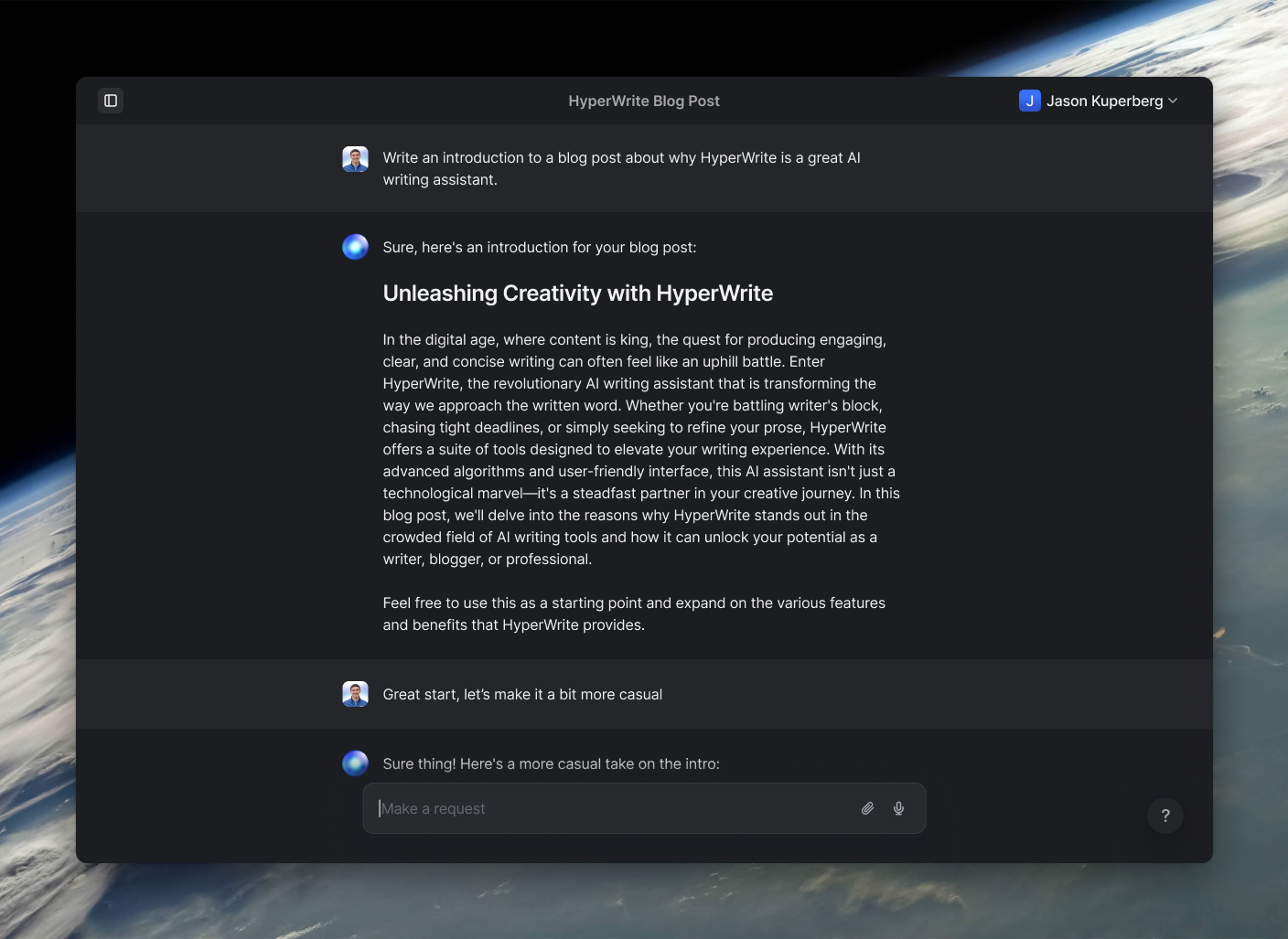
Powerful writing in seconds
Improve your existing writing or create high-quality content in seconds. From catchy headlines to persuasive emails, our tools are tailored to your unique needs.