
How Long Does It Take to Write a Book? Real Timelines


Somewhere around month four, almost every author hits the same quiet panic: everyone else seems faster than me.
How long does it take to write a book? For most authors, six months to two years, and both ends of that range are normal.
Once you can see where the months actually go, you can estimate a realistic timeline for your own book instead of guessing, and see how your pace compares with authors like Nora Roberts and George R.R. Martin.
How Long Does It Take to Write a Book?
Six months to two years. For a standard novel of around 80,000 words, roughly a year is the realistic average once you count drafting, revision, and editing together.
The range is wide for a good reason. Write full-time with a solid outline, and a first draft can come together in three to four months. Write around a day job, and one to three years is typical, and a research-heavy book or a debut can take two to four.
How long it takes to write a novel follows the same rules as any other book: a typical 80,000-word novel lands in the same six-month-to-two-year window. Length and genre move that number far more than whether the book is fiction or nonfiction. Start from a one-year baseline, then adjust for the factors below.
How Long It Took Famous Authors to Write Their Books
If your book feels like it's taking forever, you're in good company. The authors below needed anywhere from under three days to more than a decade, so there's no correct speed.
- John Boyne wrote the first draft of The Boy in the Striped Pyjamas in about two and a half days, writing almost non-stop. He's said he had long been a student of the Holocaust and had read most of the important writers on the subject, so the fast draft sat on a long foundation.
- Stephenie Meyer drafted Twilight in roughly three months, producing a 500-page manuscript before she went looking for an agent.
- Nora Roberts typically releases four books a year, and has for more than four decades, with more than 250 books to her name. As she told the AP, "I'm a fast writer."
- Margaret Mitchell began Gone with the Wind in 1926 and wrote most of it within three years; it was published in 1936 as her only novel in her lifetime.
- J.R.R. Tolkien worked on The Lord of the Rings for roughly 12 years after The Hobbit's success led his publisher to ask for a sequel, and it wasn't published until 1954 and 1955.
- George R.R. Martin published A Dance with Dragons in 2011, and The Winds of Winter still isn't finished 15 years later. In January 2026, he said he had about 1,100 manuscript pages done, roughly where he'd been since late 2022.
From a two-and-a-half-day first draft to a sequel still unfinished after 15 years, these timelines cover every speed, and books that lasted came from both ends. Speed tells you almost nothing about quality.
The Book-Writing Timeline, Stage by Stage
Every book moves through five stages, and the first draft is only one of them. Here's roughly how the time breaks down for a typical full-length book.
Editing often rivals the draft itself, so writers who budget three months for a first draft and nothing for revision tend to blow past their own deadlines.
The stages also overlap. You'll outline new chapters while drafting, and light-edit as you go. Treat these ranges as a map, not a schedule carved in stone.
How Many Words Per Day to Finish Your Book
The fastest way to estimate your own timeline is to work backward from a daily word count. Here's how long an 80,000-word draft (a typical novel length) takes at a few steady paces.
A couple of honest caveats. These are drafting days only, so add the revision and editing months from the stage table on top. And nobody writes 365 days a year, so build in sick days, slow days, and the odd week off.
Consistency beats intensity. A steady 500 words a day finishes a first draft in about six months, and most people can protect that much time. If you want to lift your daily output and actually keep it up, these proven ways to write faster help more than marathon weekend sessions that leave you drained.
First-Time Authors vs. Full-Time Authors
A first novel and a tenth novel can be the same length and still finish years apart.
First-time authors often take a year or more. For a debut novelist holding down a full-time job, one to three years is the usual range, according to novelist Keith A. Pearson. You're learning craft as you go, so you revise more and backtrack often, and with no contract, there's no deadline forcing the issue.
Full-time authors often finish a book a year or faster. Pearson notes that plenty of professionals who write for a living turn a book around in six months or less. Once the process is dialed in, planning and revision get faster, a contract supplies a hard deadline, and the author can hand one draft to an editor while starting the next.
It comes down to reps and routine more than raw talent. If your first book is taking years, that's a normal debut timeline, and your next book will come faster.
What Affects How Long It Takes to Write a Book
Two writers can start the same month and finish years apart. These are the variables that decide where you land.
Target Length
A 50,000-word short novel is a different job from a 120,000-word fantasy epic. Word count is one of the biggest levers on your timeline, which is why the words-per-day math is worth doing before you start.
Genre and Format
Genre sets the pace because it sets both the length and the prep work. A picture book typically runs 400 to 800 words, while fantasy and sci-fi novels often run 100,000 to 115,000. Fantasy also adds a job most genres skip: building the world, from its history to its magic system, before the plot can hold together. That's why a picture book can be drafted in a week or two, a chapter book in one to three months, and a sprawling fantasy can take years.
Research Load
A contemporary story you can write from experience moves fast. A historical novel or a reported nonfiction book front-loads months of reading and interviews. Boring but true: research you skip now becomes revisions later.
How Often You Write
Daily writers finish in a fraction of the time weekend-only writers do because frequent sessions maintain momentum and skip the rereading that long gaps force. Building a more efficient daily workflow that protects your writing time does more for your finish date than any single productive week.
Experience Level
Every book you finish teaches you to plan tighter and revise faster. You learn how much outlining you actually need, which kinds of scenes tend to end up cut, and where your drafts usually go wrong, so each new book needs fewer rewrites. That's why your second book is almost always quicker than your first.
The Mid-Book Slump
Most writers hit a slump around the halfway mark where the draft feels broken and the fun is gone. That phase is normal; it passes, and it's responsible for a surprising share of books that take "longer than expected."
How to Write Your Book Faster
You can't rush good revision, but you can compress the drafting stage, which is the longest one on the table. A few levers do most of the work:
- Set a realistic daily word count and protect the time. Pick a number you can hit on a bad day, not your best day, then guard that writing block from distractions. Five hundred steady words beats a planned 2,000 you skip three days running. If your typing can't keep up with your thinking, learning to type faster helps every session go further.
- Draft from a loose outline. When each session knows its job, you spend your energy writing instead of deciding what to write. The outline can be five bullets; it just has to exist.
- Separate drafting from editing. Fixing sentences while you draft is the fastest way to stall. Get the ugly version down first, then revise. Editing a bad page is quicker than writing a perfect one.
- Don't go more than a day or two without writing. Momentum is the whole game. Long gaps mean re-reading, re-remembering, and rebuilding the headspace you already paid for. If you keep stalling on the blank page, these methods to beat writer's block clear most cases in minutes and keep the daily habit intact.
- Kill the blank page. The hardest part of any session is the first sentence. Dictation, freewriting, or an AI writing co-pilot like HyperWrite's TypeAhead, which predicts your next sentence in your voice as you type, gets you past the first line and keeps the words moving.
How Long Does It Take to Get a Book Published?
Once the manuscript is done, publishing starts its own clock, and most timelines leave it out. The two routes look very different.
Self-publishing takes weeks to a few months after your manuscript is ready. You control the schedule for cover design, formatting, and the final proof, so a motivated author can go from polished file to live listing fairly fast.
Traditional publishing usually takes two to four years. First you query agents, which often takes three months to a year. Then your agent submits to publishers, which adds more months. Even after a book deal, the gap from deal to shelf typically runs one to two years while the book is edited, designed, and slotted into a release calendar.
Self-publishing puts the timeline in your hands, while traditional publishing hands most of it to other people's calendars. The choice comes down to whether a publisher's backing is worth the longer wait.
How HyperWrite Helps You Finish Your First Draft Faster
When you add up how long it takes to write a book, the first draft is the biggest chunk of writing time, and it's where most books stall. A blank page or a missed week can stretch six months into two years.
HyperWrite is built for that stage. It's a context-aware writing co-pilot that works across your browser as you draft. Unlike a general chatbot, it stays in the document with you and writes in your voice.
With HyperWrite, you can:
- Get next-sentence suggestions from TypeAhead that pick up context from your outline and other open pages, so you rarely start a sentence cold
- Keep your own style with Personas that learn from your past writing, instead of generic AI output
- Write across every tab, from Google Docs to email to research notes, without copy-pasting between apps
- Draft with writing-optimized prompts tuned from years of testing, faster than chat-style thinking models
Picture your next 500-word session with TypeAhead running in Google Docs: when you stall mid-paragraph, a next sentence in your voice is already waiting for you to accept or ignore. TypeAhead users typically accept 100+ suggestions in their first month.
Try TypeAhead free with the Chrome extension and open your manuscript for your next writing session.
Frequently Asked Questions
How long should it take to write a first book?
A first book often takes a year or more, and one to three years is common if you're writing around a full-time job. Debut authors learn craft as they go, revise more, and often write around a day job with no deadline, so a slow first book is normal, not a warning sign.
How long did J.K. Rowling take to write Harry Potter?
J.K. Rowling took five years to write the first Harry Potter book, Harry Potter and the Philosopher's Stone, by her own account. She wrote it through major life upheaval before it was published in 1997.
How long does it take to write a novel compared to a book?
A novel takes about the same time as any other book. A typical 80,000-word novel runs six months to two years, matching the general range, because length and genre drive the timeline more than whether the book is fiction.
How long does it take to write a book on average?
On average, it takes about a year to write a standard-length book at a steady pace, including revision and editing. Full-time writers often go faster, while part-time and first-time authors usually take longer.
How long does it take to write a book part-time?
Part-time, expect one to three years. Writing 300 to 500 words a day around other work finishes an 80,000-word draft in roughly six to nine months of daily writing, and revision plus editing adds several more.
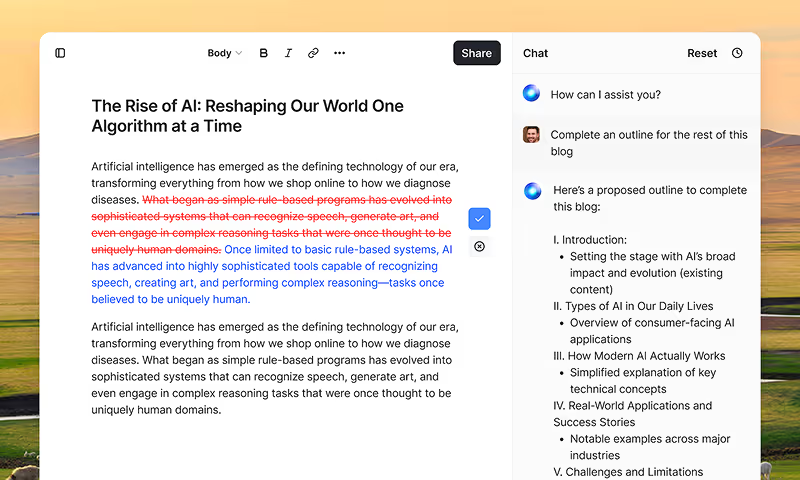
HyperWrite is the AI writing assistant that learns your style. It handles drafting, editing, and researching so you can focus on ideas.
- Autocompletes sentences as you type
- Works inside Google Docs & Gmail
- Adapts to your personal writing style
- 500+ AI tools for any writing task
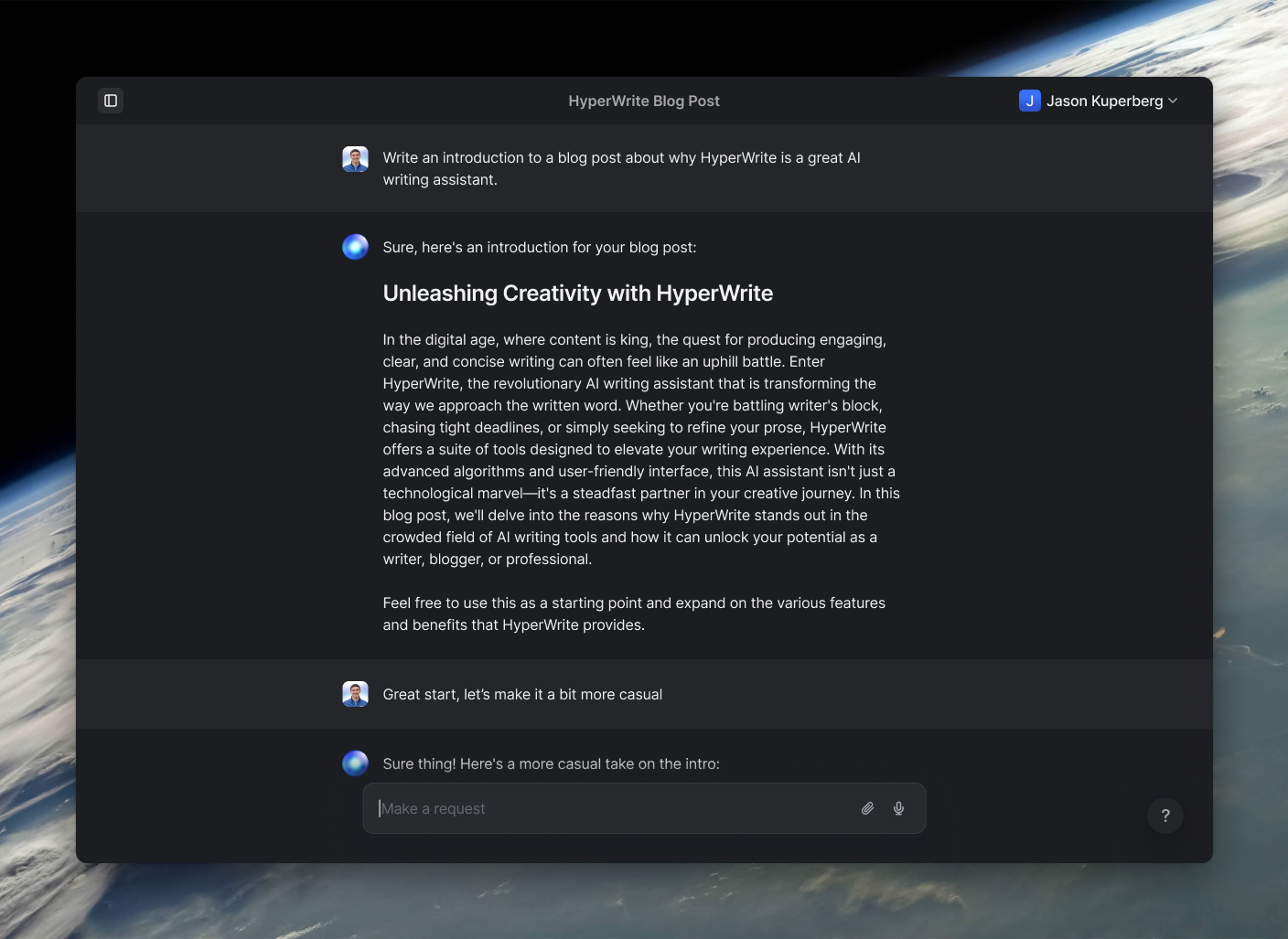
Powerful writing in seconds
Improve your existing writing or create high-quality content in seconds. From catchy headlines to persuasive emails, our tools are tailored to your unique needs.