
How Long Does It Take to Write 1,500 Words? 2 to 8 Hours


It's 9 p.m., you've got a 1,500-word piece due tomorrow, and the only thing on the page is the title. So how long does it take to write 1,500 words, really? Long enough to take seriously, short enough that you can still make the deadline.
I've written enough 1,500-word pieces to know the honest answer is a range, and it swings hard based on what you're writing and how you work. Below is that range, broken down by experience level and by writing stage, plus what actually eats the clock and how to win some of it back.
How long does it take to write 1,500 words?
For most people, a 1,500-word piece takes two to eight hours from blank page to finished draft. The spread is that wide because research and editing time swing so much from one piece to the next.
The typing barely registers. Most people type somewhere around 40 to 50 words per minute, based on 221,023 typing sessions TypeQuicker tracked through February 2026, so the keystrokes for 1,500 words take 30 to 40 minutes, well under an hour. Everything else (thinking, researching, second-guessing, fixing) is where your evening goes.
For a benchmark, Orbit Media's 2026 survey of 1,042 content marketers found the average blog post runs 1,312 words and takes 3 hours, 20 minutes to write.
Find yourself in that table, then adjust for the two things that move it most: how well you know the topic, and how much you have to look up.
To get a number for yourself, draft for 15 minutes, count the words, and multiply by four. That's your hourly pace:
- 300 words an hour: about 5 hours of drafting
- 500 words an hour: about 3 hours
- 750 words an hour: about 2 hours
- 1,000 words an hour: about 1.5 hours
Then add 1 to 1.5 hours for outlining and editing, plus whatever research the piece needs.
Writing time by stage: research, outline, draft, and edit
Here's where a typical four-hour piece actually goes.
Research is the swing factor. Write about something you already know, and it collapses toward zero; take on a cited piece about a new topic, and it can double the whole job.
Skip the outline to save time, and you'll usually pay it back with interest while drafting, stuck on a paragraph with no idea what it's for. A short self-editing pass is where a rushed draft gets rescued, so protect that last 45 minutes.
How long is 1,500 words?
Before you budget the hours, it helps to picture the size of the thing.
At a standard 500 or so words per single-spaced page, 1,500 words runs about 3 pages single-spaced or 6 pages double-spaced in a 12-point font. Call it 7 to 10 paragraphs, and roughly six minutes to read.
Fonts, margins, and spacing nudge all of those, so treat them as a rough baseline.
Essays vs. blog and content articles: why the time differs
A graded essay and a blog post can both run 1,500 words and still take wildly different amounts of time. They're different jobs, and they bill different hours.
Academic essays
An academic 1,500-word essay usually takes four to nine hours, and a heavy-research brief can stretch it across a couple of days. Citations, source reading, and a clean reference list all add up, and the argument has to actually hold together.
Expect somewhere around five to ten sources for a 1,500-word essay. One University of Edinburgh lecturer's guide puts a typical essay at five to ten and a top-mark one at 8 to 15. The type of essay you're writing changes the load too: a reflective piece moves faster than a literature review.
Blog and content articles
A 1,500-word blog or content article runs closer to two to three hours for an experienced writer on a familiar topic. There's less formal citation overhead, the structure is reusable, and you often already know the subject cold.
New or data-heavy topics push that number back up, because now you're researching like it's an essay again.
What changes how long it takes
Two writers can hit the same word count hours apart. These are the levers that explain the difference:
- Topic familiarity: the single biggest factor; knowing the subject can halve your time.
- Research and citations: every source you have to find and format is time off the clock.
- Typing speed: a faster words-per-minute rate helps at the margins, though thinking is the real bottleneck.
- Planning: outlining first turns drafting into filling in the blanks.
- Editing standard: a publish-ready polish takes longer than a rough internal draft.
- Focus: one clean block usually beats five interrupted ones.
How to write 1,500 words faster: 7 strategies
You can't skip the thinking, but you can stop wasting time around it. Seven things that reliably help:
- Outline before you draft. Ten minutes of bullets now saves an hour of staring later, and each bullet becomes a paragraph that already knows its job.
- Research in one batch, then stop. Gather your sources up front so drafting stays in flow instead of bouncing to Google every two sentences.
- Set a timer per section. Give the intro ten minutes, each body chunk fifteen, the conclusion ten. A deadline you can see moves faster than a vague "finish tonight."
- Write the easy section first. Start where you have the most to say. Momentum from a strong middle is one of the most reliable ways to write faster, and it makes the intro almost write itself.
- Kill distractions for one block. Phone in another room, tabs you don't need closed, notifications off. It's far easier to stay focused for 45 minutes than to half-write for three hours.
- Draft ugly, edit later. Writing and editing are different modes, and doing both at once is one of the biggest time sinks there is. Get the bad version down, then fix it.
- Beat the blank page fast. The first sentence is where a lot of drafts get stuck. If you stall, push past the block with a throwaway opener you'll delete later.
Can you write 1,500 words in an hour?
Yes, but only under the right conditions.
If you know the topic cold and skip heavy research, 1,500 words in an hour is doable. That's about 25 words a minute including thinking time, which is realistic for a familiar blog draft and brutal for a cited essay.
Give yourself a day and almost anyone can write 1,500 solid words, research and editing included. The catch is the edit: speed without a cleanup pass shows, so budget at least a short one. When you're racing the clock, letting an AI draft the first rough paragraph means you start editing instead of staring, the same trick that works for speeding up school essays.
How much time does AI actually save?
AI has made writing faster, though not by as much as you might expect. Orbit Media's 2026 survey found that 92% of content marketers now use AI, and the average post takes 3 hours, 20 minutes to write, about 50 minutes less than at the 2022 peak.
The time saved didn't buy better results on its own. The marketers most likely to report strong results still ran a formal editing process with a human in charge, and those who put more hours into each post were still more likely to see results. So let AI speed up the blank-page part, and spend some of the time you save on the edit.
How HyperWrite cuts your 1,500-word writing time
Whether it's a blog post, a strategy memo, or a board update, the slow part of 1,500 words is getting from a blank page to a draft that still sounds like you.
HyperWrite is a writing co-pilot for professionals who already know what they want to say and just need it on the page faster. Here's where it fits into each stage:
- Beat the blank page: AutoWrite drafts a first paragraph on any topic, in the format you need, so you have something to shape from the first minute.
- Keep the draft moving: TypeAhead completes your sentences in context in Gmail, Google Docs, or your CMS, pulling from your other open tabs, which phone-style autocomplete can't do.
- Sound like yourself: set up a Persona once, and HyperWrite's suggestions stay in your own voice.
- Pressure-test the structure: run your outline and rewrites past the AI Writing Assistant, built on prompts tuned from years of A/B testing and faster than ChatGPT-style thinking models.
- Finish the edit: pull the whole piece together in the AI Document Editor and tighten it before it goes out.
It's the same co-pilot professionals at Google, Netflix, LinkedIn, and Spotify reach for when they write. Cut the dead time between knowing what to say and having it written, and 1,500 words stop eating your whole evening.
Pick the piece on your list this week, whether it's an investor update, a proposal, or a blog post, and start your first draft free in HyperWrite's AI Document Editor. Then see how much of that two-to-eight-hour range you win back. Writing in Gmail or Google Docs? HyperWrite for Chrome brings TypeAhead into every tab.
Frequently asked questions
Can you write 1,500 words in a day?
Yes, you can write 1,500 words in a day comfortably. A single focused day covers research, drafting, and editing for most writers, with time to spare on a familiar topic.
How long does it take to write 1,500 words in 5 hours or 3 hours?
Five hours fits a researched 1,500-word essay with a full editing pass, while three hours suits a familiar blog article with a lighter edit. Both are realistic when you outline first.
How long does it take to write 1,500 words without research?
About two to three hours on a topic you already know: roughly 20 to 30 minutes to outline, 1.25 to 1.5 hours to draft, and 45 minutes to an hour to edit.
How many references does a 1,500-word essay need?
A 1,500-word essay typically needs about five to ten references, and a top-mark essay can use 8 to 15. Check the assignment rubric before you start.
How many paragraphs should a 1,500-word essay be?
Usually about seven to ten. University writing guides suggest roughly 10% of the word count for the introduction, 80% for the body, and 10% for the conclusion, so about 150, 1,200, and 150 words. With academic paragraphs running around 250 words, the body is often five paragraphs.
How long does it take to type 1,500 words?
Typing 1,500 words takes about 30 to 40 minutes at a typical 40 to 50 words per minute, before any thinking, research, or editing. The composing is what stretches the total into hours.
How long does it take to write 1,300 or 1,400 words?
Writing 1,300 or 1,400 words saves only about two to five minutes of typing compared with 1,500 words. The thinking and research still drive the total, so the time feels nearly identical.
Is 1,200 words enough for a 1,500-word essay?
Usually not. 1,200 words is 20% short of 1,500, and a typical allowance is about 10% either side, or 1,350 to 1,650 words. Check your brief first, since some courses set a stricter limit.
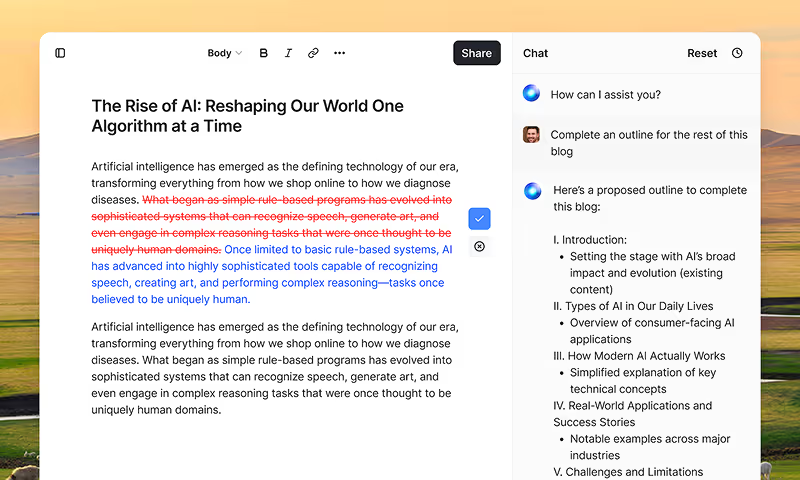
HyperWrite is the AI writing assistant that learns your style. It handles drafting, editing, and researching so you can focus on ideas.
- Autocompletes sentences as you type
- Works inside Google Docs & Gmail
- Adapts to your personal writing style
- 500+ AI tools for any writing task
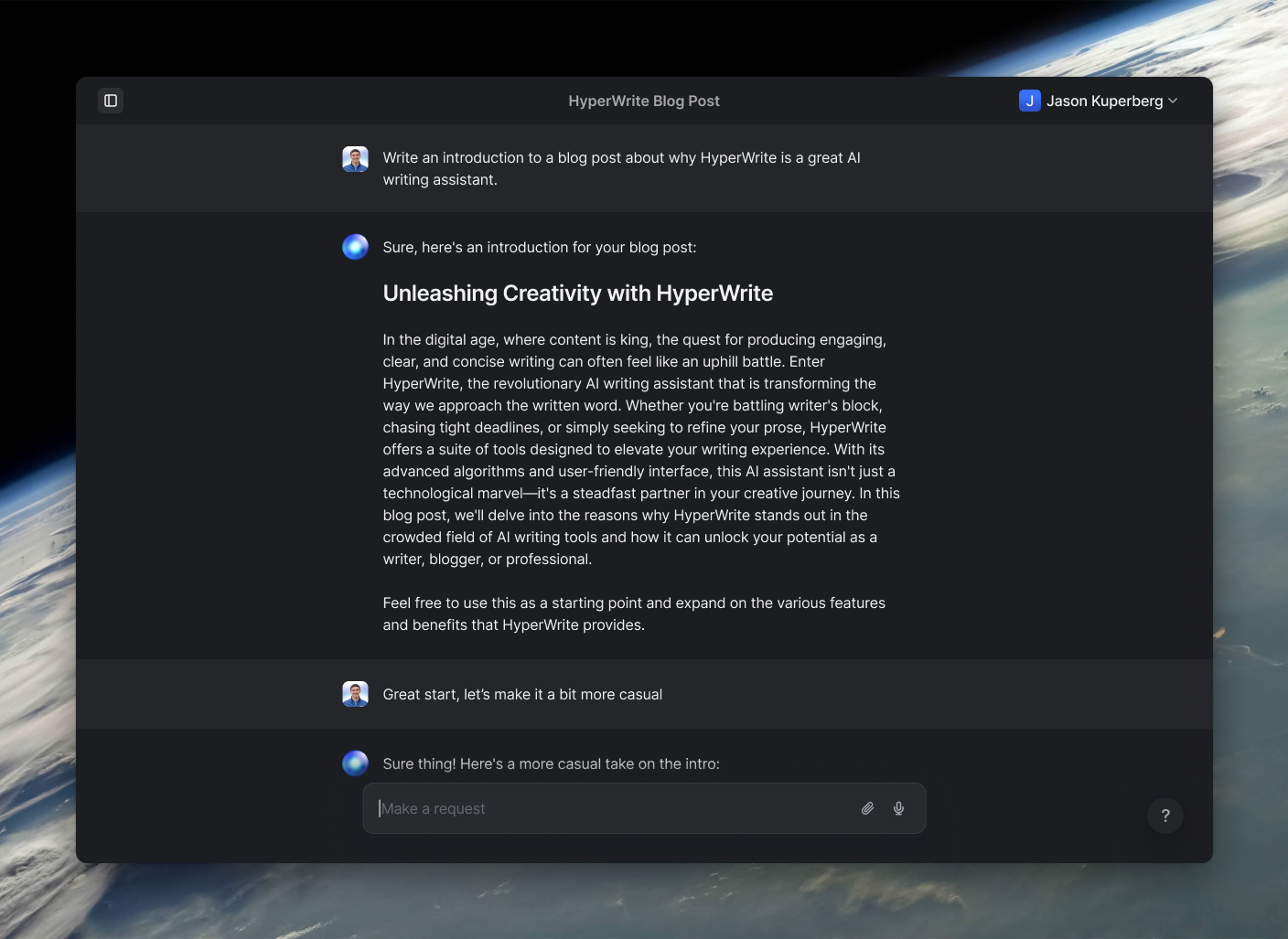
Powerful writing in seconds
Improve your existing writing or create high-quality content in seconds. From catchy headlines to persuasive emails, our tools are tailored to your unique needs.