


Cover up the company name on most mission statements, and you couldn't guess who wrote them. "Empowering people to achieve more through innovative solutions" could describe a bank, a software startup, or a dog-walking app.
That sameness is why most mission statements get written once and never read again. A good one does the opposite. It states your purpose plainly enough that your team could repeat it back from memory.
Writing one that sticks is simpler than it looks: follow the formula below to write a mission statement your team actually remembers, with three templates and examples to copy.
What is a mission statement?
A mission statement is one or two sentences that say what your organization does, who it serves, and why it matters. It's written in the present tense, because it describes why you exist right now, not where you hope to be someday. That present-tense focus separates it from a vision statement.
The mission statement formula
Most mission statements answer a few core questions. Cover these four, and you have everything you need to draft one.
- What you do. The product, service, or work at the center of the organization.
- Who you serve. The specific people or group you exist for, rather than "everyone."
- How you do it. The method or conviction that makes your way distinct.
- Why it matters. The change or benefit you create, the point behind the work.
Mission statement templates
Most mission statements follow one of three shapes. Pick the structure that fits how your organization talks, then swap in your own specifics until it sounds like you rather than a form.
The full formula is the safest starting point, since it forces you to name every piece before you trim it down. The purpose statement suits mission-driven brands where the why is the whole story.
The action statement fits when a single strong verb carries your identity. Here is each template with example wording:
Full formula:
Our mission is to help small teams ship work on time by turning scattered tasks into one clear plan, so no deadline gets lost in a thread.
Purpose statement:
We exist to give first-generation students a real path to college.
Action statement:
To put legal help within reach of every small business.
Writing one for a cause rather than a company? A nonprofit mission statement usually leans on the purpose and action styles.
From first draft to final line
Your first draft will run long, and that's fine. You'll tighten it next.
Plug your pieces into a template for a rough first version. It won't sound good yet, and that's the point, because you now have words to shape instead of a blank page.
Trim every word the meaning survives without, then read it out loud. Run it past a few people on your team, and if they can say it back in their own words, it's working.
If you'd rather work through the drafting step by step, our guide on how to write a mission statement walks through three approaches you can borrow.
Mission statement examples worth studying
The best-known missions all make a deliberate move. Read each one for the technique behind it, then borrow the technique, not the wording.
Patagonia: "We're in business to save our home planet."
At seven words, it drops the product entirely and lets the why carry everything. Naming a cause bigger than clothing turns the mission into a test the company can hold every decision against, from how it sources materials to which causes it funds.
The lesson is simple: when your purpose is the whole point, cut everything that isn't it. It reads like a pure purpose statement, because that's what it is.
Google: "To organize the world's information and make it universally accessible and useful."
It opens on one strong verb, organize, then names the scope and the payoff without ever mentioning search, ads, or any single product. That's why it still fits a company that now does far more than it did at the start.
Borrow the principle: name the job, not the tool, and the mission outlasts your product line.
Microsoft: "To empower every person and every organization on the planet to achieve more."
It goes deliberately broad, but a concrete verb and a named audience keep it from drifting into a slogan. "Every person and every organization" tells employees who the work is for, and "achieve more" gives them an outcome to point at.
The takeaway for your own draft: go wide only if a real audience and a real result hold it down.
LinkedIn: "To connect the world's professionals to make them more productive and successful."
This is the clearest of the four on audience. It says exactly who it serves and the two outcomes it promises, so a new hire could read it once and know the point of the work.
A specific audience does double duty here, telling everyone who the work is for and quietly filtering out who it isn't.
Notice what none of them do. None lists a feature, and none reaches for a buzzword. That restraint is the hardest part to copy, and the most worth it.
Where mission statements go wrong
Most weak mission statements share the same faults. These four drain the meaning out of a statement the fastest.
- Abstract fluff: "Delivering excellence through innovative solutions" says nothing. Trade buzzwords for concrete words a stranger would understand.
- Trying to include everything: A mission crammed with every product and value reads like a paragraph and sticks like nothing. Pick the core.
- Sounding like everyone else: If a competitor could paste their name onto your mission, it isn't yours. Lean on your how and your why.
- Writing it once and shelving it: A mission only works if it guides decisions, so put it where the team sees it and revisit it as you grow.
Write your mission statement faster
A mission statement is short, but it takes a lot of drafts to get there. Most of the time goes to rewording the same idea until one version finally lands. HyperWrite speeds up that loop.
Flexible AutoWrite turns your notes on the what, who, and why into a first draft in seconds, and TypeAhead suggests context-aware completions as you type, drawing on your open tabs and past writing so each line already sounds like you.
Its Personas feature keeps every version in your brand's voice. You decide which wording is true to the company.
Not sure how to phrase it? TypeAhead suggests your next line as you type, in your own voice. Try it in the free HyperWrite Chrome extension.
Frequently asked questions
How long should a mission statement be?
A mission statement should be one or two sentences. That's long enough to cover your purpose and audience, but short enough for your team to remember and repeat. If it runs to a paragraph, cut it down.
What makes a good mission statement?
A good mission statement is specific, concrete, and written in plain language. It names a real audience and a real purpose instead of leaning on buzzwords, and it captures what makes your approach different. The best ones are short enough to stick and clear enough to guide decisions.
Can you use AI to write a mission statement?
Yes, you can use AI to draft a mission statement, as long as the substance stays yours. AI is useful for turning your notes into first drafts and offering different phrasings to compare, which speeds up the wording. The purpose, audience, and values behind it still have to come from you.
What is a mission statement example?
A good mission statement example is IKEA's: "to offer a wide range of well-designed, functional home furnishing products at prices so low that as many people as possible will be able to afford them." In one sentence, it names what the company makes, who it serves, and how it stays distinct.
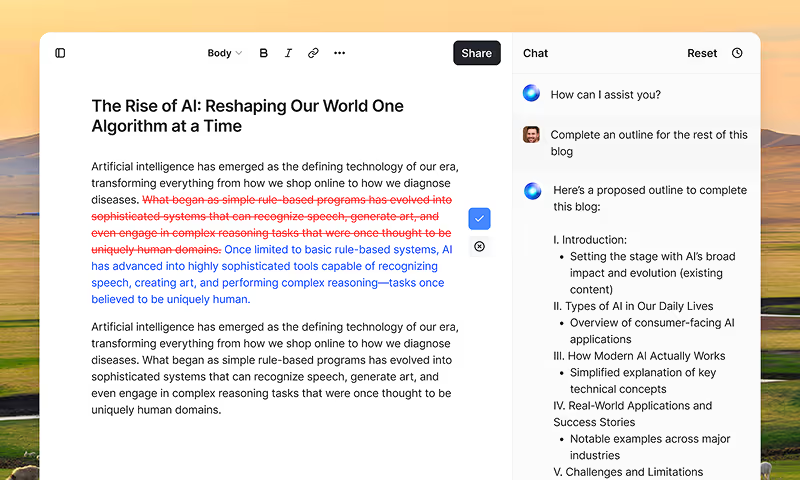
HyperWrite is the AI writing assistant that learns your style. It handles drafting, editing, and researching so you can focus on ideas.
- Autocompletes sentences as you type
- Works inside Google Docs & Gmail
- Adapts to your personal writing style
- 500+ AI tools for any writing task
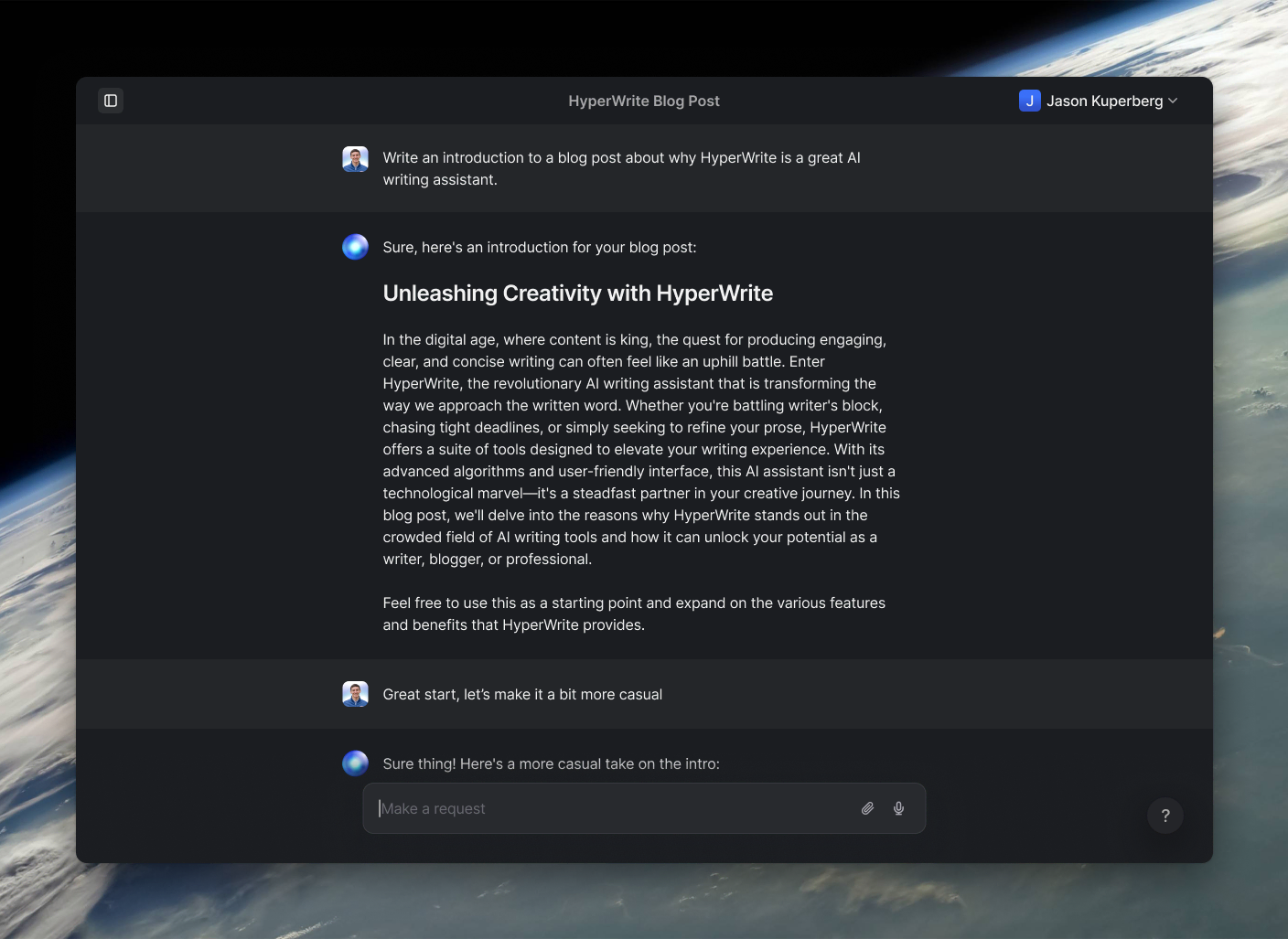
Powerful writing in seconds
Improve your existing writing or create high-quality content in seconds. From catchy headlines to persuasive emails, our tools are tailored to your unique needs.