
How to Write a Mission Statement: 3 Approaches That Actually Stick


After reviewing dozens of organizations’ mission statements across various sectors and stages, here's what I've learned about writing a mission statement that’s actually useful: your approach matters as much as the wording you land on.
The right approach changes everything
A new, 10-person start-up has different needs than a 200-person company making an update. A product-led SaaS business has a different starting point than a service provider relying on deep client relationships. Getting the method right before you start saves you two full revision cycles.
The three approaches to writing a mission statement covered below address the scenarios that come up most often. Each starts from a different place and produces a different kind of statement, but they reach the same target: a single sentence, specific enough to belong only to your organization.
3 ways to write a mission statement
Method 1: The outcome-first approach
What it is: Start with the change you create, then work backward to describe your activity and audience.
How it works: Instead of opening with what your organization does, open with what's different in the world because you exist. Once that outcome is clear, layer in who benefits and how you make it happen.
Most teams default to describing their activity because it's the easiest part to put into words. Starting with the outcome breaks that habit. It forces the most important question in any mission statement: what actually changes because of your work?
Draft it first as a plain statement: "Because of our work, [audience] can [specific change]." Then restructure it into mission statement form. If the outcome disappears during rewriting, you've slipped back into activity-first language.
When to use it: Outcome-first is best for established organizations that know their impact but struggle to articulate it without jargon. If your team can describe programs in detail but go quiet when asked what actually changes, start here.
Real example: REI: "To inspire, educate and outfit for a lifetime of outdoor adventure and stewardship."
Notice what REI didn't write: "We sell outdoor gear and apparel to people who enjoy nature." That's a business description. Instead, REI names three activities (inspire, educate, outfit) and anchors them to a single outcome: a lifetime of outdoor adventure and stewardship.
The audience isn’t named because the activities imply it. Anyone reading this knows immediately who REI serves and why it exists. That's the outcome-first approach working exactly as it should.
Method 2: The audience-first approach
What it is: Start with the most specific description of who you serve, then build activity and outcome around that clarity.
How it works: Describe your primary audience in as much detail as you can. The actual group, not "businesses" or "people in need." Once that specificity is in place, the right activity and outcome follow naturally because they're linked to a real population.
Push the description until it feels almost too narrow. "Independent restaurant owners with fewer than 10 employees" is more useful than "small business owners." "First-generation college students in rural communities" is more useful than "underserved students."
Most teams resist this step because narrowing the audience feels like shrinking the organization. It doesn't. It makes the mission more credible, not smaller. The specificity you establish here sharpens every other word in the statement.
When to use it: This is the right starting point for early-stage organizations still finding their positioning, or any organization whose audience is its clearest differentiator. Use it when who you serve is more distinctive than what you do or why you do it.
Real example: Charity: Water’s mission statement is "Bringing clean and safe drinking water to people in developing countries."
Compare that with what they could have written: "We improve health outcomes in underserved communities." Both are accurate, but the second belongs to hundreds of organizations. The first names a specific activity (bringing clean water) and a geographically specific audience (people in developing countries). No outcome is needed: the specificity of the audience and activity makes the impact self-evident. That's the audience-first approach at its most effective.
If your audience description could apply to three other organizations in your sector, it's not specific enough. Keep narrowing until only your organization serves that exact group.
Method 3: The verb-first approach
What it is: Start with the single strongest verb that describes your core activity, then build an audience and outcome around it.
How it works: Strip everything your organization does down to one verb phrase, not a list of services. Then ask: who does that activity serve, and what changes for them?
The verb is almost always the weakest part of a mission statement. Most organizations soften their core activity with verbs that could belong to anyone else in their sector, like "support," "empower," or "provide."
A specific, active verb makes the rest of the statement more credible before the reader finishes the sentence. It also forces internal clarity. If your leadership team can't agree on one verb, it signals that the organization hasn't fully decided what its primary role actually is.
The test: replace your verb with "support" and read it back. If the statement still makes sense, the verb isn't doing enough work. "Trains and certifies," "connects independent artists," "builds financial tools" — each points to only one kind of organization. "Supports" points to none in particular.
When to use it: This approach works best for organizations whose core activity is genuinely distinctive, where what you do separates you more than who you serve or the outcome you produce.
Real example: HubSpot: "Helping millions of organizations grow better."
That's six words. Three are doing real work: help (the verb), organizations (the audience), grow better (the outcome). HubSpot could have written, "To empower companies to achieve their growth potential through marketing, sales, and service software." That version says more but means less.
Every word they cut made the statement stronger. "Helping" is simple, but it's load-bearing because the audience and outcome are specific enough to give it weight. Strip it away, and the statement collapses. That's how you know the verb is working.
Which approach should you choose?
Pick the method that fits the clarity you already have.
Use outcome-first if:
- Your organization has a track record and measurable impact.
- You can describe what changes for your audience but struggle to say it plainly.
- Your current statement describes activities but not why they matter.
Use audience-first if:
- Your organization is early-stage, and the audience is the clearest thing you've defined.
- Your sector is crowded, and who you serve distinguishes you more than what you do.
- Your current statement could belong to a hundred similar organizations.
Use verb-first if:
- Your core activity is genuinely distinctive, not a variation of others’ in your sector.
- Your statement keeps growing because you're trying to describe everything.
- You need to cut language, not add it.
One important note: these three approaches aren't mutually exclusive. Most strong mission statements end up with a clear audience, a specific verb, and an explicit outcome. The right approach just determines where you start. It gets you unstuck.
Best practices for every method
- Keep it under 25 words: The best mission statements are short enough to memorize. If yours runs longer, it's trying to do too much. Cut down the activity list and keep the outcome.
- Run the name-swap test: Remove your organization's name. Does the mission statement still point to you? If a competitor could swap in their name and it still makes sense, it needs revising.
- Write for outsiders, not insiders: Avoid jargon, acronyms, and internal shorthand. If someone who has never heard of your organization can't understand what you do at a glance, rewrite it.
- Read it out loud: A statement that sounds awkward when spoken will sound awkward in every board meeting, investor pitch, and job interview. If it doesn't flow naturally in conversation, it won't stick.
- Build in a review cycle: According to McKinsey Quarterly, employees whose sense of purpose connects with their companies’ are five times more likely to report job satisfaction. That link breaks down when the mission no longer reflects what the organization actually does. Review your mission statement every 2–3 years, or whenever your core work, audience, or market position shifts.
Write your mission statement faster with HyperWrite
The hardest part isn't knowing what to say. It's turning your input into clear, specific language without drafting in circles. HyperWrite’s AI Writing Assistant factors in your approach, audience, verb, and outcome to produce multiple drafts in seconds, so your team evaluates real options, not flat approximations.
From there, the AI Document Editor lets you store versions side by side and work through revisions until one passes the name-swap test. And if you're drafting directly in Google Docs or any other browser tab, TypeAhead reads your open context and completes sentences in your voice. This way, the wording keeps up with your thinking across every tab you have open.
Start with the AI Writing Assistant. No credit card needed.
Frequently asked questions about writing mission statements
What's the difference between a mission and a vision statement?
The main difference between a mission statement and a vision statement is timing. A mission statement describes what your organization does and who it serves right now. A vision statement describes the future: the change you're working to make permanent.
How long should a mission statement be?
A mission statement should be one sentence, ideally under 25 words. If you need more than that, the statement is trying to do too much. Cut the activity list and keep the outcome.
What makes a mission statement too generic?
A mission statement is too generic when a competitor could swap in their name, and it would still make sense. Statements with "support," "empower," or "help people thrive" tend to fail this test. Specific verbs, named audiences, and explicit outcomes are what make a statement yours alone.
Can I use AI to write a mission statement?
Yes, you can rely on AI to write a mission statement. Use it to generate multiple variations quickly from your specifics: your audience, core activity, and outcome. Then evaluate and refine the drafts with your leadership team.
The HyperWrite AI Tools library is designed for exactly this kind of structured drafting. The more specific your input, the more useful the output.
How do I know which approach is right for my organization?
The right mission statement approach for you depends on what’s already clear. If you know your impact but struggle to describe it, try the outcome-first approach. If your audience is your sharpest differentiator, use the audience-first method. If your core activity is genuinely distinctive, use the verb-first approach.
Most organizations find that one of the three approaches feels like less work. That's usually the right one.
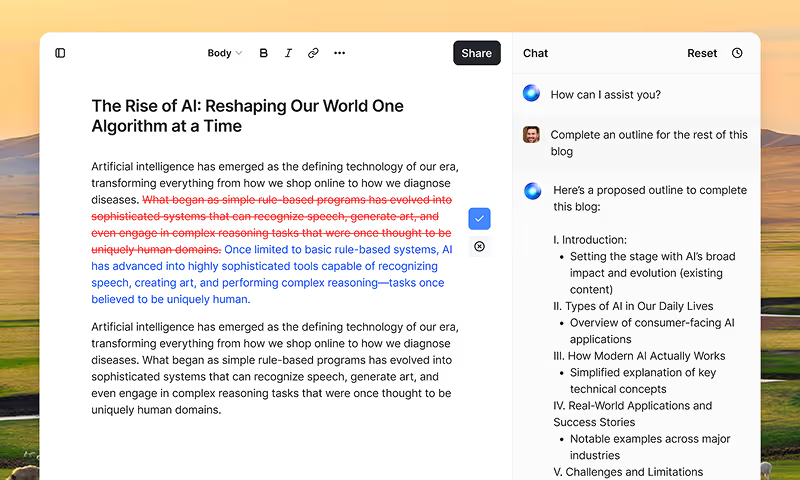
HyperWrite is the AI writing assistant that learns your style. It handles drafting, editing, and researching so you can focus on ideas.
- Autocompletes sentences as you type
- Works inside Google Docs & Gmail
- Adapts to your personal writing style
- 500+ AI tools for any writing task
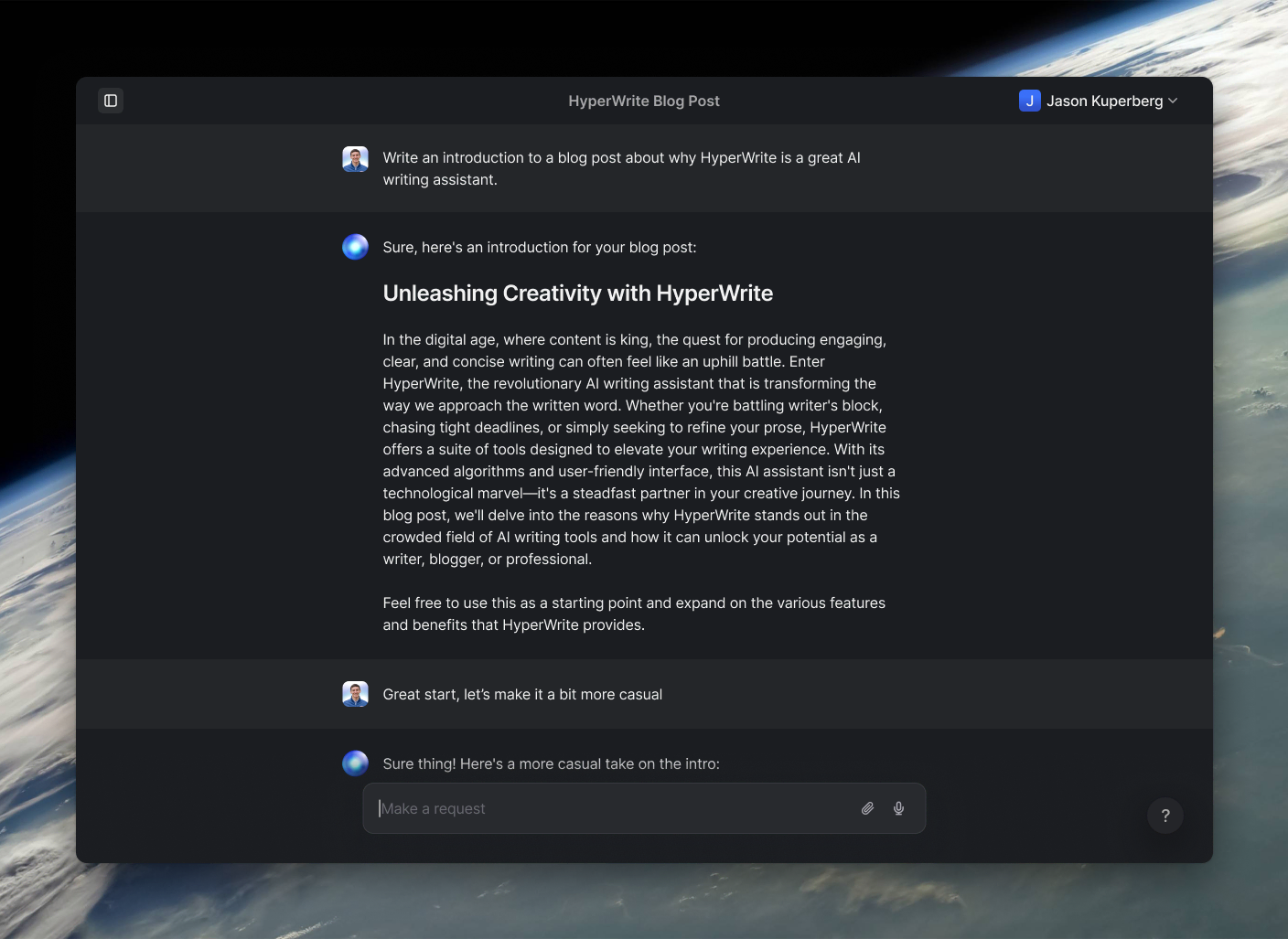
Powerful writing in seconds
Improve your existing writing or create high-quality content in seconds. From catchy headlines to persuasive emails, our tools are tailored to your unique needs.