
How to Write a Nonprofit Mission Statement in 5 Steps


After facilitating mission statement workshops with a dozen nonprofit leadership teams, I’ve developed a 5-step process for writing a clear, useful statement in one focused session.
What you'll need before you start
Before you open a blank document, make sure you’re clear on four points:
- Your beneficiaries: Who specifically do you serve? The more precise, the better. "People in need" is too broad. "First-generation college students in rural South Carolina" is a starting point.
- Your core activity: What’s the primary thing your organization does? Not a list of programs, just the main work.
- Your intended impact: What changes because of your work? What's different in the world, or for your beneficiaries, as a result?
- Your voice: Is your organization formal or conversational? Urgency-driven or hope-focused?
Time required: 60–90 minutes for a first draft, plus a short review cycle with your leadership team.
How to write a mission statement for a nonprofit: 5 steps
Step 1: Define your beneficiaries in specific terms
Write down exactly who you serve, without softening or broadening it. Most organizations serve a specific population, not "the community" or "people everywhere." The more specific your answer, the stronger your mission statement will be.
- Ask yourself: If you had to describe your primary beneficiary to someone who knows nothing about your organization, what would you say?
- Write down three to five descriptors. You won't use all of them in the final statement, but specificity at this stage prevents vagueness later.
If your answer is 'everyone' or 'our whole community,' push further. Even broad-access nonprofits have a main beneficiary group. Start there.
Step 2: Reduce your core activity to one verb phrase
Bring what your organization does down to one strong verb phrase. Not a list or a paragraph.
Examples:
- "provides legal representation to"
- "teaches financial literacy to"
- "connects volunteer mentors with"
- "delivers fresh meals to"
The verb you choose matters. "Empowers" is vague. "Trains and places" is specific. "Advocates for policy change on behalf of" tells you something real.
Aim for a verb that makes the activity clear without needing explanation. If you're stuck between two activities, look at where most of your budget and staff time actually go. That's your core activity.
Step 3: Name the impact, not just the activity
This is the step that most nonprofit mission statements skip, and it's what makes a statement memorable. There's a meaningful difference between stating what you do and stating what changes because you do it.
- Weaker: "We provide job training to formerly incarcerated individuals."
- Stronger: "We provide job training to formerly incarcerated individuals so they can build stable careers and support their families."
The first describes an activity. The second describes an outcome. Donors, board members, and grant reviewers connect with outcomes, not activities.
Write one sentence that starts with "so that" or "in order to" and completes the picture. You may not use those exact words in the final draft, but the outcome needs to be explicit.
Step 4: Draft using the mission statement formula
Use this formula as your starting point: [Organization name] + [core activity] + [beneficiaries] + "to" or "so that" + [impact or outcome]
Three examples using the formula:
- "Bright Futures provides college counseling to first-generation students in rural communities to help them graduate debt-free and career-ready."
- "Open Door connects volunteer mentors with at-risk youth on Chicago's South Side to reduce recidivism and build long-term community stability."
- "Harvest Kitchen trains and employs adults experiencing homelessness to build culinary careers and break the cycle of poverty."
Write three to five variations using your inputs from steps 1–3. Don't edit while drafting. Get the options on the page first, then evaluate.
Read each draft out loud. A mission statement that reads awkwardly won’t sound any better in a board meeting, grant proposal, or donor conversation.
Step 5: Test your draft with four questions
Before you finalize, run every draft through these four questions:
- Does it name who you serve? If the beneficiary isn't clear without additional context, revise.
- Does it describe what you do? A reader with no prior knowledge should be able to picture the work.
- Does it say why you matter? The impact should be explicit, not implied.
- Could this be a different organization? If so, your statement is too generic.
That last question is the most useful. A statement like "We improve lives through education and community support" could belong to 10,000 nonprofits. A strong mission statement belongs to your organization alone.
Share your top two drafts with three to five people outside your nonprofit. If they can explain what your nonprofit does after reading it, you're close. If they can't, revise.
What good nonprofit mission statements look like
The best examples are short, specific, and outcome-focused. As the National Council of Nonprofits points out, mission clarity is fundamental; it makes governance possible.
Two real-world examples worth looking at:
- Feeding America: "To advance change in America by ensuring equitable access to nutritious food for all in need." Notice how the outcome is clear.
- Make-A-Wish: "We create life-changing wishes for children with critical illnesses." No insider language, no broad population. The beneficiary is immediately apparent.
Both are under 25 words. Neither requires background knowledge to understand. That's the target.
Mission statement mistakes that weaken your nonprofit's credibility
Most mission statement drafts fail for the same five reasons. Knowing common pitfalls before you start saves you a full revision cycle later.
- Writing by committee without a clear decision-maker: Mission statements written by groups with no designated facilitator almost always come out bloated and vague. Someone needs to hold the pen and make the final call.
- Using jargon your beneficiaries wouldn't recognize: If the people you serve wouldn't see themselves in your mission statement, rewrite it. "Underserved populations" and "marginalized communities" are insider terms. Use plain, specific descriptions instead.
- Trying to include every program and service: A mission statement focuses on the primary work. Secondary programs belong in other communications.
- Confusing mission with vision. Your mission describes what you do now. Your vision describes the future your work is building toward. "We provide emergency shelter to homeless veterans" is a mission. "A country where no veteran sleeps without a roof" is a vision. Both matter, but they aren’t the same document.
- Mistaking length for thoroughness. The best nonprofit mission statements are under 30 words. If yours is running long, cut the activity list and keep the outcome.
Write and refine your nonprofit mission statement with HyperWrite
The drafting stage is where most teams get stuck. You have the inputs. Turning them into clear, concise language takes more passes than most people expect.
Here's how HyperWrite helps:
- Draft faster: The AI Writing Assistant generates multiple mission statement variations from your specific inputs in seconds, so your team evaluates real options instead of staring at a blank page.
- Refine for tone: Paste your best draft and ask it to tighten the language, simplify the phrasing, or adjust the tone to match your organization's voice.
- Edit in context: The AI Document Editor lets you store multiple drafts side by side and work through revisions until the statement passes the four-question test.
- Write as you think: If you're drafting in Google Docs or any other browser tab, TypeAhead reads your open context and completes sentences in your voice. So, the wording keeps up with your thinking, across every tab you have open.
Start with the AI Writing Assistant. No credit card needed.
Frequently asked questions
How long should a nonprofit mission statement be?
A nonprofit mission statement should be one to three sentences, ideally under 30 words. If you need more than that, the statement is trying to do too much.
What’s the difference between a mission and vision statement for a nonprofit?
The main difference between a mission statement and a vision statement is the timescale. A mission statement describes what your organization does today. A vision statement describes the future your work is building toward. Your mission is the work, your vision is the world it creates.
What’s the hardest part of writing a mission statement for a nonprofit?
The hardest part is being specific without feeling narrow. Most teams default to broad language because they're afraid of excluding someone. Naming your primary beneficiary precisely makes the statement stronger, not smaller.
Does a nonprofit need a mission statement to apply for grants?
Yes. Most grant applications require a mission statement, and funders use it to quickly assess whether your organization fits their priorities. A vague or generic statement can cost you consideration before the reviewer sees anything else in your application.
Can I use AI to help write a mission statement for a nonprofit?
Yes. Use AI to generate draft variations quickly, then evaluate and refine them with your leadership team. Give it your specific inputs (who you serve, what you do, the change you create) rather than having it generate something from scratch. The more specific your prompt, the more useful the output.
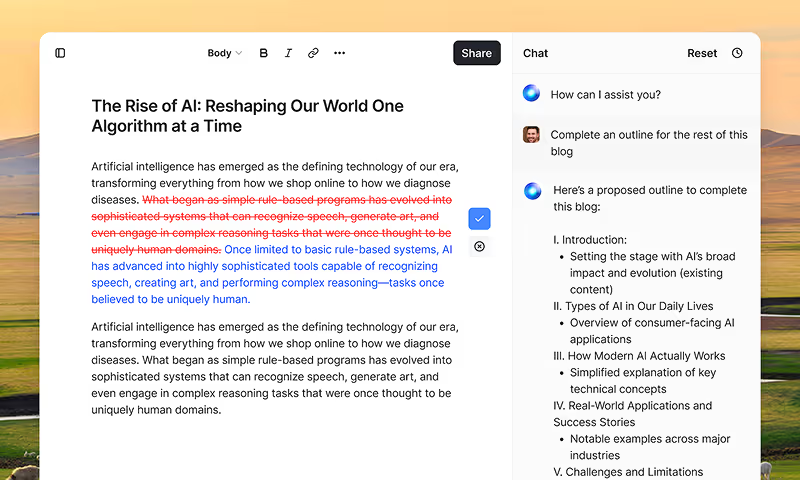
HyperWrite is the AI writing assistant that learns your style. It handles drafting, editing, and researching so you can focus on ideas.
- Autocompletes sentences as you type
- Works inside Google Docs & Gmail
- Adapts to your personal writing style
- 500+ AI tools for any writing task
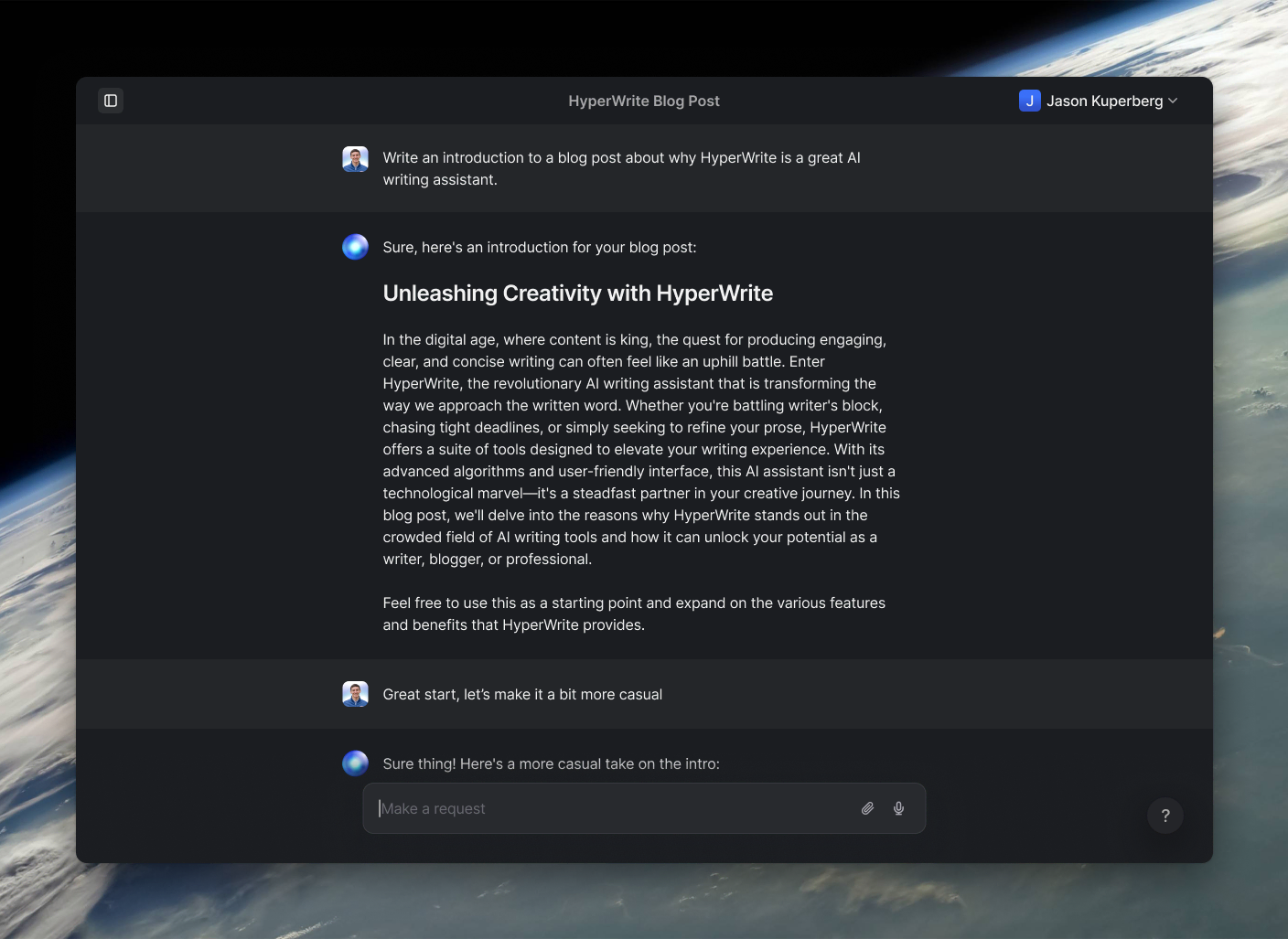
Powerful writing in seconds
Improve your existing writing or create high-quality content in seconds. From catchy headlines to persuasive emails, our tools are tailored to your unique needs.