


You have about five seconds before a visitor decides whether to stay or bounce, and they'll spend them reading your words, not admiring your design. That's what makes knowing how to write website copy the highest-payoff skill on your site.
What makes website copy convert?
Converting copy moves a visitor to do something like book a call, start a trial, buy, or get in touch. It does that by being clear, relevant, and easy to act on. The biggest reason copy usually falls flat is perspective.
Most businesses write from the inside out, describing what they do and how proud they are of it. High-converting copy is written from the outside in, starting with the reader's problem and speaking in their words.
And there isn't much room to get it wrong: Nielsen Norman Group found that users read only about 20% of the words on an average page, so the words that do land have to work fast.
How to write website copy in 7 steps
Step 1: Know exactly who you're writing to
Get specific about your reader before you write anything. A page for "everyone" reaches no one. Name one person: their job, the problem that brought them to your site, and what a win looks like for them.
Then write down the exact words they'd use for that problem, and put those words in your copy. Matching their language is the fastest way to show you get it.
Someone shopping for project management software isn't typing "collaborative productivity suite." They want to "stop chasing people for updates."
Step 2: Lead with the problem before the solution
The visitor arrived with a problem. Name it before you say a word about yourself. Nothing earns attention faster than showing you already understand what's wrong.
Compare these two service-page openers:
- Inside-out: "Our web design service helps businesses build beautiful websites."
- Outside-in: "Your website gets traffic but almost no inquiries."
The second one makes the reader feel understood, which buys you the few seconds you need to explain how you help. Open with the pain, then bridge to your solution.
Step 3: Write one clear message per page
Every page needs one job. Cram five messages onto a page and you dilute all of them.
Each page type answers a single question:
- Homepage: "What is this, and is it for me?"
- Service page: "Can you solve my specific problem?"
- Pricing page: "What does this cost, and is it worth it?"
State that core answer once, near the top, then let everything below it back up that one idea. If a sentence doesn't push the reader toward the page's job, cut it.
Step 4: Use plain, specific language
Clarity converts. Jargon and vague claims make readers work, and working readers leave. Swap abstract phrases for concrete ones, and back claims with specifics.
- Vague: "We deliver best-in-class results for our clients."
- Specific: "We cut one client's support tickets by 40% in three months."
Write the way you'd talk. Use contractions, short sentences, and familiar words. If a phrase sounds like a corporate brochure, rewrite it as if you were explaining it to one person across a table.
Step 5: Structure copy for skimming
Since readers scan rather than read, build pages that give up their meaning at a glance. A visitor should understand your offer from the headings and first lines alone.
- Front-load the value in every headline and opening sentence.
- Break text into short paragraphs of two to three lines.
- Use subheadings that carry meaning on their own, not clever labels.
- Add bullets for lists of benefits, features, or steps.
Formatting is how a skimming reader takes in the page.
Step 6: Draft fast, then edit for conversion
Getting words on the page is the slow part for most people, so split drafting from editing. Write a rough version fast, without judging it. Then come back and sharpen it against three questions:
- Is the reader's problem named in their own words?
- Is the language plain, with the jargon cut?
- Does each line earn its place, or can it go?
HyperWrite helps you clear the blank-page stage. Its Flexible AutoWrite feature turns a few notes into a full first draft, and its AI Tools have ready-made options for rewrites, summaries, and outlines when a section needs reshaping.
Step 7: End every page with one clear CTA
Tell the reader exactly what to do next, once. Unbounce's analysis of 18,639 landing pages found that pages with a single link converted at 13.5% on average, versus 10.5% for pages with five or more.
Every competing link is a decision the visitor can avoid, so give them one. Two evidence-backed tips for the CTA itself:
- Write it in the first person. Unbounce reports on a ContentVerve test where changing a button from "Start your free 30-day trial" to "Start my free 30-day trial" lifted click-throughs by 90%. The move from "your" to "my" did all the work.
- Make it specific to the offer. HubSpot's analysis of 330,000 CTAs found that personalized CTAs convert 202% better than generic ones. "Get my free audit" beats "Submit" every time.
Page-by-page copy formulas
Different pages do different jobs. Here's what each one needs.
Homepage
Open with a clear value statement (what you do plus who it's for), follow it with a line of proof, and point to one primary CTA. Save the detail for interior pages.
Service or product pages
This is where most conversions happen, so it earns the most care. Sell the outcome the reader gets, not a feature list, and end on a specific action, never a limp "contact us to learn more."
About page
Counterintuitively, your About page is still about the reader. Explain who you are and why you're credible, then connect it back to how that helps them. This is the natural home for your credentials and proof.
Back every claim with proof
Even sharp copy falls flat without evidence. Claims convert when you back them up, so weave proof through your pages:
- Specific results ("increased sign-ups 3x in two months")
- Testimonials in your customers' own words
- Recognizable clients or logos where you have them
- Numbers wherever you'd otherwise use an adjective
Common website copy mistakes to avoid
Most underperforming pages make the same few mistakes. Catch these before you publish:
- Writing about yourself instead of the reader. Lead with their problem first, then your credentials.
- Burying the message. If the value isn't clear in the first line, most visitors never reach the second.
- Vague, jargon-heavy claims. "World-class solutions" says nothing. Specifics do the selling.
- Weak or missing CTAs. Every page needs one obvious next step.
- Publishing the first AI draft. A raw draft isn't finished copy; the editing is what makes it convert.
Write website copy that converts, faster
The edits are what make copy convert, so the sooner you have a draft to work on, the better.
HyperWrite's TypeAhead works as a context-aware co-pilot that drafts alongside you in any browser tab and pulls context from your other open tabs as you write your pages. And you can teach its Personas your voice up front, so drafts start closer to how you actually write.
Still starting every page from a blank screen? Try TypeAhead free with the HyperWrite Chrome extension and get your next page drafted in your own voice.
Frequently asked questions
How do I write website copy that converts?
You write website copy that converts by starting with the reader. Name the visitor's problem in their own words, lead with outcomes rather than features, keep the language plain, and end each page with one clear call to action. Clarity and relevance drive conversions more than clever wording.
What is the most important part of website copy?
The most important part of website copy is the headline and opening line. Since visitors read only a fraction of a page, your first words have to communicate what you offer and who it's for. If the opening doesn't connect, most readers never reach the rest.
How long should website copy be?
Website copy should be as long as it needs to be to do the page's job, and no longer. A homepage stays short and scannable; a service page can run longer if it answers real buyer questions. Cover what the reader needs, then stop. Padding hurts more than it helps.
Should I use AI to write website copy?
You can use AI to draft website copy, but the editing should be yours. AI is useful for getting past the blank page and producing a first draft quickly. The specifics, proof, and reader-focused language that make copy convert come from human judgment, so treat the AI output as raw material, not the finished page.
How do I write a call to action that converts?
You write a converting call to action by being specific and using the first person. "Get my free audit" outperforms "Submit" because it's clear and reader-focused. First-person, personalized CTAs convert significantly better than generic ones, so tie the button text directly to the offer.
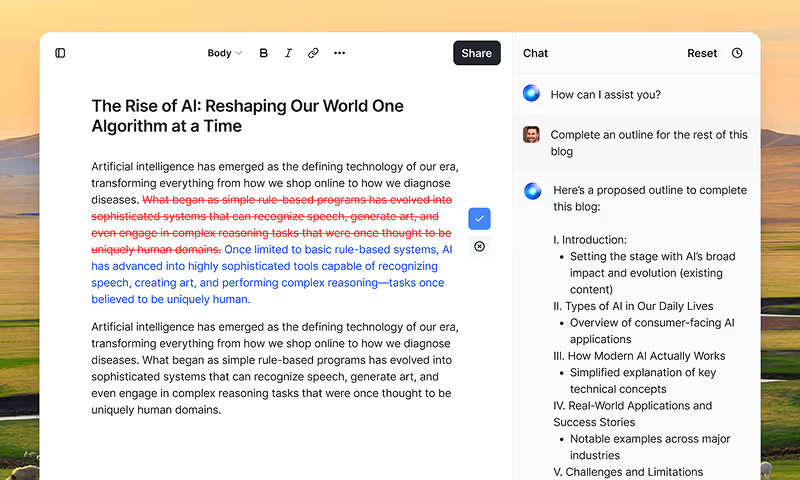
HyperWrite is the AI writing assistant that learns your style. It handles drafting, editing, and researching so you can focus on ideas.
- Autocompletes sentences as you type
- Works inside Google Docs & Gmail
- Adapts to your personal writing style
- 500+ AI tools for any writing task
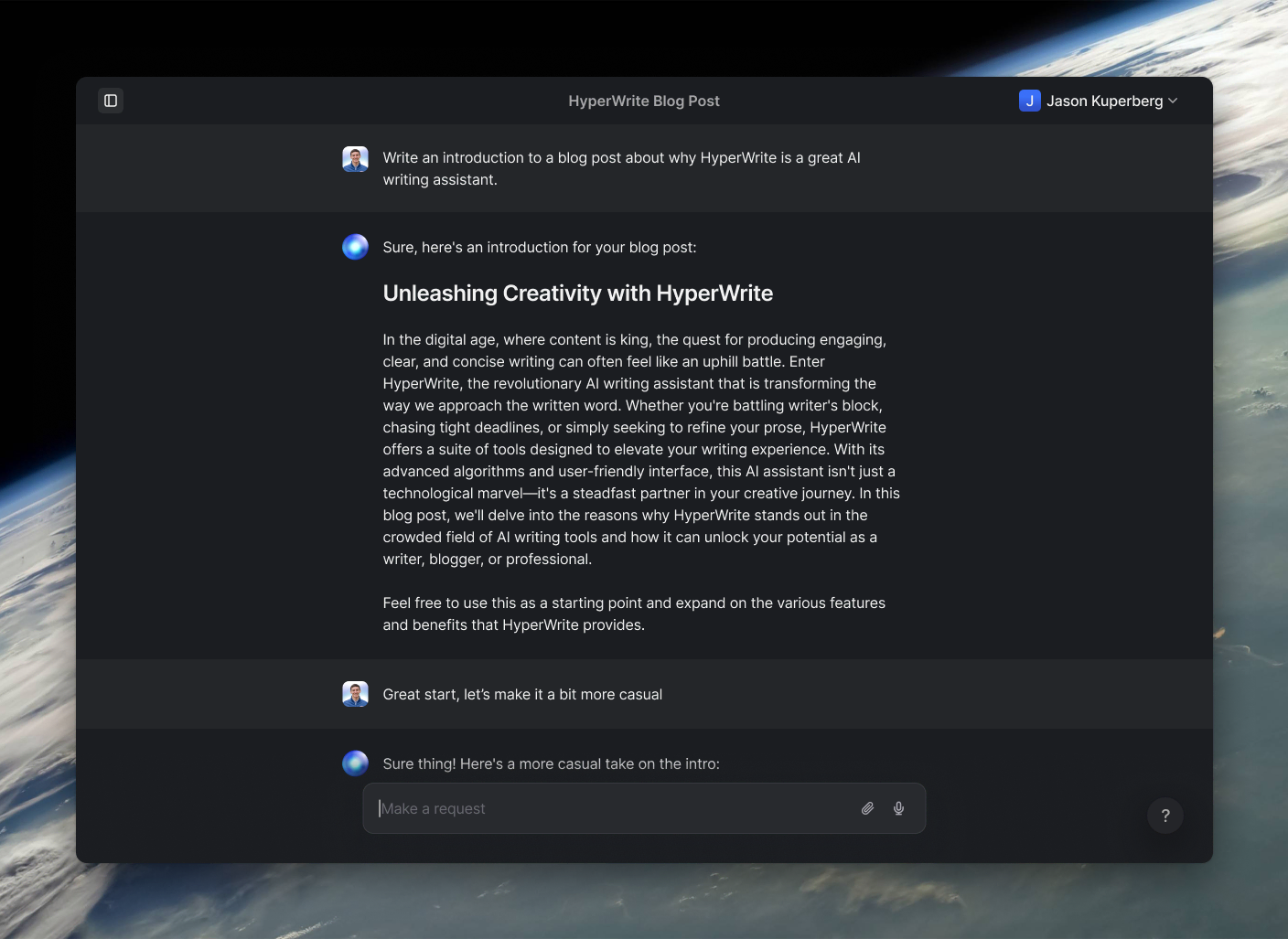
Powerful writing in seconds
Improve your existing writing or create high-quality content in seconds. From catchy headlines to persuasive emails, our tools are tailored to your unique needs.