


If you're figuring out how to write a vision statement, start with one question: where do you want your organization to be in five to ten years? A strong one answers it in one or two clear, ambitious sentences that get everyone behind the same goal.
The best vision statements are usually short, specific, and ambitious enough to pull people forward. This guide covers how to write one, with a simple process, real examples, and the mistakes to avoid.
What is a vision statement?
A vision statement describes the future your organization is working toward. It answers one question: what do we want to become? A good one gives everyone, from founders to new hires, a shared picture of where the company is headed.
Vision statement vs mission statement
These two often get mixed up, and telling them apart is the first step to writing a good one.
- A mission statement describes what you do now. It's about purpose in the present: who you serve and how. Microsoft's mission, "to empower every person and every organization on the planet to achieve more," describes what the company does today.
- A vision statement describes where you're going. It's the future state you're aiming for, usually five to ten years out.
In simple terms, a mission is the "why we exist," and a vision is the "where we're headed." You write the vision to point at the horizon, then let the mission and your strategy do the work of getting there.
How to write a vision statement in 6 steps
Step 1: Gather the right people
A vision statement speaks for the whole organization, so it shouldn't come from one person in isolation. In a small company, that might mean the founders and a few early employees. In a larger one, pull in leaders and a range of voices across teams.
Getting input early does two things: it produces a richer statement, and it builds buy-in. People commit to a future they helped shape.
Step 2: Look five to ten years ahead
Set a time horizon and picture success at the end of it. Five to ten years is the sweet spot, far enough to be ambitious, close enough to stay real. Ask what you want the organization to have achieved, what impact you want to have had, and what "winning" looks like.
Don't limit yourself to what feels safely achievable. A vision should stretch the organization. If it doesn't feel ambitious, it won't inspire anyone.
Step 3: Anchor it to your core values
Your vision has to fit who you are. Lay it beside your core values and check that they pull in the same direction. A vision that contradicts your values, or that could belong to a company with completely different principles, won't hold up.
This is also the step that keeps your statement honest. A vision rooted in what your organization truly cares about reads as real; one bolted on for show reads as marketing.
Step 4: Draft it long, then cut
Start by writing everything down without worrying about length. Get the ambition, the impact, and the key ideas onto the page in full. It's easier to trim a complete draft than to pad a thin one. Once the ideas are down, start cutting the fluff.
Strip jargon, remove anything vague, and keep tightening until you're left with one or two sentences a stranger could understand and repeat. Short, specific, simple, and ambitious is the target.
This is the stage where wording matters most, and where an AI drafting tool can help you move faster. HyperWrite's Flexible AutoWrite turns your rough notes into a polished draft in seconds, giving you tighter phrasings to react to instead of a blank page.
Step 5: Use clear, present-tense language
Write the vision as if the future is already here. Present tense ("we create," "we bring") makes it feel immediate and attainable rather than hypothetical. Avoid words open to interpretation. If a phrase could mean five different things, it means nothing.
Aim for language that produces a mental image. A reader should be able to picture the future you're describing rather than nod along to abstract ideals.
Step 6: Get feedback and finalize
Take your draft to stakeholders, partners, employees, and investors, and see how it lands. Does it inspire them? Do they read it the way you intended? Feedback catches blind spots and surfaces phrases that don't translate.
Expect a few rounds of revisions. HyperWrite's AI Document Editor can speed this up: ask its built-in AI for feedback on each draft and rework phrasings on the spot as comments come in.
A statement worth keeping usually takes several attempts to get right. Once it resonates and still matches your mission and values, it's done.
Real vision statement examples
The strongest vision statements are short and unmistakable. Four examples are worth looking at:
- IKEA: "To create a better everyday life for the many people." It's broad enough to guide decades of decisions, yet clearly rooted in who IKEA serves. Every word carries weight: "the many people" signals affordability and reach without spelling it out.
- LinkedIn: "Create economic opportunity for every member of the global workforce." The most important phrase is "every member": it sets a scale the company can chase indefinitely, and it maps directly to what LinkedIn builds.
- Alzheimer's Association: "A world without Alzheimer's and all other dementia." It states the outcome and nothing else, no programs, no methods, just the finish line the whole organization is working toward.
- Habitat for Humanity: "A world where everyone has a decent place to live." Plain, jargon-free, and impossible to misread, it describes a future anyone can picture without a word about how they'll build it.
Notice what they all avoid: buzzwords, jargon, and length. None of them tells you the strategy. Each paints a future you can picture and measure progress against.
Tips for a strong vision statement
Once you have a draft, keep these principles in mind as you tighten it:
- Keep it short. One or two sentences, ideally under 30 words. If people can't remember it, it can't guide them.
- Be specific to you. Describe an outcome only your organization would claim. A vision that could belong to any company guides no one.
- Write in present tense. It makes the future feel within reach.
- Stay ambitious. The point is to stretch the organization toward something bigger.
- Cut the jargon. Clarity beats sophistication. A vision anyone can understand is one everyone can follow.
Common mistakes to avoid
Most vision statements that fall flat make one of these mistakes:
- Making it a paragraph. Length buries the idea. If it takes four sentences, it isn't sharp yet.
- Confusing it with a mission or a goal. The vision is the destination, not the daily work or a metric.
- Filling it with buzzwords. Words like "world-class" and "best-in-class" say nothing and could apply to anyone.
- Writing it alone. A vision no one helped shape is a vision no one owns.
- Setting it and forgetting it. Revisit it every year or so. When you reach it or outgrow it, write a new one.
Write your vision statement faster
Writing a vision statement means a lot of drafting and rewording, and that's where HyperWrite helps.
Its TypeAhead tool works as a context-aware co-pilot, suggesting your next line as you type in any browser tab, including Google Docs, where you'll likely be drafting your vision statement.
Personas learn from your past writing, so the suggestions come out in your own voice rather than a generic default.
Tired of reworking the same sentence over and over? Try TypeAhead free with the HyperWrite Chrome extension and draft your next statement in your own voice.
Frequently asked questions
What is the difference between a vision statement and a mission statement?
The difference is timing: a mission statement describes what you do now, while a vision statement describes where you're going. The mission is your present purpose; the vision is the future you're working toward, usually five to ten years out. Companies often publish both.
How long should a vision statement be?
A vision statement should be one to two sentences, ideally under 30 words. Short statements are easier to remember, repeat, and act on. If yours runs to a full paragraph, it likely needs cutting until only the core idea remains.
What tense should a vision statement be written in?
A vision statement should be written in the present tense. Phrasing the future as if it's already here ("we create," "we bring") makes the vision feel immediate and attainable rather than distant or hypothetical.
How often should you update a vision statement?
You should revisit a vision statement about once a year. A vision is a living document; review it to confirm it still reflects where the organization is headed. When you achieve it or outgrow it, that's the signal to write a new one.
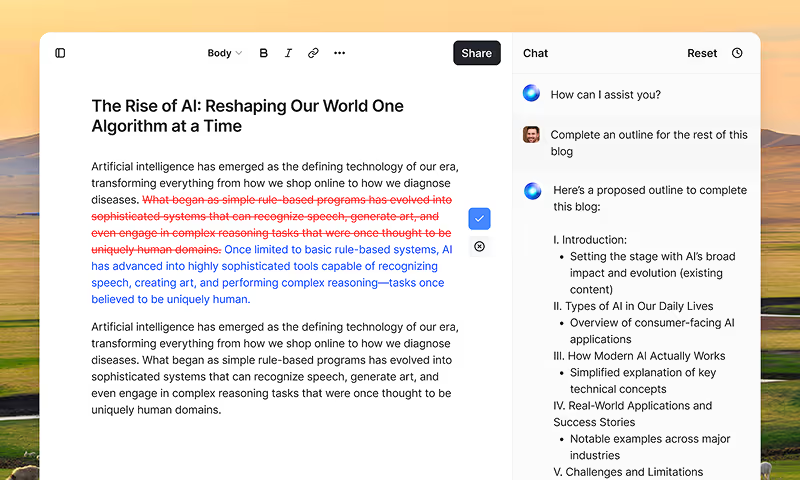
HyperWrite is the AI writing assistant that learns your style. It handles drafting, editing, and researching so you can focus on ideas.
- Autocompletes sentences as you type
- Works inside Google Docs & Gmail
- Adapts to your personal writing style
- 500+ AI tools for any writing task
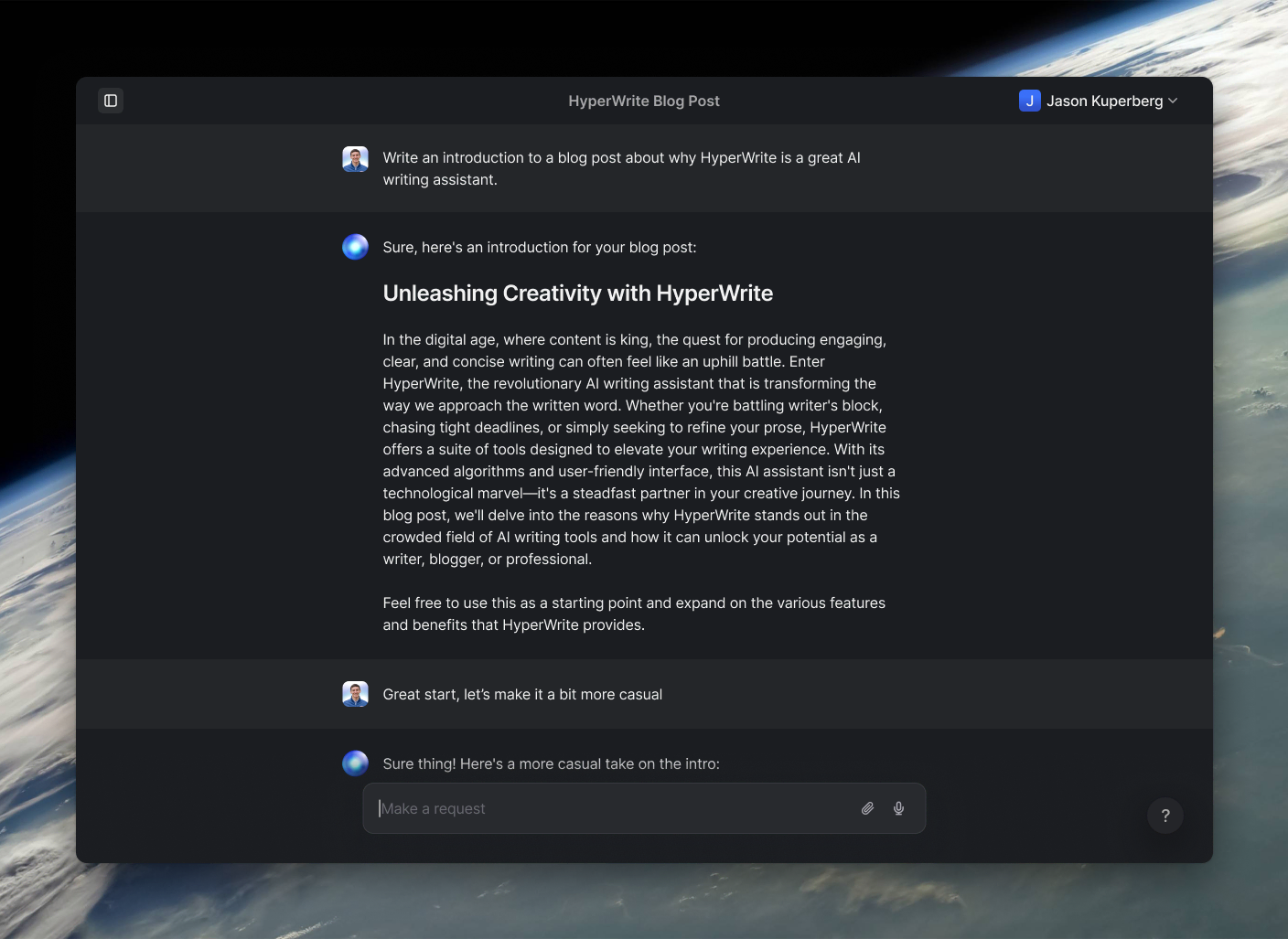
Powerful writing in seconds
Improve your existing writing or create high-quality content in seconds. From catchy headlines to persuasive emails, our tools are tailored to your unique needs.