
How to Structure a Blog Post: 8 Steps for SEO Writers


Structure beats length for blog post rankings: a tight 900-word post can outrank a rambling 2,000-word one when it's built to be scanned and pulled into featured snippets. Here's how to structure a blog post to do exactly that.
What is a blog post structure?
A blog post structure is the deliberate arrangement of intro, headers, body, internal links, and FAQ that helps readers and search engines process the content efficiently. Strong structure raises time on page, captures featured snippets, and supports conversion, regardless of word count.
How to structure a blog post in 8 steps
The first three lock the architecture. The last five execute it.
1. Choose the structure based on search intent, not your topic
The structural decision is the most important call you make on the entire post. The same keyword can mean different things to Google. Search your target keyword and look at the top three results.
Check if these articles are listicles, how-to guides, comparison articles, or explainer + template hybrids. Match the structure of top-ranking competitors, then improve on the execution.
2. Write an intro that hooks and places the keyword
The intro does three jobs: signal authority, promise value, and place the keyword naturally for SEO. Most readers skip longer intros entirely, so it's best to target 1 to 2 sentences.
For competitive keywords, open with a contrarian claim or a stat. For low-competition keywords, lead with the direct value promise. Place the keyword in the first paragraph and make sure the sentence reads naturally without forcing it.
Tools like HyperWrite's AutoWrite generate full hook paragraphs from a one-sentence prompt, which can break the typical drafting stall on the hardest paragraph in the post.
3. Define the topic in the first H2
The first H2 after your intro should answer the question "What is [topic]?" Lead the answer with the question echoed, in subject-verb-object form, in the first sentence. Google reads the first sentence after an H2 as the featured snippet candidate for definitional queries.
A clean definition section captures snippets for every related "what is" search variant and primes skim-readers for the rest of the article. Most ranking blog posts now lead with a definition for this exact reason.
4. Build H2s around keyword variations and reader questions
Don't repeat your H1 in your H2s. Use long-tail variations and question-format headers like "How does [topic] work?", "What's the difference between X and Y?", "When should you use [topic]?". Each H2 gets indexed independently.
A well-structured article with 5 to 8 H2s can rank for 10 or more related keywords if the headers target search variants instead of duplicating the main topic. Use Google's "People Also Ask" box and autocomplete to find the right questions to anchor your H2s to.
To compare SEO content tools that surface those variants for you, check out our Writesonic vs MarketMuse breakdown.
5. Front-load lists, tables, and direct answers
Skim-readers and search engines both reward content structured for fast consumption, and lists, tables, and direct answers in the first half of the article do most of the SEO heavy lifting.
Use a numbered list for a process, a bulleted list for non-sequential items, and a table when the topic has clear options to weigh. Paragraph snippets are still the format Google pulls most often, but lists and tables win the queries where they fit, so a table for a "best of" or "vs" comparison becomes snippet-eligible where a paragraph wouldn't be.
6. Make every section scannable
Bold the meaningful phrase in each paragraph (the actual insight, not the keyword). Keep paragraphs to 4 lines or fewer. Break dense passages with subheaders every 200 to 300 words. Use bullet points to chunk lists that would read as walls of text.
A reader skimming the post in 30 seconds should pick up 70 to 80% of the value. If your bolds, headers, and bullets don't carry the argument standalone, the structure isn't doing its job.
7. Place internal links at points of high reader attention
Internal links work best when placed early in sections rather than buried at the bottom, and tied to specific keyword anchors instead of "click here" phrasing. 3 to 5 internal links per article is the typical sweet spot.
Don't link the keyword you're trying to rank for in this article. Link the related, lower-difficulty terms that point to other content on your site. Internal linking is a structural decision, not an afterthought added during the final pass.
8. Close with an FAQ that targets featured snippets
The FAQ is the most underused structural element on most blog posts. Each question is an opportunity to capture a "People Also Ask" snippet for a related query the main body doesn't directly address.
Format every FAQ answer with the question echoed in the first sentence, followed by a short direct answer between 40 and 80 words. Pick the questions from Google's "People Also Ask" box for your target keyword.
A well-formatted FAQ section can double the search visibility of a post without changing the body content.
A blog post structure template you can copy
Adapt the template below to your topic. The brackets show what to replace.
Title: [Action verb + your keyword + number of steps or audience qualifier]
Meta description: [Short value promise containing the keyword, 140 to 160 characters]
URL slug: [keyword with hyphens, no filler words]
Intro (1 to 2 sentences): [Contrarian claim or stat for competitive keywords, or direct value promise for low-competition keywords.] Here's how to [keyword] [the unique angle this article delivers].
H2: What is [topic]?
[Question echoed in the first sentence, in subject-verb-object form. Direct answer follows. Total 60 to 100 words. This is your featured snippet candidate.]
H2: How to [keyword] in [N] steps
[One to two sentence framing line that sets up the steps below.]
H3: 1. [Action verb + concrete instruction]
[100 to 150 words. Explain what to do, why it works, and one specific tactic. Front-load the most important insight. Bold the key phrase.]
[Repeat for each subsequent step, with verb-led H3 headers.]
H2: Common [topic] mistakes that [negative outcome]
[Brief framing line, then 3 to 5 mistakes, each 40 to 70 words.]
H2: [Section heading that names what this section delivers, including the tool or resource you want to surface]
[Bridge content that introduces the tool or resource. Includes social proof and a specific CTA.]
H2: Frequently asked questions
H3: [Question from People Also Ask box]
[40 to 80 word answer with the question echoed in the first sentence.]
[Repeat for 4 to 5 FAQs.]
This structure ranks well because it matches search intent (a clear how-to format), captures featured snippets (a definition section plus NLP-correct FAQs), serves skim readers (bold callouts, bulleted steps, short paragraphs), and provides Google with multiple ranking signals (H2 keyword variations, a structured FAQ, internal links throughout the body).
Common blog post structure mistakes that kill rankings
Even experienced writers make the same structural mistakes on the same kinds of posts. Four show up most often:
- Skipping the SERP check before drafting. Writing 2,000 words on top of the wrong structure means the post can't rank, no matter how strong the prose is. Check the top three results before you outline.
- Repeating your H1 verbatim in your H2s. Every duplicate header wastes a chance to rank for a related keyword. H2s should target search variants and not echo the title.
- Burying the direct answer in the middle of a section. Google reads the first sentence after each H2 as the snippet candidate. Padding the section opener with throat-clearing kills the snippet opportunity.
- Writing FAQs that don't echo the question. Openers like "It depends" or "That's a common question" waste the first sentence. Repeat the question's subject-verb-object up front, so Google reads it as a complete standalone answer.
Fix these patterns, and most existing posts will see indexing and snippet improvements within the next crawl cycle.
How HyperWrite speeds up everything after the structure is set
Once you know how to structure a blog post, the hard part left is producing them consistently. If you're scaling up, our roundup of the best content marketing automation tools maps the wider stack. For the drafting itself, that's where HyperWrite speeds you up.
TypeAhead reads your other open browser tabs and drafts context-aware sentence completions in your voice, so you move through each section faster instead of starting cold. Personas match your voice, so the draft sounds like the brand instead of generic AI.
For longer-form work, the AI Tools Library has hundreds of pre-built tools for specific writing tasks, from drafting full paragraphs to reworking a rough passage from a short prompt.
Try TypeAhead free with the Chrome extension. It works across every tab in your browser, from Gmail to Google Docs
Frequently asked questions
What is the best structure for a blog post?
The best structure for a blog post matches the search intent of your target keyword. Use action-led step headers for "how to" queries, a definition-led structure for "what is" queries, and a comparison structure with tables for "best of" or "vs" queries. Match what the top-ranking results use, then improve on the execution.
How long should a blog post be?
A blog post should be as long as the topic requires and no longer. For competitive keywords, look at the average length of the top three results and write to that length, then add unique value. Length doesn't drive rankings on its own. Topical completeness and structural quality do.
Where should the keyword appear in a blog post?
The keyword should appear in the title, the meta description, the URL slug, the first paragraph of the intro, at least one H2 (ideally the first), and somewhere in the conclusion. Avoid forcing it. If a placement reads unnaturally, use a close variation instead.
Do you need an FAQ section in a blog post?
Yes, you need an FAQ section in a blog post. FAQs capture People Also Ask snippets, target long-tail question variants, and add structural depth that signals to Google the page covers the topic fully. Format each answer with question echo plus a direct answer between 40 and 80 words.
How many H2s should a blog post have?
A blog post should have 4 to 8 H2 sections for posts in the 1,000 to 2,000 word range. Each H2 should target a different keyword variation or reader question. More H2s break up the post for skim-readers and give Google more opportunities to index the content for related searches.
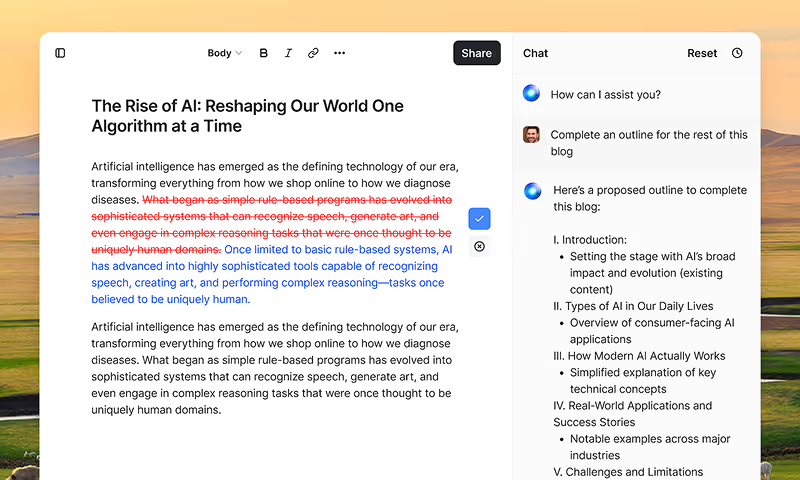
HyperWrite is the AI writing assistant that learns your style. It handles drafting, editing, and researching so you can focus on ideas.
- Autocompletes sentences as you type
- Works inside Google Docs & Gmail
- Adapts to your personal writing style
- 500+ AI tools for any writing task
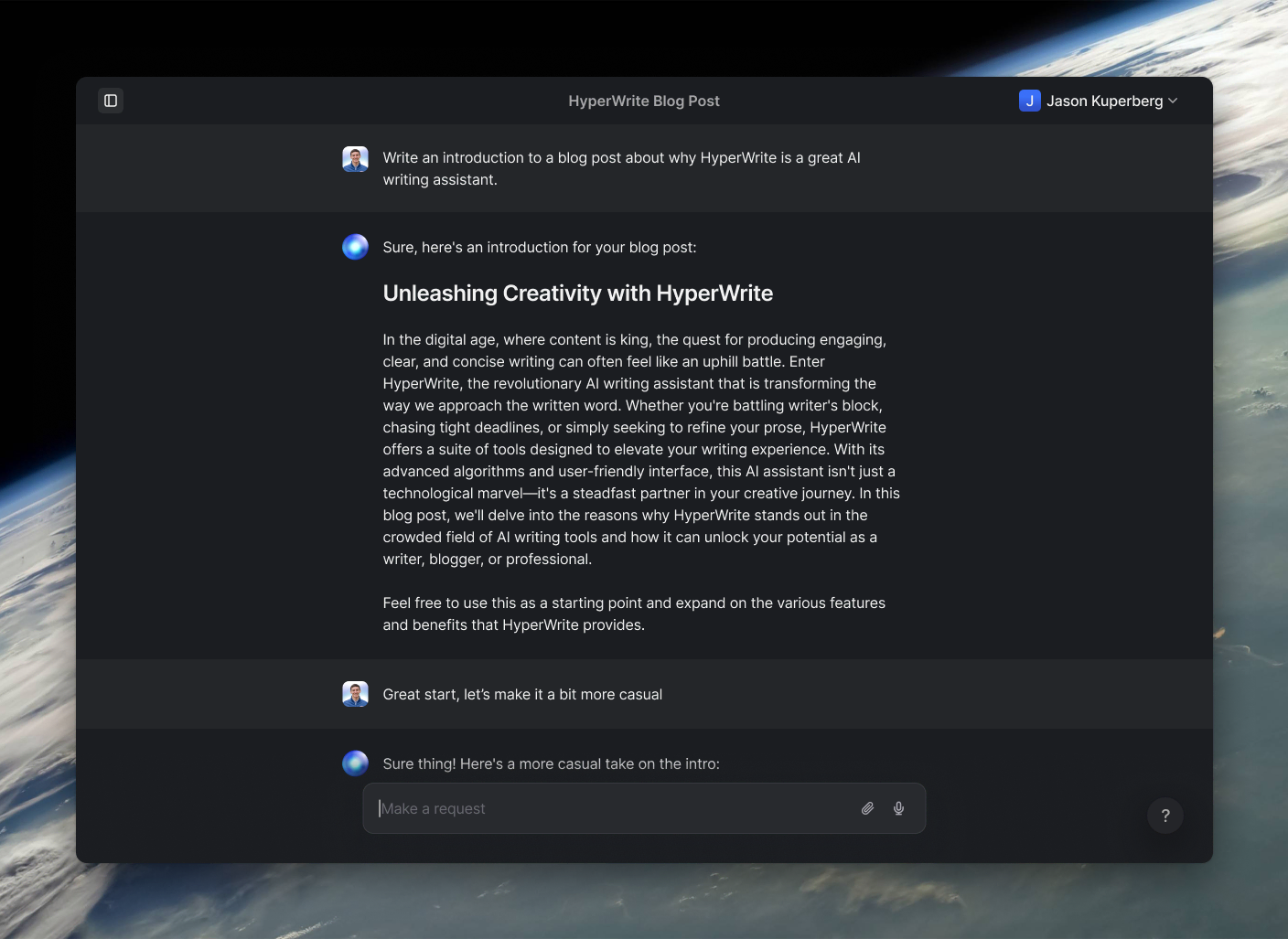
Powerful writing in seconds
Improve your existing writing or create high-quality content in seconds. From catchy headlines to persuasive emails, our tools are tailored to your unique needs.