
Writesonic vs MarketMuse: Which SEO Content Tool Wins in 2026?


One builds content fast, while the other tells you what content to build. Testing both Writesonic and MarketMuse reveals exactly when each one earns its price tag.
Writesonic vs MarketMuse: What's the difference?
Writesonic is an AI search visibility platform built to produce content fast: blog posts, ads, product descriptions, and social copy.
MarketMuse is an AI content intelligence platform that tells you what to write and how thoroughly to cover it, based on topic modeling and SERP analysis.
Choose Writesonic if: You need AI search visibility tracking alongside content generation, and want both in one platform.
Choose MarketMuse if: You're an SEO strategist or content team that needs data-driven briefs, content scoring, and topic authority planning.
Meet Writesonic
Writesonic is an AI search visibility platform with built-in content generation, offering up to 50 AI articles per month on Growth (and custom volume on Enterprise), plus a native SEO checker and autonomous AI agents available in limited trial runs on paid plans (10–100/month depending on tier) and full agentic workflow access on Enterprise.
Meet MarketMuse
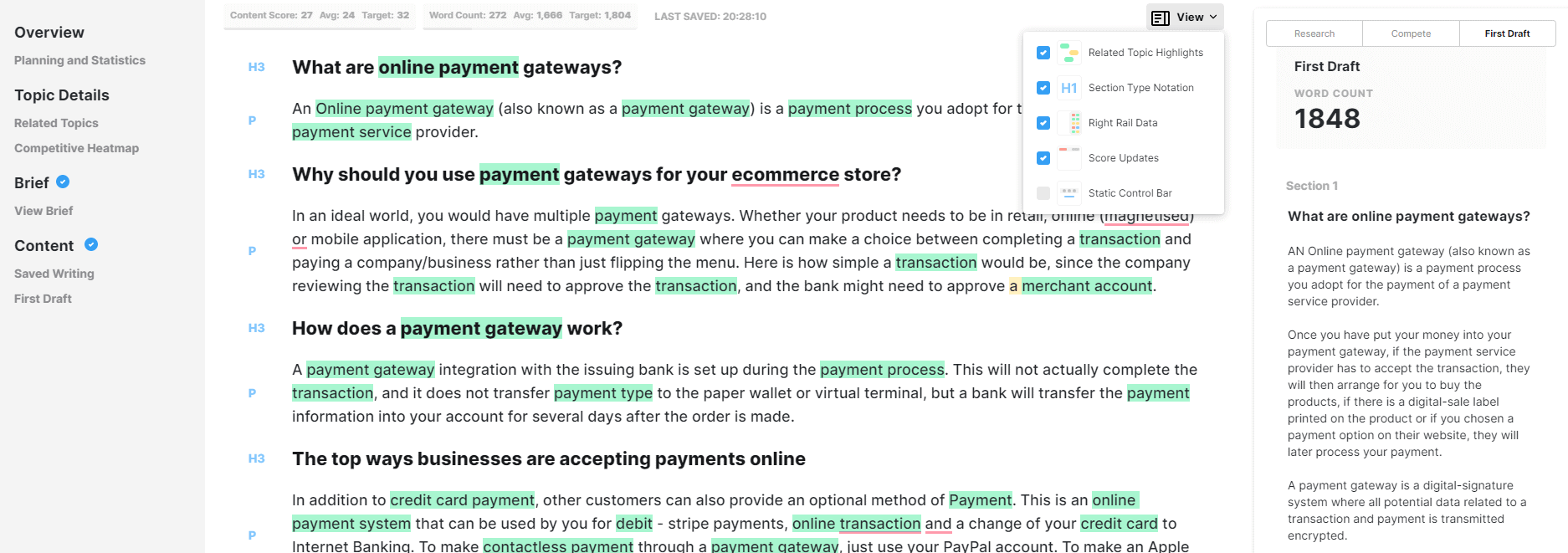
MarketMuse is a content strategy platform that scores your content against what already ranks and tells you which topics you can realistically win based on what you've already published. The standout is Personalized Difficulty, which replaces generic keyword scores with a difficulty rating based on your site's existing topical coverage and historical performance.
Writesonic vs MarketMuse: Feature-by-feature comparison
AI writing and content generation
Writesonic: Built for content marketers who work with volume and efficiency. The Article Writer 6.0 produces full drafts up to 5,000 words from a single topic prompt, and the template library covers short-form tasks from product descriptions to LinkedIn ads, ad copy, and email sequences.
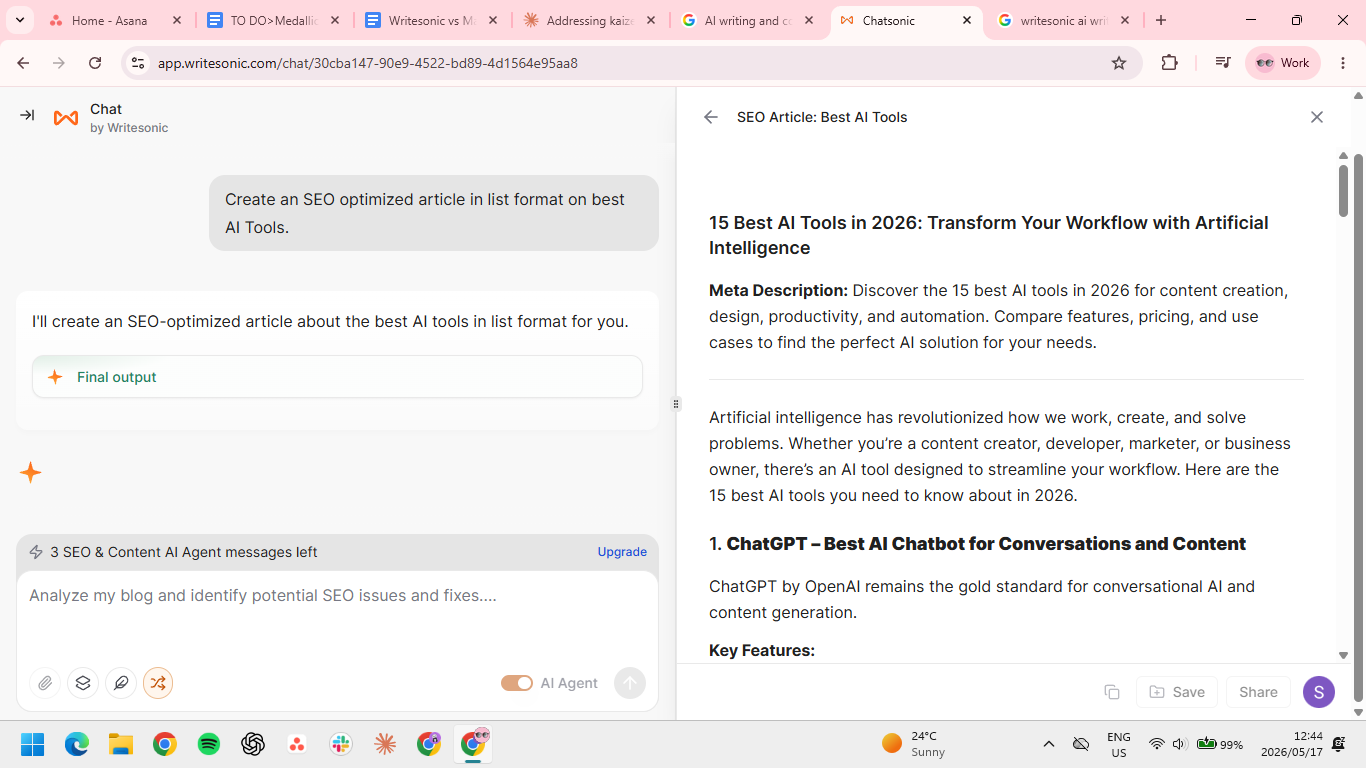
MarketMuse: Used to build briefs, then write in Google Docs or hand off to a freelancer. SEO leads at mid-market companies use it to scope what should be written, not to do the writing.
Winner: Writesonic, if output volume is the goal.
Integrations and exports
Writesonic: Native integrations include Google Search Console and WordPress on all paid tiers, with GA4 and Looker Studio unlocking on Enterprise.
MarketMuse: Integrates with WordPress and Google Docs, with API access for teams pulling brief data into their own systems. Built to hand off, not publish. Briefs export cleanly to PDF, Google Docs, or are shared via link, which is the workflow content directors actually use.
Winner: Writesonic for tool-stack integration.
Workflow integration and team fit
Writesonic: Fits well into solo and small-agency workflows. It plays well with WordPress and Google Search Console, and the per-seat pricing scales linearly. Where it strains is at team scale: there's no real approval flow, shared brand voice that holds up across writers, or an editorial layer between draft and publish.
MarketMuse: Assumes a strategist scoping the work, a brief getting handed off, and a writer (human or AI) executing against it. The platform is built for editorial teams running content as a program. Smaller teams often find it overbuilt for their volume; larger teams find it the only tool that handles the full strategy-to-publish pipeline without spreadsheets.
Winner: Depends entirely on team size. Writesonic for solo and small teams; MarketMuse for editorial programs with defined roles.
SEO and content optimization
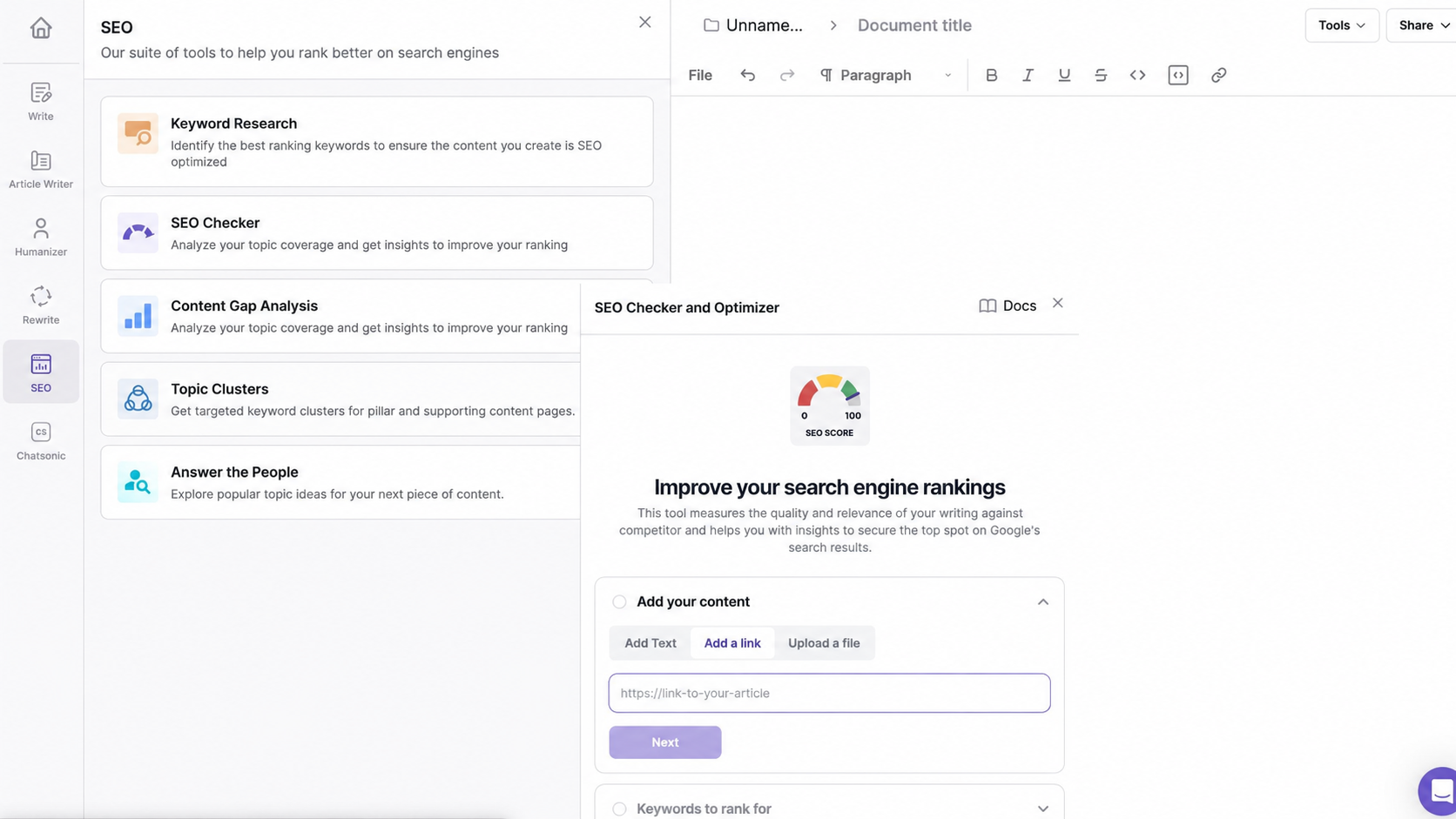
Writesonic: SEO stack relies on a Surfer integration and an in-editor optimization checker. It tells writers which keywords to add and how often. It’s as useful as a checklist while drafting, but not enough for teams trying to win competitive search verticals where on-page optimization is the floor.
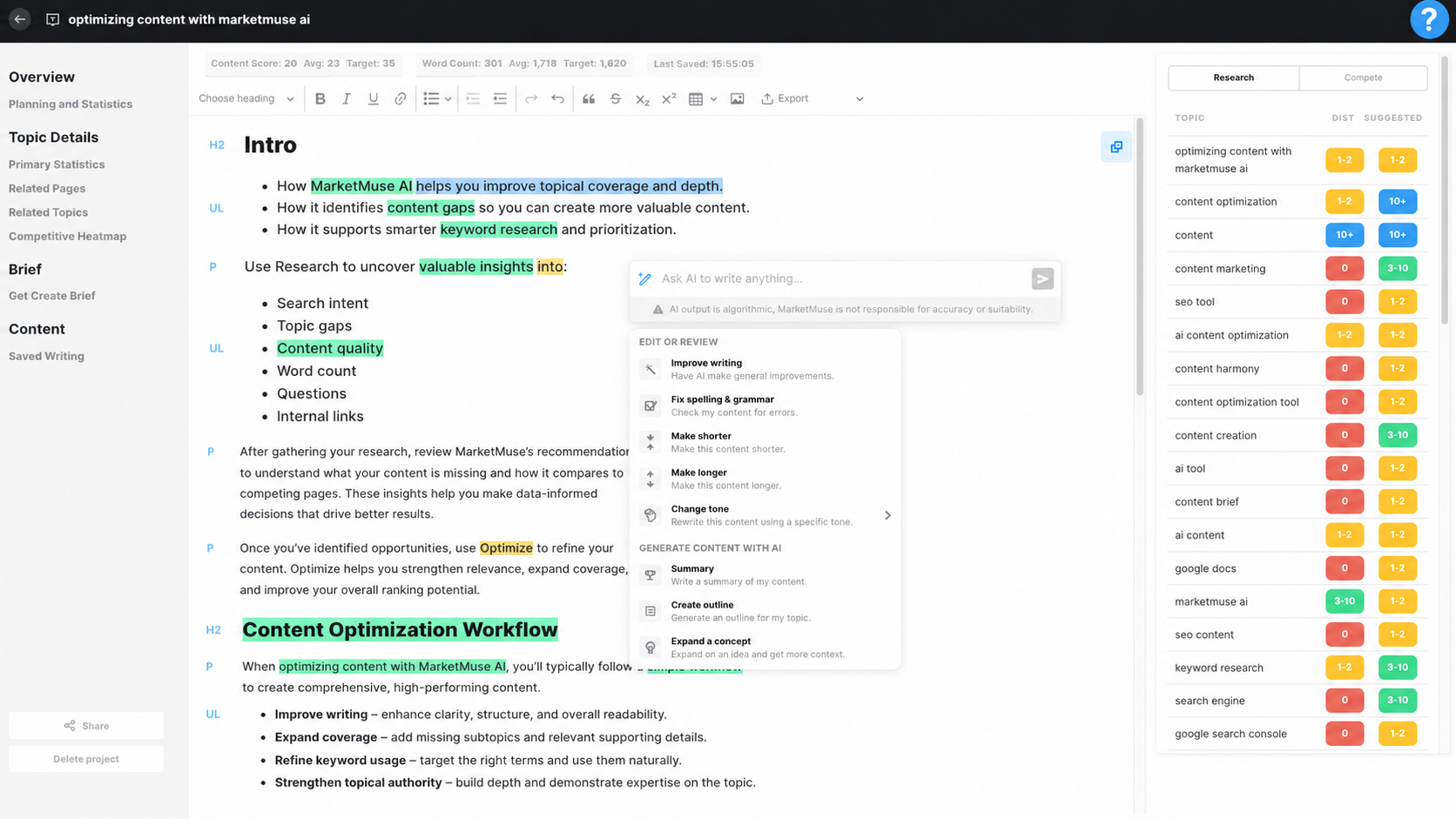
MarketMuse: Optimize tool builds a topic model from the top-ranking pages, calculates a target content score, and tells writers which subtopics and entities are missing from their draft. SEO managers use it to find the gap between what they wrote and what the SERP rewards.
Winner: MarketMuse. Topic modeling and content scoring at this depth don't exist in Writesonic.
Content briefs and research
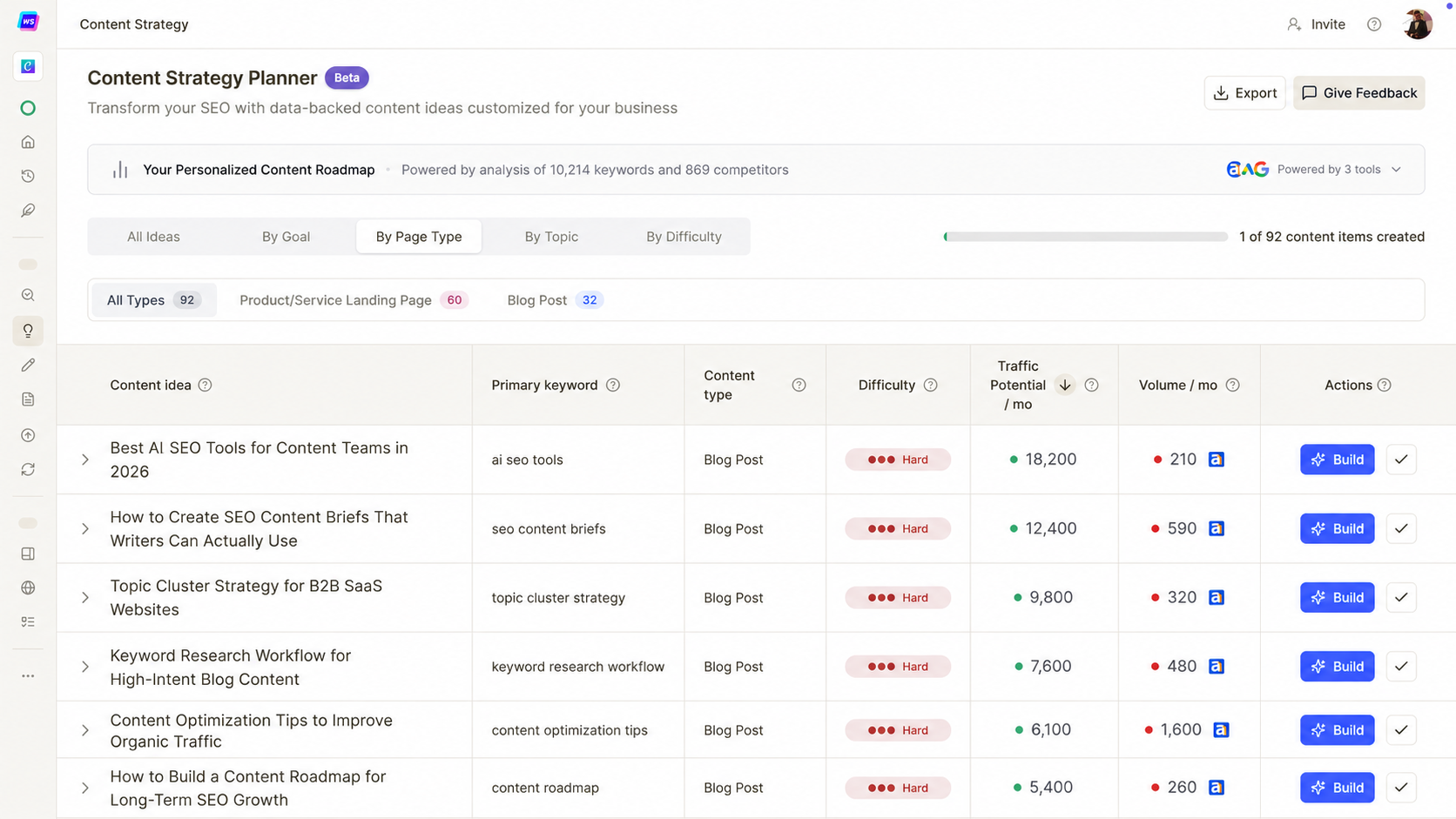
Writesonic: Helps generate content ideas, keyword targets, and SEO roadmaps that look useful at first glance. But those outputs still need human research. A freelancer handed a Writesonic brief can’t rely on it alone to understand the topic, choose the right angle, or know what to say with real authority.
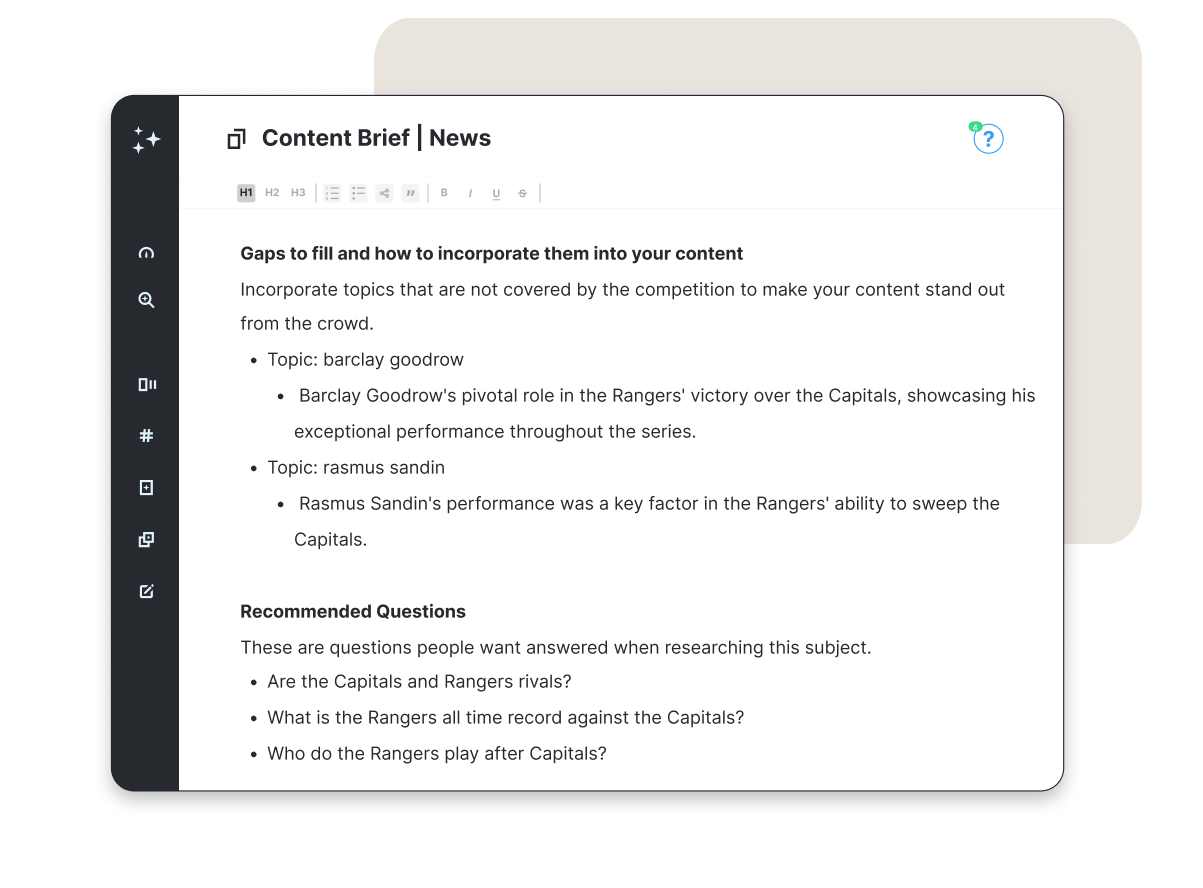
MarketMuse: Briefs are where the platform becomes most useful for content teams. They surface gaps competitors missed, suggest angles to cover, and list questions the article should answer. That gives writers a starting point, but they still need human research to turn the brief into something useful and authoritative.
Winner: MarketMuse. The brief is the product.
Templates and use cases
Writesonic: The template library covers short-form tasks from product descriptions to LinkedIn ads, ad copy, and email sequences. Each one prompts for a few inputs and outputs short-form copy. Most marketers won't use more than a dozen, but those that fit a workflow save time at scale.
MarketMuse: Nine brief types, each shaped around the article format: Article, Comparison, FAQ, Guide, How-to, Listicle, Local, News, and Product Review. Lower tiers (Optimize, Research) only unlock the Article brief; all nine types require the Strategy plan.
Winner: Writesonic for wider short-form coverage.
Ease of use and learning curve
Writesonic: Dashboard navigation is clear, the "what to focus on next" prioritization helps new users start, and most templates are self-explanatory. The trade-off shows up later: tool-switching disrupts flow and brand voice configuration takes trial and error.
MarketMuse: The platform is dense with features (Topic Navigator, SERP X-Ray, Heatmap, Personalized Difficulty, Inventory, Content Score), and dashboards take time to read fluently. Once a strategist gets comfortable, the depth pays off. For solo writers, the ramp is steep.
Winner: Tie. Writesonic out of the gate; MarketMuse for teams willing to invest the ramp time.
Pricing and plan structure
Writesonic: Entry pricing is $99/month ($79/month on annual billing) for Starter. This includes 15 AI articles, 10 site audits, and ChatGPT-only visibility tracking. Gemini and Google AI Overviews tracking unlock at Basic ($199/mo annual), Sentiment Analysis and Action Center at Growth ($399/mo annual), and all 10 AI platforms at Enterprise (custom pricing).
MarketMuse: MarketMuse doesn't publicly list prices; all paid plans require contacting sales for a quote. According to GetApp, paid plans range from $99/month (Optimize) to $499/month (Strategy). The Free plan gives 10 queries/month, enough to test the interface but not enough for real work.
Winner: Writesonic for budget-conscious teams. MarketMuse, where content quality justifies the premium.
What real users are saying
Writesonic
Pros
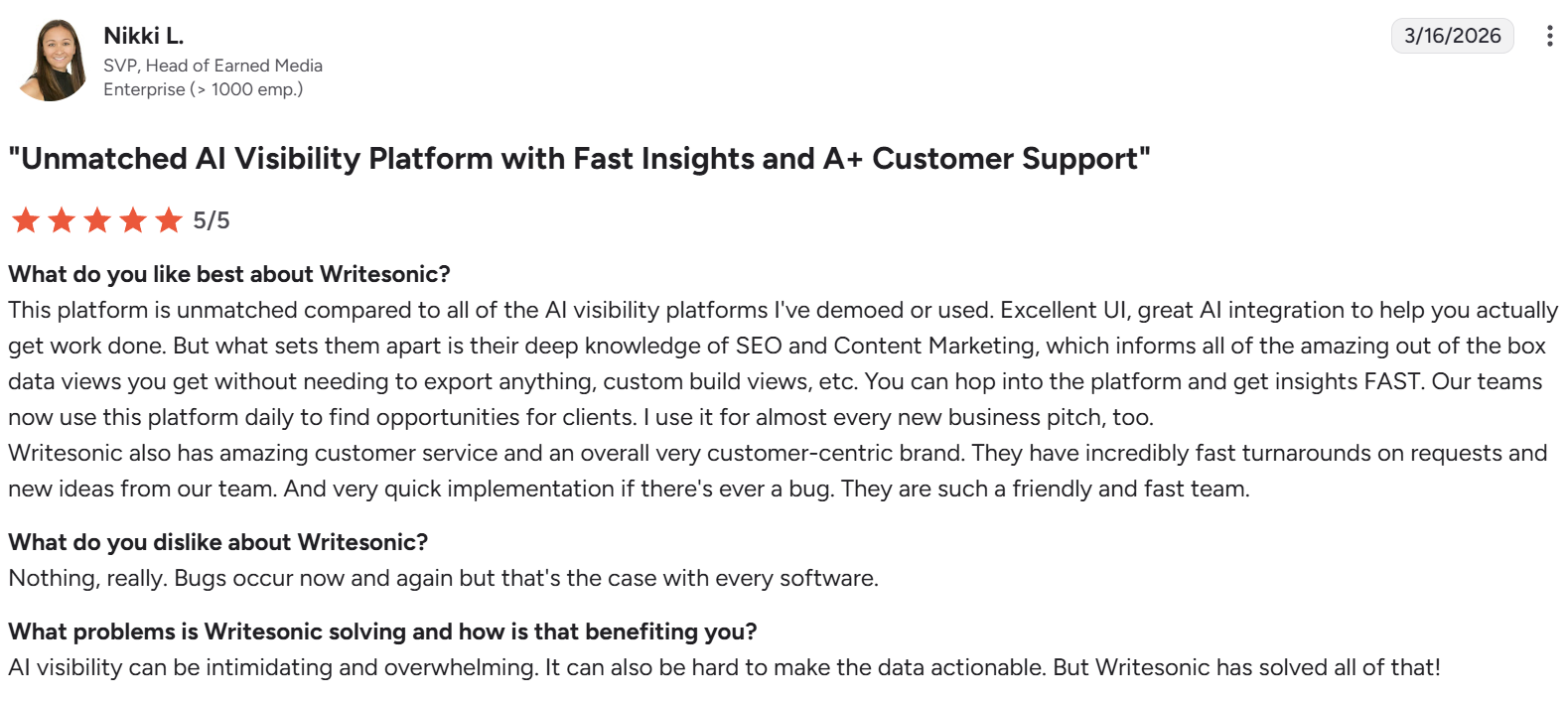
- The Enterprise plan supports AI search visibility tracking across 10 AI platforms in one dashboard, useful for marketing teams trying to figure out where they show up in AI answers. Nikki L., SVP, Head of Earned Media at an enterprise calls Writesonic, "unmatched compared to all of the AI visibility platforms I've demoed or used."
- The Action Center turns metrics into next steps. Sam S., Group Chief Executive Officer at a small business, shares that it helps their team “build a plan on a monthly basis with clear instructions on how to implement them.”
- Drafts come together fast. Swapnil S., a DevOps engineer in financial services, says it “removes that blank-page anxiety by giving you a smart first draft or outline in [seconds].” The same speed makes it easy to scale content production across multiple programs or geographies without burning out a small team.
- Onboarding is easy. Setup, configuration, and the dashboard's "what to focus on next" prioritization make Writesonic easier to get started with than most enterprise SEO platforms. The 7-day no-questions-asked refund window also takes some risk out of trying it.
Cons
- Output goes generic on niche or technical topics. Manual editing is still required to match brand voice and depth or make sense of technical content. Vikas G., a digital marketing manager, says “manual editing is still necessary to match brand voice and depth” for these topics.
- Switching between features disrupts writing flow. Starting in one tool, copying to another, tweaking formatting across screens, it adds up over a long session. So, you’re “spending more time jumping between features than actually writing,” says Sourabh D., SRE in computer software.
- Higher-tier features are gated even on $499/month plans. Christophe D., an SEO Manager, says, “Some features are blocked or limited with my $500 plan.” The Growth tier's Action Center is capped at only a handful of items per month before users need to upgrade to Enterprise.
- Brand voice training applies inconsistently. Even with writing styles configured, output drifts back toward generic AI phrasing on certain templates. The kind of voice-consistent AI writing some teams need isn't really Writesonic's strength.
MarketMuse
Pros
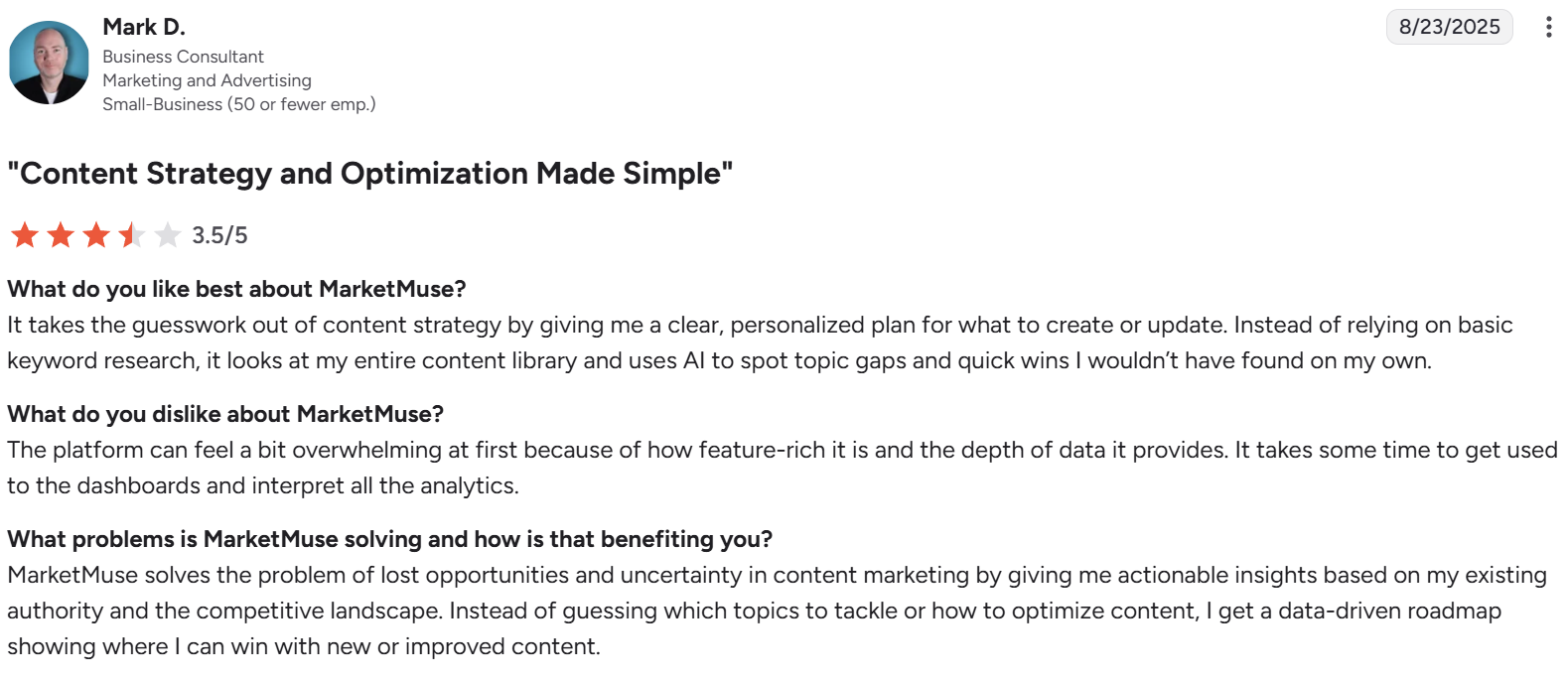
- Content strategy + personalized roadmap. MarketMuse analyzes your entire content library to refresh opportunities and "quick wins" you'd miss with standard keyword research. Mark D., a Business Consultant, says it "takes the guesswork out of content strategy" by building a plan around what you've already published.
- SERP X-Ray simplifies competitor research. Instead of opening 10 tabs to compare ranking pages, MarketMuse pulls competitor data, target keywords, and content scoring into one view. Ashish P., a small-business user, says SERP X-Ray and Heatmap “ease my task to do competitor research with my targeted primary keyword.”
- Briefs include concrete production specs. The research tool tells you how long a blog should be, how many inline images to include, and what depth of coverage will compete with top content. Jonathan L., a content marketing manager, says this gives him “better sense of what to ask for when working with content writers and graphic designers.”
- Suite covers the full content workflow. Research, briefs, optimization, and inventory tracking sit in one platform instead of spread across separate subscriptions. Serg V., a company founder, remarks that the full suite of apps gives him "a different set of tools to create comprehensive content for people and SEO."
Cons
- Steep learning curve. MarketMuse is dense with features and analytics, and the dashboards take time to read fluently. It "can feel a bit overwhelming at first," according to business consultant Mark D., and getting comfortable with the dashboards and interpreting the analytics takes some adjustment.
- Interface forces tool-hopping during single-article workflows. Justin D., a senior email marketer, notes you “end up jumping around from tool to tool” for keyword research and optimization for a single article.
- Content score metrics trail competitors on certain queries. MarketMuse's scoring works, but it's not always the sharpest signal in the category, compared to other tools like Surfer SEO.
- The editor can crash or lag mid-write. Content scores and topic research can take a while to load, and the editor itself can stall. A user in financial services notes it "sometimes crashes, which is a little frustrating while writing," though autosave protects unfinished work.
How to make your choice
That said, if you're picking one, here's how you should go about it.
Writesonic is better for:
- Solo creators and small marketing teams who need content generation and SEO in one platform
- Content production at volume (up to 50 AI articles per month on Growth)
- Short-form copy: ads, social posts, product descriptions, and email sequences
- Early-stage businesses building their first content engine
- Teams that want AI search visibility tracking without enterprise-level complexity
MarketMuse is better for:
- In-house SEO and content teams with established budgets
- Sites trying to build topical authority in competitive niches
- Content strategists who need defensible briefs to hand to writers
- Teams that already have writers and need optimization, not generation
- Editorial publishers prioritizing depth over output volume
The verdict on Writesonic vs MarketMuse
MarketMuse is the stronger tool for serious SEO teams. The Personalized Difficulty scoring and topic models genuinely change how content gets prioritized, and nothing else in this comparison does it the same way. For teams publishing weekly and competing for real keywords, it pays for itself in research time alone.
Writesonic doesn't compete on that level, and it doesn't try to. It's a fast, versatile platform that covers content generation and AI search visibility in one place. For solo creators and small teams, that's the right trade.
If you're not running a content program: HyperWrite
If you're not running a content program, neither one fits your actual workflow. You're writing investor updates, candidate emails, and Slack messages that need to sound like you, not 2,000-word SEO articles.
HyperWrite takes a different approach. Its TypeAhead Chrome extension lives in your browser, not a separate app, and finishes your sentences in real time across Gmail, Google Docs, Slack, and any text field you're typing in.
What makes it different:
- Personas train it on your writing samples, so suggestions sound like you — not generic AI output.
- TypeAhead works in real time across every tab in your browser. No copy-pasting between platforms.
- Responses are faster than ChatGPT-style thinking models; useful when you're mid-email, not mid-project.
- The AI Document Editor handles long-form with full document context.
Still switching to a separate AI tab every time you need help writing something? Try TypeAhead free with the Chrome extension and write alongside an AI that already knows what you're working on.
Frequently asked questions
Which is more affordable, Writesonic or MarketMuse?
Writesonic is significantly more affordable. Writesonic’s Starter plan runs $99/month (or $79/month annual). MarketMuse's paid plans start at $99/month for Optimize (per GetApp data), but pricing isn't listed publicly and requires contacting sales. MarketMuse offers a Free plan with limited queries, but you'll quickly hit usage caps on serious work.
Can MarketMuse replace Writesonic for content writing?
No, MarketMuse cannot fully replace Writesonic for content writing. While MarketMuse can generate some AI content, the platform is built for strategy and optimization more than high-volume content. Most teams use MarketMuse to plan and optimize, then use a separate AI writer or human writer for production.
Does Writesonic have SEO features like MarketMuse?
Yes, Writesonic has SEO features, including an SEO Checker, site audits, and an AI SEO Agent. However, MarketMuse's content scoring and topic modeling go deeper, with Personalized Difficulty scores based on your site's topical coverage and performance history, plus competitive analysis built into every brief.
Which tool is better for small businesses?
Writesonic is better for most small businesses. The price point fits smaller budgets, the interface is faster to learn, and the variety of writing tools covers most marketing needs: blogs, ads, social, and email. MarketMuse's pricing and complexity are usually overkill for small teams under five people.
Do Writesonic and MarketMuse offer free trials?
Yes, both tools offer ways to test before paying. Writesonic has a free trial with limited credits, and MarketMuse offers a Free plan with a small number of queries per month. The free options are enough to evaluate the interface and basic output, but not enough for ongoing work.
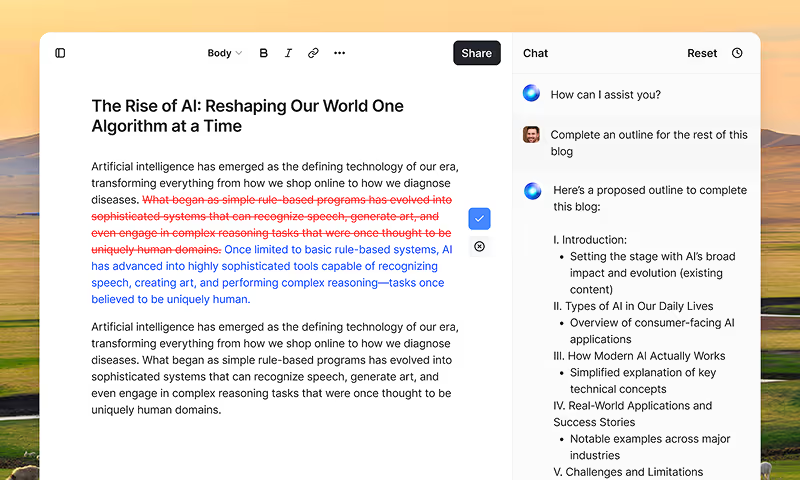
HyperWrite is the AI writing assistant that learns your style. It handles drafting, editing, and researching so you can focus on ideas.
- Autocompletes sentences as you type
- Works inside Google Docs & Gmail
- Adapts to your personal writing style
- 500+ AI tools for any writing task
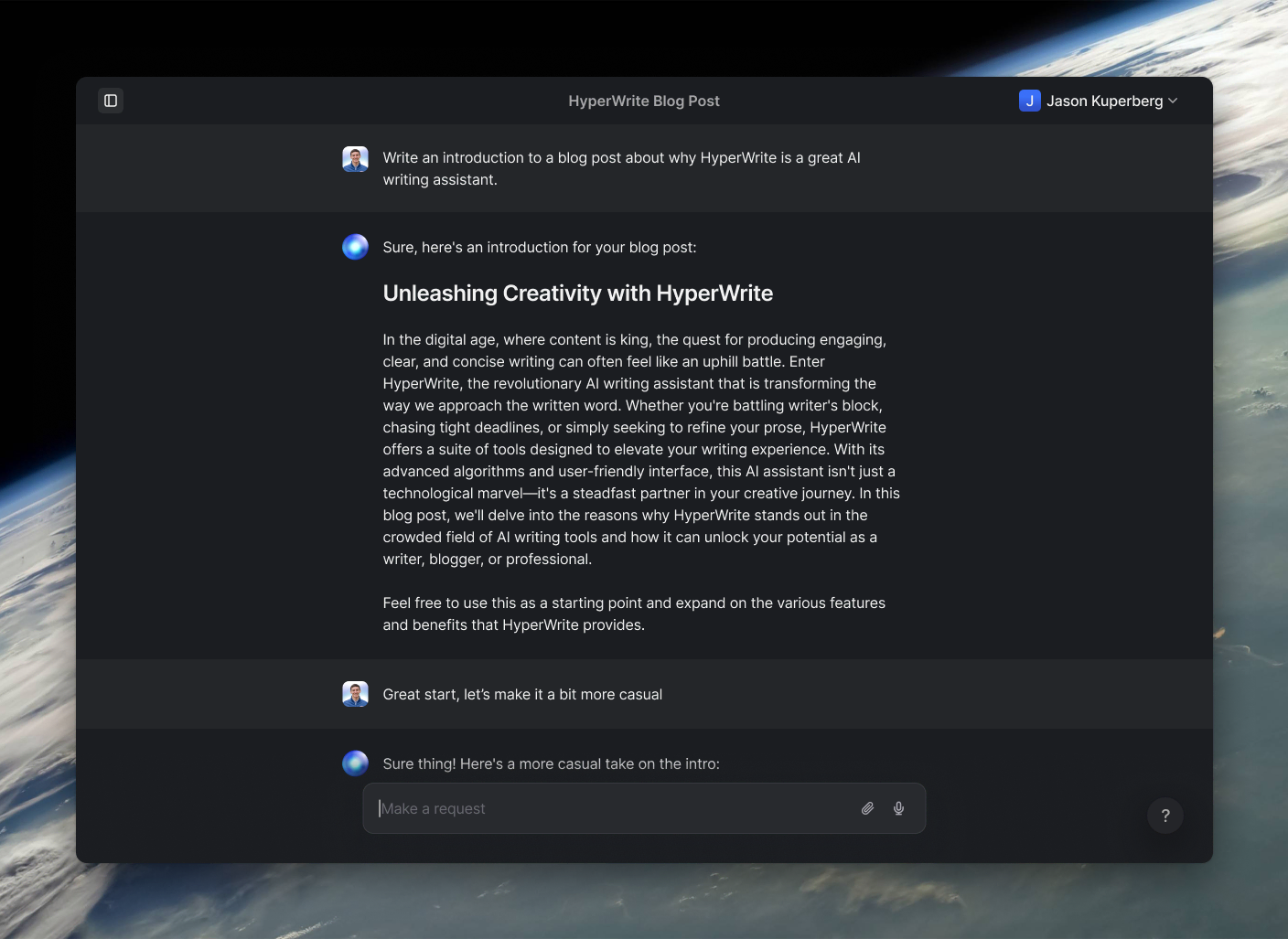
Powerful writing in seconds
Improve your existing writing or create high-quality content in seconds. From catchy headlines to persuasive emails, our tools are tailored to your unique needs.