
Pros and Cons of AI Writing Tools for Writers in 2026

AI writing tools speed up a first draft, and they produce text that sounds like nobody in particular wrote it. Both of those things are true at once, and which one wins depends entirely on what you're writing.
The pros and cons of AI writing tools come down to seven benefits and seven drawbacks, each one judged by what happens when you actually use the tool, marketing promises and panic headlines set aside. By the end, you'll know which tasks are a fit for AI and which ones still need a person doing the thinking.
What are the pros and cons of AI writing tools? At a glance
7 pros of AI writing tools
A demo makes any AI writing tool look impressive. These are the seven that hold up once it's part of your actual routine.
1. A blank page stops being the hardest part
Staring at an empty document is where most writing sessions stall. A rough AI draft, even a mediocre one, gives you something to react to and edit instead of something to conjure from nothing.
2. Routine writing gets done faster
Product descriptions, meeting summaries, and templated emails don't need a human's full creative attention, and AI handles that volume in a fraction of the time a person would spend on it. Several AI tools do this at no cost before a paid plan is ever necessary.
3. Editing existing text takes less effort
Grammar, clarity, and tone checks that used to require a second reader now happen in real time, catching what a tired pass over your own writing usually misses.
A sentence that reads fine after your third read-through often isn't fine at all; it's just familiar, and that familiarity is exactly what a fresh set of eyes catches.
4. Non-native speakers get a real assist
Fluency in a second language is hard-won, and an AI tool that catches awkward phrasing or suggests a more natural structure does work that used to require years of practice or an expensive editor.
5. Research and summarizing move faster
Condensing a long report or a stack of sources into a working summary used to eat an afternoon. AI does a rough pass in minutes, pulling out the likely key points so you start from a working outline instead of a wall of unread sources.
The verification and judgment calls still land on you, since a summary is only as trustworthy as the read you give it afterward.
6. It doesn't keep business hours
A human editor keeps business hours. A drafting tool doesn't, which matters more than it should when a deadline lands badly. Waiting until morning for a second opinion isn't an option when the deadline is morning.
7. Smaller teams can produce more
A solo marketer or a two-person content team can cover the ground that used to require hiring a third writer, at least for the volume of routine content that doesn't need a distinct voice.
The difference between doing this well and doing it badly comes down to how the workflow is set up, more than which tool gets picked.
7 cons of AI writing tools
These downsides surface later, once the tool becomes a daily habit.
1. The voice comes out generic
Left unedited, AI writing defaults to a flat, competent-sounding register that reads like it was written by nobody specific, because, in a sense, it was. A few specific fixes handle most of that without switching tools.
2. It states wrong facts with total confidence
Even the current top models hallucinate on 15% to 20% of factual citation tasks, and 35% to 55% on niche or recent topics, with no warning label on the errors. The only real fix is fact-checking AI-assisted writing before it’s published.
3. Sentence patterns repeat across pieces
The same transitional phrases, rule-of-three lists, and paragraph shapes show up again and again, until you can practically predict the next sentence before you read it.
A line like "it's not just about X, it's about Y," or an opener like "in today's fast-paced world" isn't wrong in isolation. It's the frequency that gives it away, appearing unprompted across topics that have nothing in common.
4. Original thinking is the one thing it can't produce
An AI model generates the statistical average of what's already been written on a topic. It can't have had an experience, formed a genuine opinion, or noticed something nobody else has said yet.
5. AI-detection tools can flag your work, right or wrong
Detection software isn't reliable enough to trust as a verdict; it misfires often, especially on multilingual and neurodivergent writers, but a flag still causes problems in a classroom or at a job.
6. Skills can erode with heavy use
A writer who always starts from an AI draft gets less practice structuring an argument from scratch, and that muscle weakens the same way any skill does without use.
The first draft is where you figure out what you actually think, working through a weak point until it holds up. Skip that step often enough and the skill doesn't just get rusty, but it stops developing at all.
7. Sensitive information can end up somewhere it shouldn't
Pasting a draft that includes client data, unpublished research, or proprietary details into a third-party tool means that information is now contained on someone else's servers, under someone else's data policy.
Academic integrity and plagiarism
The stakes here are different from a marketing department's, and the rules are still being written. AI-generated text isn't plagiarism in the traditional sense because it isn't copied from a specific source.
But submitting it as your own original work still misrepresents whose thinking produced it, and that's the real concern behind most academic integrity policies. Institutions aren't handling this the same way:
- Outright ban: No AI on graded work, at any stage.
- Process-limited: AI is fine for brainstorming and outlining, off-limits for the final draft.
- Disclosure-based: AI is allowed if you state exactly where you used it.
Check which one your specific institution or publication has actually written down, since assuming the wrong policy is the mistake that causes trouble. Detection tools complicate this further.
A score just estimates how closely a passage resembles machine-generated patterns; it isn't a verdict. Treat a flag as a reason to talk to someone, not as proof of anything on its own.
When to use AI and when not to
The answer depends on the task, since a blanket rule doesn't hold up across every situation.
Good fits for AI:
- A first-pass outline you'll restructure yourself
- A rough draft of routine, low-stakes content (a product description, an internal update)
- A grammar and clarity pass on something you already wrote
- Summarizing a long document before you read it in full
- Repetitive, templated writing where every instance follows the same shape
Poor fits for AI:
- Anything requiring a citation, a statistic, or a fact you haven't independently verified
- Graded academic work where the institution's policy prohibits it or requires disclosure you haven't given
- Writing meant to carry a specific, personal voice, a eulogy, a recommendation letter, a persuasive pitch that depends on you
- Legal, medical, or financial content where a confidently wrong answer causes real harm
- Anything about current events or recent developments the model may not have accurate information on
Should you use AI writing tools?
A tool that hallucinates on 15 to 20% of citations is a liability in a research paper, and barely a concern in a first-draft product description a human will edit before it publishes anyway.
The pros and cons here both hold; the work is weighing them against the specific task in front of you, every time you sit down to write something new.
The AI writing tool that sounds like you
HyperWrite is built to fix the generic-voice problem, the most noticeable downside of AI-generated content. Set up a Persona once and it matches your voice everywhere you write, from full drafts to TypeAhead's real-time suggestions, so the output still sounds like you instead of a flattened average.
It won't fix the other two, though. Factual accuracy and academic-policy compliance still come down to your own verification and judgment, the same as with any tool.
Tired of editing a flat, generic voice out of every AI draft? Try TypeAhead free with the HyperWrite Chrome extension and start your next draft in a voice that's actually yours.
Frequently asked questions
What are the downsides of using AI for writing?
The downsides of using AI for writing are a generic voice, confidently stated factual errors, and repetitive phrasing. Reduced original thinking, AI-detection risk, and data leaving your control round out the list.
What is the 30% rule in AI?
There isn't a single 30% rule in AI. In education, it's a ceiling: keep AI under about 30% of a submission, though Turnitin never set that line. At work, it's the 70/30 split: AI does the routine 70%, humans keep the 30% that needs judgment. In enterprise AI, it's a budgeting guide: about 30% of AI spend on data quality. None is an official rule.
What are five pros and five cons of AI in writing?
The five pros of AI in writing that come up most are: faster drafts, quicker editing, help for non-native speakers, faster research summaries, and more output from small teams. On the con side: a generic voice, factual hallucinations, repetitive phrasing, less original thinking, and AI-detection risk.
What are the disadvantages of using AI tools?
The two big disadvantages of using AI tools are unreliable accuracy and a flattened, generic voice. Two other costs are worth watching: your own drafting skills weakening if you lean on AI for every first draft, and sensitive data ending up on a third party's servers if you paste in the wrong material. A policy you didn't check can also catch you out.
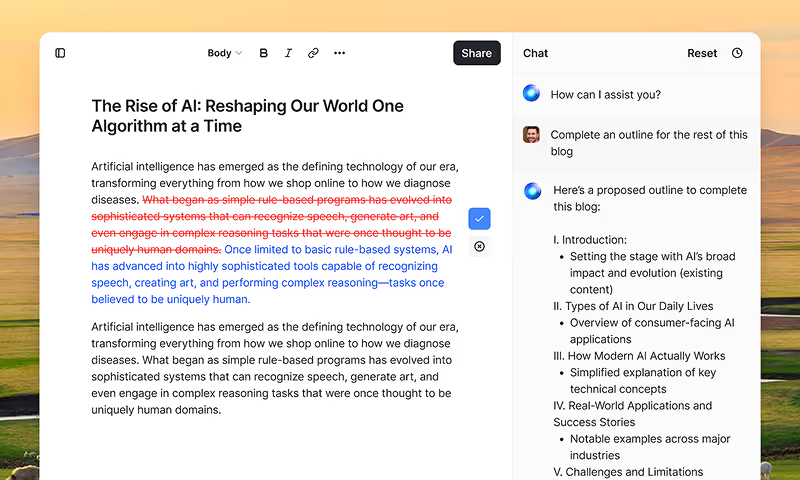
HyperWrite is the AI writing assistant that learns your style. It handles drafting, editing, and researching so you can focus on ideas.
- Autocompletes sentences as you type
- Works inside Google Docs & Gmail
- Adapts to your personal writing style
- 500+ AI tools for any writing task
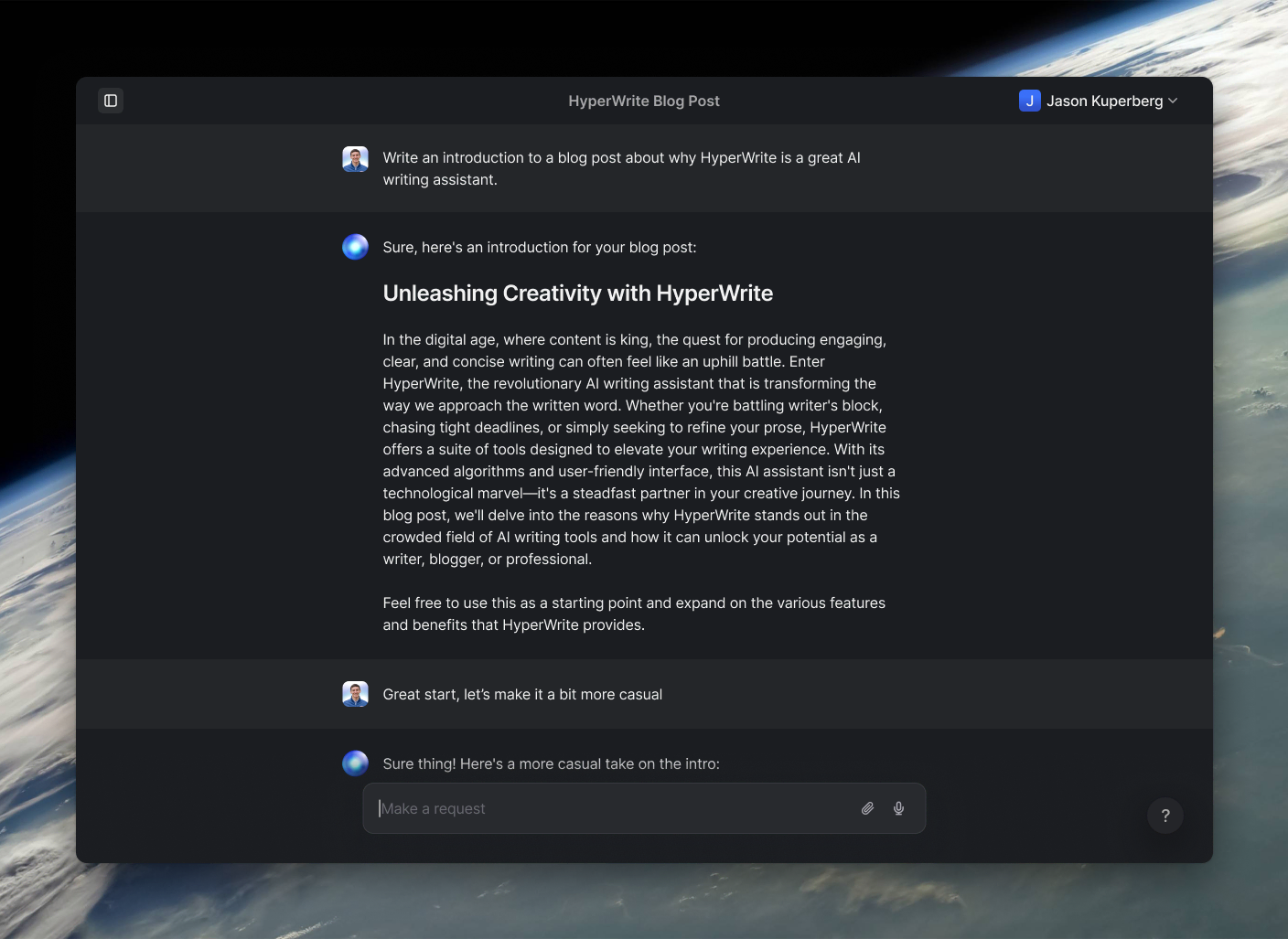
Powerful writing in seconds
Improve your existing writing or create high-quality content in seconds. From catchy headlines to persuasive emails, our tools are tailored to your unique needs.