
9 Benefits of AI Writing Tools for Busy Professionals 2026

Writing a solid first draft has traditionally been one of the biggest bottlenecks in knowledge work, often consuming hours of concentration to establish a baseline structure. The benefits of AI writing tools go beyond providing quick answers to questions.
In 2026, professionals lean on them for research and drafting, and for the tedious parts of writing that used to eat the most time.
The 9 benefits of AI writing tools at work
Each of these nine benefits solves a distinct problem, from the blank page to the deadline that lands after everyone else has gone home.
1. Beating the blank page and drafting faster
The UNC Writing Center lists brainstorming and outlining among its top recommended uses of generative AI tools. Having AI produce an immediate blueprint or usable text shifts your role from typist to editor, letting you focus on critical judgment calls instead of staring at a cursor.
Workplace use: Starting a complex proposal or quarterly report from scratch usually takes hours of setup. Generating a quick AI draft gives you an instant framework to push back against, refine, and reshape in minutes.
2. Research and summarizing move faster
Condensing dense documents into high-level overviews makes key information digestible fast. The UNC Writing Center also recommends AI summaries for exactly this: orienting yourself to a long text before reading it in full. Skipping the manual line-by-line scanning saves hours when processing long-form material.
Workplace use: A 40-page vendor proposal gets summarized in seconds, letting you spot critical risks and key terms before deciding if a cover-to-cover read is even necessary.
3. Grammar and clarity cleanup
Sentence-level refining serves as a fast second set of eyes that smooths out clunky prose and improves overall coherence. Requesting targeted feedback on clarity or tone turns a decent draft into a crisp, professional document.
Workplace use: Run a client email or proposal section through a quick clarity pass to catch awkward phrasing you’ve grown blind to. Weigh each suggestion instead of accepting it on autopilot, and AI becomes a way to improve your writing skills while keeping your own voice.
4. Maintaining a consistent team tone
A shared style and format keep external communications sounding unified, even when several people write them. Training output on custom style guides prevents individual pieces from clashing in voice or structure.
Workplace use: A marketing department creating email campaigns, social updates, and product copy across five writers can apply one shared persona, so the output stays on the same brand voice no matter who drafted it.
5. Scaling content output without extra headcount
Smaller teams can publish at a much higher volume by pushing routine, lower-stakes content through AI drafts. Delegating standard updates, product details, and basic documentation keeps output moving without overloading an existing team.
Workplace use: A two-person team can match a larger department's output by handing standard drafts to AI content writing tools. That frees the team to focus on flagship projects and high-stakes campaigns, where a wrong call actually costs the business.
6. Helping non-native speakers write with confidence
Structuring ideas and refining phrasing helps non-native English speakers get their meaning across clearly. A 2025 Annals of Cardiac Anaesthesia article found AI tools measurably improve clarity and grammatical accuracy for non-native English authors, helping them publish in high-impact journals.
Addressing subtle language gaps during the drafting phase eliminates the need for manual line-by-line proofreading or external editing support.
Workplace use: A team member writing in a second or third language can run a fast natural-phrasing pass before sending a major client proposal. This catches minor nuances and awkward phrasing instantly, so the message comes across as clear and professional.
7. Automating routine transactional writing
Polite emails, meeting agendas, and status updates eat into high-priority work even though they take minimal original thought. Handing these repetitive tasks to AI keeps you from breaking focus every time one lands in your inbox.
Workplace use: Prevent constant context switching throughout the day by generating meeting summaries and scheduling emails in seconds. Reclaiming those small ten-minute blocks adds up to hours of uninterrupted focus over a week, one of the clearest wins when you use AI for work productivity.
8. Working outside business hours
Working on tight deadlines often means needing feedback or edits outside standard business hours. Instant access to writing support eliminates delays when colleagues, editors, or supervisors are unavailable.
Workplace use: Polishing a proposal late at night no longer requires waiting for someone else to log on before sending. You can run a fast clarity check, resolve clunky phrasing, and submit first thing in the morning. Following the best practices for AI-assisted writing helps late-night drafts match your personal writing voice before you press send.
9. Repurposing content across channels and audiences
Rewriting the same information for executives, clients, or internal teams usually takes multiple drafts. Let the tool adjust the level of technical detail, and you can tailor complex ideas for any audience without starting from scratch.
Workplace use: A product manager can take a dense technical spec and instantly convert it into a high-level summary for leadership, a bulleted update for sales, or a customer-facing release note.
Where AI writing tools still need you
None of this runs unsupervised. AI tools still invent facts and citations that read as confident as the real thing, and they default to a flat, generic voice until you shape it, so anything client-facing needs a human read before it ships.
Treat the output as a first draft and the benefits above hold up. If you want the full picture before you lean on one, read up on the pros and cons of AI writing tools first.
Try HyperWrite on your next draft
Most of the benefits above come down to two things: getting the first words down and keeping them sounding like you. That's where HyperWrite is built to help.
Its flagship feature, TypeAhead, gives you real-time sentence completions right in your browser as you write, pulling context from your other open tabs so the suggestions fit what you're actually working on.
Set up a Persona and those suggestions stay in your own voice, whether you're drafting a proposal, clearing your inbox, or repurposing a report for a new audience. And because there's a free plan, you can see it work on your real writing before you pay for anything.
Still losing your first working hour to a blank page? Try TypeAhead free with the HyperWrite Chrome extension and get your next draft down in your own voice, right inside the doc or email you're already in.
Frequently asked questions
Why is AI writing good?
AI writing tools are good because they speed up drafting, help structure ideas when you're stuck, keep tone consistent across a team, and support writers working in a second language.
What is the 30% rule in AI?
The 30% rule is an informal guideline. In education, it's often described as capping AI content at 30% of a submission, though Turnitin has never defined that threshold. In workplace use, it usually means AI handles 70% of routine work while a person keeps the 30% requiring judgment.
Can you legally publish a book written by AI?
Publishing a book written by AI itself isn't restricted, but copyright protection is the real question. The U.S. Copyright Office requires human authorship, so text generated entirely by AI can't be copyrighted, while a book where you made substantial creative decisions, structuring, editing, and directing, can be. Only your human-authored contributions are protected.
What are the downsides of using AI in writing?
The main downsides of using AI in writing are factual errors stated confidently, a generic default voice, and the risk of an AI-detection tool flagging the work.
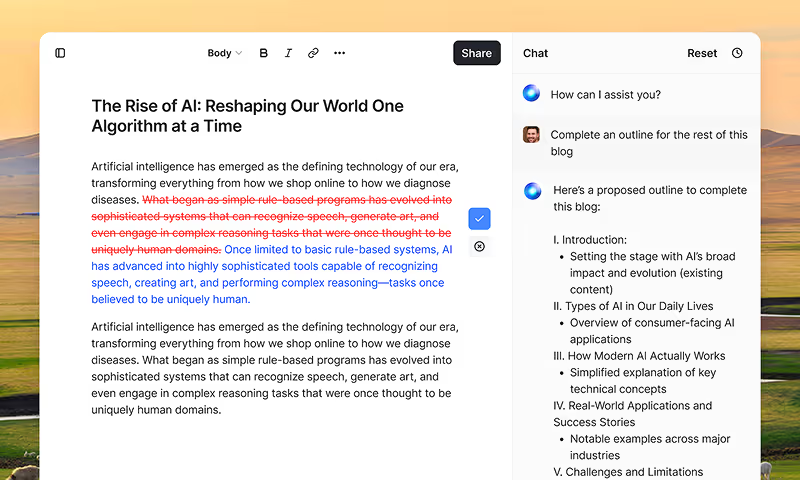
HyperWrite is the AI writing assistant that learns your style. It handles drafting, editing, and researching so you can focus on ideas.
- Autocompletes sentences as you type
- Works inside Google Docs & Gmail
- Adapts to your personal writing style
- 500+ AI tools for any writing task
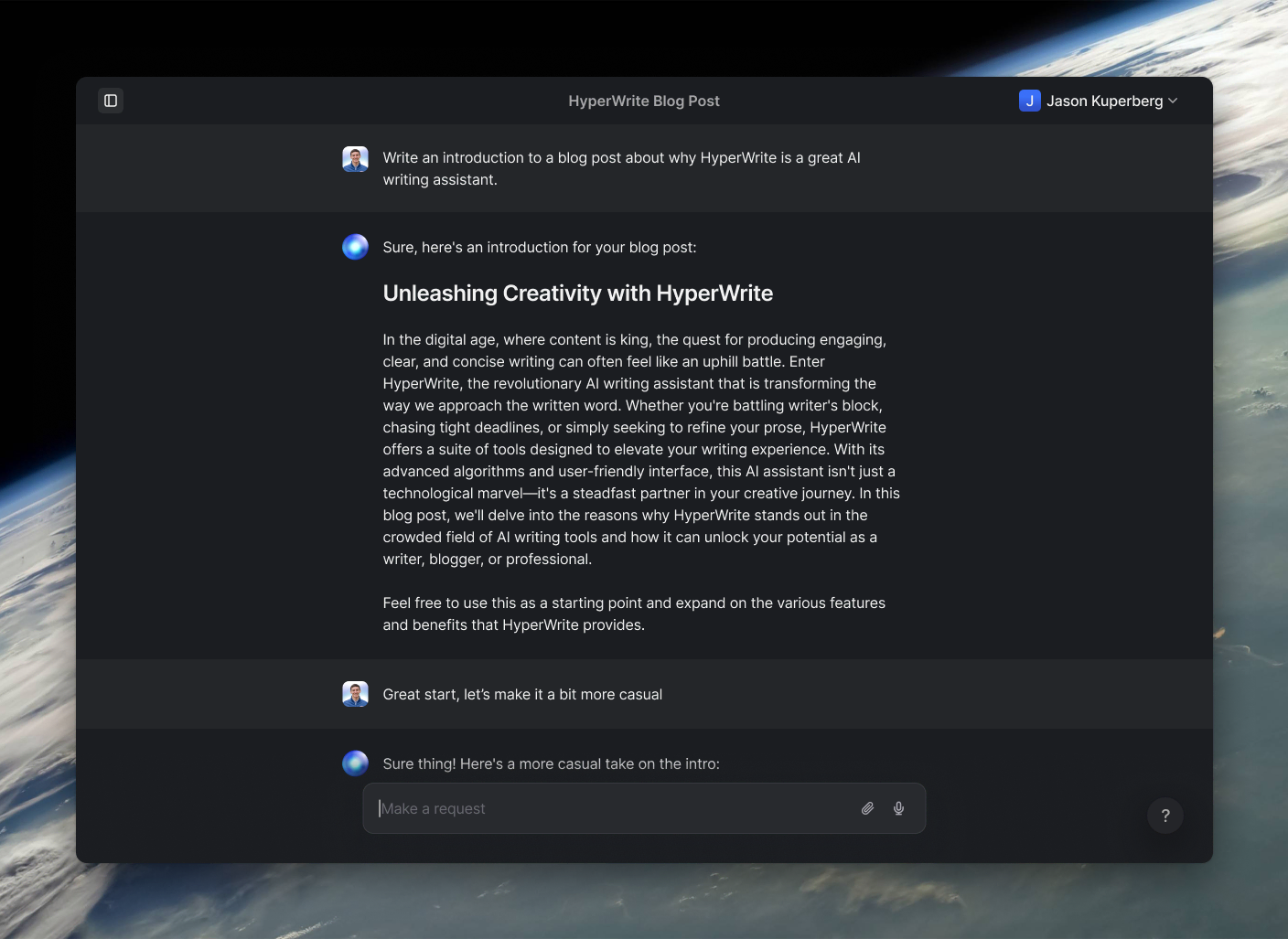
Powerful writing in seconds
Improve your existing writing or create high-quality content in seconds. From catchy headlines to persuasive emails, our tools are tailored to your unique needs.