


Most TikToks are lost in the first three seconds. A viewer decides to stay or swipe before you reach your point, which is why the script matters. A TikTok script template hands you a structure that front-loads the hook and keeps people watching.
This one works for any niche. You get the core structure, hook formulas, fill-in templates for different video types, and the mistakes that kill watch time.
How a TikTok script is built
A TikTok script has three parts, and TikTok's own creative guidance recommends the same shape: a hook, a body, and a close. The hook stops the scroll, the body delivers one idea, and the close tells the viewer what to do next.
- The opening seconds carry the most weight. 90% of ad recall impact is captured within the first six seconds, so the hook has to earn every second that follows.
- Match your script to a natural speaking pace, not a word count. Read it aloud and time yourself against the clip length, and if you're racing to fit everything in before it ends, cut lines instead of speeding up. Write the way you talk, in two to four short beats, so it lands naturally on camera.
The TikTok script template
Copy this, fill the brackets, and read it aloud before you film.
- Hook (first 3 seconds): [a bold claim, question, or POV that names your viewer's problem or curiosity]
- Setup (1 line): [why they should care, or a promise of what's coming]
- Body (2 to 3 beats): [deliver the idea in steps, tips, or a quick story, one point per beat]
- Payoff: [the answer, result, or punchline that closes the loop your hook opened]
- CTA (1 line): [one action, like follow, save, comment, or tap the link]
Example filled in for a skincare creator reads like this:
- Hook: "Stop using face wash with these three ingredients."
- Setup: "I broke out for years before I checked the label."
- Body: "Sulfates strip your skin barrier. Strong fragrance triggers irritation. Denatured alcohol dries you out, so your skin overproduces oil to compensate."
- Payoff: "Cut those three, give it two weeks. Most 'sensitive skin' is just this."
- CTA: "Make sure to follow! I'm posting the full list next."
Remember to cut any line the video survives without, since pauses and cuts hold attention better than extra words.
Hook formulas that stop the scroll
The hook does most of the work, so keep these formulas ready and fill in the brackets.
- The contrarian claim. "Everything you've heard about [topic] is wrong."
- The mistake warning. "Stop doing [common action] if you want [result]."
- The open question. "Why does [frustrating thing] keep happening?"
- The list tease. "[Number] [things] that [outcome], and the last one surprised me."
- The result reveal. "How I [desired result] in [timeframe], without [common method]."
- The curiosity gap. "Did you know [surprising fact about topic]?"
- The POV. "POV: you just [relatable situation your audience lives every day].
TikTok script templates for different video types
Swap the all-purpose template for one of these when the video type calls for it.
Educational or how-to
- Hook: "Here's how to [outcome] in [timeframe]."
- Body: [three numbered steps, one line each]
- Payoff: "Do that and [result]."
- CTA: "Save this so you have it later."
Story or before-and-after
- Hook: "[Timeframe] ago, [starting situation]."
- Body: [three beats: what happened, the turning point, the change]
- Payoff: "[the lesson or result]."
- CTA: "Comment if this sounds like you."
Product or promo
- Hook: "I found the [product] that finally [solves problem]."
- Body: [what it does, the moment it clicked, one honest caveat]
- Payoff: "Worth it if you [use case]."
- CTA: "Link in bio if you want to try it."
Listicle
- Hook: "[Number] [things] I wish I knew before [situation]."
- Body: [rapid-fire list, one line each, save the best for last]
- Payoff: "Number [X] changed everything."
- CTA: "Follow for part two."
Real TikTok hooks worth studying
What earns three seconds of attention is the specific wording. Here are five real hooks and the small choices that make each one land.
The contrarian claim
@realsimple: "That rule about drinking eight glasses of water a day is pretty outdated."
"That rule" does the work here. It assumes the viewer already knows the eight-glasses advice, so the hook lands the second they hear it. "Pretty outdated" keeps the tone casual instead of preachy. A stiffer version like "science has debunked" would read as a lecture and get swiped.
The mistake warning
@thedentalathlete: "If you're stretching before a run, you're doing it wrong."
The direct "you're doing it wrong" is what makes this stick. It points at the viewer rather than the topic. If it’s something passive like, “Static stretching before a run reduces performance." you keep the same claim but lose the accusation, which is the part that holds the swipe.
The list tease
@justicebuys: "10 things I bought for my kitchen."
Two small choices carry this one: the exact number (10, not "a few") and the personal frame ("I bought," not "the best of"). The number promises a finite scroll; "I bought" promises honest picks over an affiliate roundup.
The result reveal
@whatemmyreads: "How on earth do I read 20 to 30 books a month?"
"How on earth" is the whole trick. The creator is voicing the viewer's reaction back to them, so the video feels like an answer rather than a boast. The 20-to-30 range also reads more honest than a single round number would, and specific beats vague every time ("a lot of books" gets nobody to stay).
The curiosity gap
@kbacon: "Did you know that type O blood was originally called type 0 blood."
This one plays the "did you know" cadence completely straight, which is what makes it work. The viewer settles in expecting a real fact, and the video pays off with a pun ("0" was a typo, so it's type O).
A curiosity gap doesn't have to open onto trivia. It just has to promise a reveal the viewer can't see coming, and a joke lands as long as the setup sounds sincere.
Where TikTok scripts lose viewers
The script is usually where a flat video fails first. These six mistakes drain watch time.
- A slow hook. Opening with a logo, a greeting, or a wind-up hands the viewer an easy reason to swipe. Lead with your strongest line up front, before the viewer has already swiped.
- Cramming in too much. One video, one idea. A script that covers three topics loses people at the first tangent.
- Writing it like an essay instead of talking. Formal, full sentences sound stiff on camera. Write in fragments and contractions, the way you'd actually say the line if the camera were off.
- Ending with no direction. A video that stops cold wastes the attention you earned. Pick the single action you want, follow, save, or comment, and close on that instead of asking for all three.
- Ignoring what's on screen. Say what the viewer is seeing at that exact second, or the mismatch between your words and the visual pushes them away.
- Leaving in filler. Trim every word the point survives without. Short scripts leave more room for the pauses that hold attention.
Write your TikTok scripts faster
The camera work is quick. The writing is the slow part, especially landing a hook that sounds like you instead of a template. HyperWrite helps you draft the words. Its Personas feature, once set up, keeps your scripts in your own voice across the platform, so drafts read like you talk rather than like generic AI.
TypeAhead suggests your next line so a rough outline fills in faster. The AI Tools Library has prebuilt tools to spin out hook variations you can test against each other. You still bring the idea, the delivery, and the edit. HyperWrite just gets the script out of your head faster.
Stuck on a hook that still sounds like a template? Try TypeAhead free with the HyperWrite Chrome extension and get your first script down in your own voice.
Frequently asked questions
What is a TikTok script template?
A TikTok script template is a reusable structure for short-form videos. It maps out the hook, body, and call to action so you fill in your topic instead of starting from a blank page. Most templates follow a hook-body-close shape that front-loads attention.
How long should a TikTok script be?
A TikTok script should match its clip length at a natural speaking pace. Read your draft aloud with a timer running, and if you're rushing to fit it in before the clip ends, cut lines instead of speeding up your delivery.
How do you write a TikTok hook?
You write a TikTok hook by leading with curiosity, tension, or a bold claim in the first line. Name your viewer's problem, tease a result, or open a loop the rest of the video closes. Keep it to about 10 to 14 spoken words so it lands in the first three seconds.
Do scripted TikToks sound fake?
Scripted TikToks only sound fake when they read like an essay. Written in fragments, contractions, and your normal phrasing, a script sounds natural on camera. Reading it aloud before filming catches anything that comes across as stiff.
Can AI write TikTok scripts?
Yes, AI can write TikTok scripts, though the idea and voice should stay yours. AI is useful for drafting hooks, structuring the body, and spinning out variations to test, which clears the blank-page stage. You still supply the angle and the delivery, so treat the draft as a starting point.
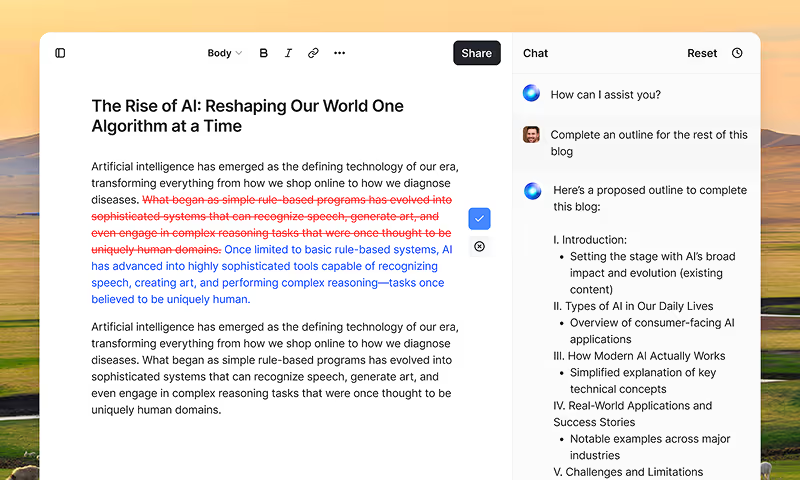
HyperWrite is the AI writing assistant that learns your style. It handles drafting, editing, and researching so you can focus on ideas.
- Autocompletes sentences as you type
- Works inside Google Docs & Gmail
- Adapts to your personal writing style
- 500+ AI tools for any writing task
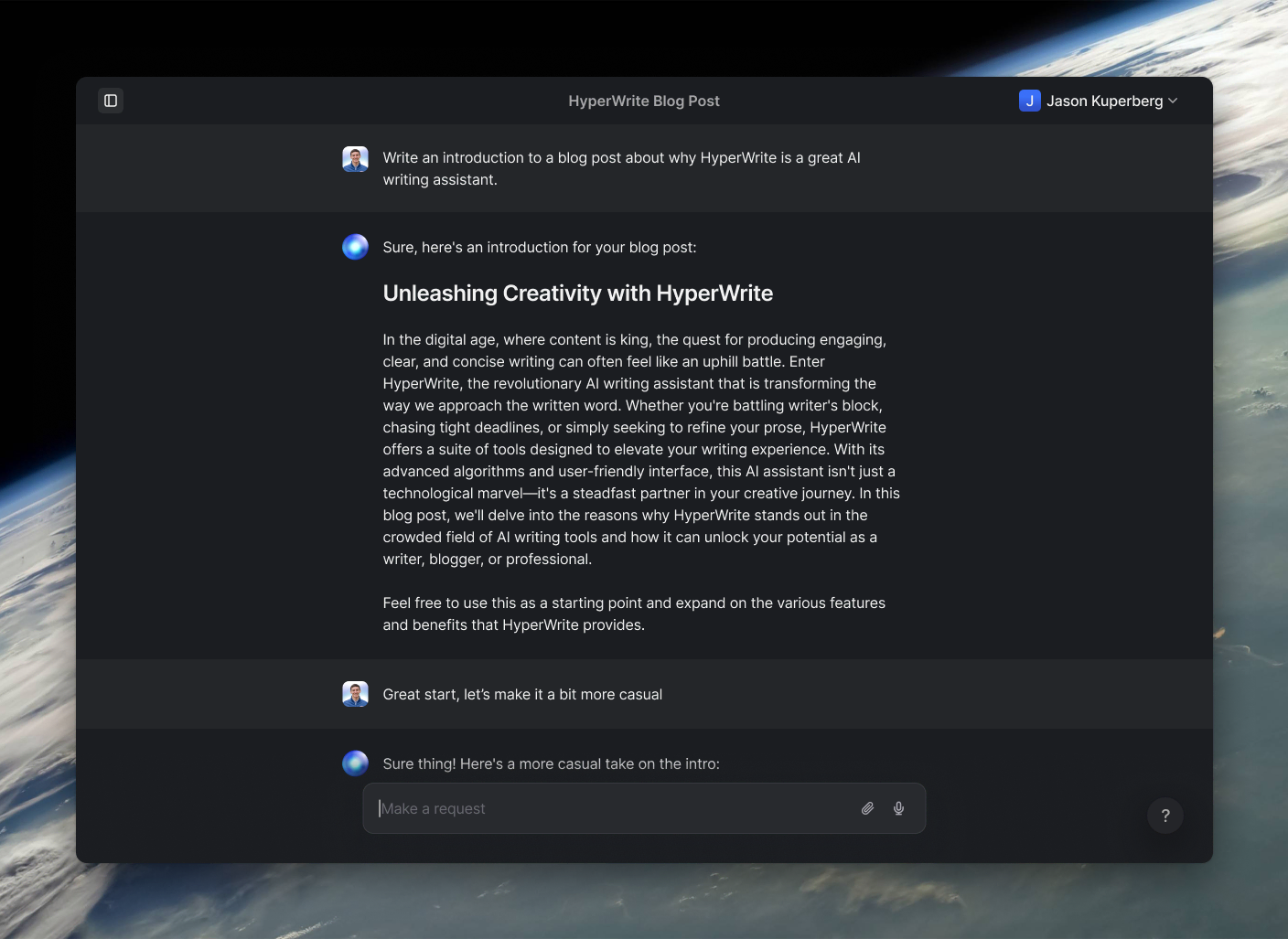
Powerful writing in seconds
Improve your existing writing or create high-quality content in seconds. From catchy headlines to persuasive emails, our tools are tailored to your unique needs.