


Two seconds is all a social media post gets to stop the scroll. These 10 social media hooks have consistently won that window of attention across LinkedIn, X, and Instagram in side-by-side testing.
What a social media hook actually does
Good hooks do three things in the first second or two:
- Pattern interruption breaks the scroll rhythm. The brain treats social feeds as background until something disrupts the expected pattern: a contrarian claim, an unexpected number, a fragment instead of a sentence. The interruption forces a conscious decision: keep scrolling or read on.
- Curiosity gap creates an open loop that the brain wants to close. Information gap theory shows that unresolved questions act like an itch: the discomfort is real, and the only way to resolve it is to keep reading.
- Recognition signals to a specific reader that the post is for them. A hook that names a niche audience or describes a specific situation triggers a "that's me" response, which is a clear engagement signal. The reader stays because the post just identified them.
The constraint that makes hooks hard is space. LinkedIn cuts posts off at 210 characters before the "see more" button. X gives you one line. Instagram captions get truncated after the first three lines.
Facebook hides the rest of long posts behind a "See more" link after around 480 characters on desktop and three lines on mobile. The hook has to land before any of the rest of your writing matters.
10 social media hooks worth stealing
Steal them. Adapt them. Don't run all ten in the same week.
1. The Contrarian Claim
Template:
[Popular belief] is wrong. [What works instead].
Pattern interruption plus curiosity gap. Readers expecting agreement get disagreement, which creates tension they want to resolve by reading on.
Example:
Stop posting daily on LinkedIn. It's the fastest way to tank your reach.
Best for: LinkedIn, X.
Don't use it unless you can back the claim with real reasoning in the body. Empty contrarianism gets called out, and the comments will eat you alive.
2. The Specific Number Lead
Template:
[Specific number] [unexpected outcome].
Numbers signal research and authority. But choose them carefully because round numbers like 50% or 10x read as estimates or invented, so use specific ones (73%, 47, $4,300).
Example:
I analyzed 100 of my own LinkedIn posts. The ones over 800 words got 3x the saves.
Best for: LinkedIn, X, long-form posts.
If the number is invented or "directionally true," skip it. Smart readers can tell, and the credibility hit affects everything that comes after.
3. The Personal Confession
Template:
I [vulnerable thing]. Here's what happened.
Vulnerability signals authenticity, which is the one thing AI-generated content cannot fake. Readers lean in.
Example:
I quit my $200K job to start a business. I made $4,300 in year one.
Best for: LinkedIn especially, Instagram captions, Facebook.
If the confession is humblebrag in disguise ("I'm too productive and it's hurting me"), it reads worse than no hook at all. Make sure the vulnerability is real.
4. The Curiosity Gap
Template:
[Setup that promises an answer]. [Tease the answer without giving it].
The setup needs to promise a specific payoff. The tease needs to hint at the shape of the answer without giving it away. "I learned something interesting" fails on both counts.
Example:
I asked 50 founders the same question last quarter. Their answers came back with one uncomfortable theme.
Best for: X threads, LinkedIn carousels.
If the body of the post doesn't actually deliver the answer, this hook backfires. Cliffhanger without payoff is the definition of clickbait.
5. The Direct Address
Template:
If you [specific situation], [specific message].
Calls out a niche reader so loudly they can't scroll past. Everyone else does, which is the point. You wanted the niche reader anyway.
Example:
If you write your own LinkedIn posts, you're probably making this one mistake.
Best for: LinkedIn, Facebook Groups, X.
If the niche is too small to drive any engagement, adjust the specificity to match your audience size.
6. The Pattern Interrupt
Template:
Drop the reader into a scene, fragment, or unexpected format.
The eye trained to skip "normal" social posts pauses on anything that breaks the rhythm. Single-sentence opens, a scene with a time stamp, or a fragment all work.
Example:
Tuesday. 3:47 PM. I'm about to fire the best engineer on my team.
Best for: Any platform, especially X, Instagram, and Facebook.
Don't use random formatting tricks for their own sake. The interrupt has to lead somewhere real, or it reads as gimmick.
7. The Loss-Aversion Warning
Template:
Stop [common practice]. It's costing you [specific outcome].
People react more strongly to potential losses than equivalent gains. A warning hook taps that asymmetry without needing exaggeration.
Example:
Stop ending your posts with “Thoughts?” It's the single biggest reason your engagement is dying.
Best for: LinkedIn, X.
Overusing it makes you sound like a doomsday account. Mix it with other hooks across your weekly posts.
8. The Quoted Moment
Template:
“[Quote],” [person] said. [What happened next]."
Dialogue creates an instant scene. Readers want to know who said it, why, and what happened.
Example:
“You'll never raise from a tier-one VC,” my old boss told me. Six months later, I closed our Series A.
Best for: LinkedIn, long-form posts, Instagram captions, Facebook.
If the quote is invented or "directionally accurate," drop it. Fabricated dialogue is the easiest hook style to spot, and it kills trust fast.
9. The Counterintuitive Result
Template:
We [did the opposite of expected]. [Surprising result] happened.
Unexpected outcomes create cognitive dissonance the reader wants to resolve. The brain runs the math on "how is this possible?" automatically.
Example:
We cut our ad spend by 60% last quarter and pipeline grew 3x.
Best for: LinkedIn (B2B especially), X.
Has to be real. Fabricated counter-results get screenshotted and quote-tweeted, and not in a way you want.
10. The "What If" Reframe
Template:
What if [common assumption] is actually backwards?
Plants a question the reader can't unsee. Once you've asked it, they're already running their own answer in their head, which keeps them in the post.
Example:
What if your sales team isn't the problem? What if it's the leads you're handing them?
Best for: LinkedIn, X, Facebook Groups.
Overused right now on LinkedIn, so make sure your reframe is genuinely new, not the same take everyone has already posted.
Match the hook to the platform
Not every hook works on every platform. Here's a quick reference for picking the right one.
The biggest mistake here is using a LinkedIn-shaped hook on X or vice versa. Adjust length, tone, and structure for each platform.
How to write hooks that don't sound like AI
Templates make the structure easy. The hard skill is writing fast while making them sound like a real human.
- Use details only you would know. "I learned a lesson about money” is generic. "I learned a lesson when my $40K Stripe payout arrived four days late and I missed payroll" is specific. The numbers, the name of the tool, and the consequence are the things AI can't make up.
- Read it out loud. If you wouldn't actually say "Here's a fact that might surprise you" to a colleague over coffee, don't write it. Hooks should pass the conversation test.
- Drop the reader into the moment. "Today I want to share”...is a preamble. Skip it and open inside the action. "My CFO walked into my office on a Tuesday with a paper bag" is the kind of opening that pulls a reader straight into the post.
- Skip the buzzword stack. Words like "transform," "unlock," "leverage," and "revolutionary" don't add weight to a hook. They lighten it. Cut every one of them before posting.
Mistakes that kill hooks before they land
A bad hook isn't usually obvious:
- Burying the lede under a context sentence. "Last week I was thinking about something interesting..." is throat-clearing. Cut everything before the actual interesting thing.
- Using a hook that doesn't match the body. A contrarian hook followed by 200 words of generic agreement reads as bait. The hook has to lead somewhere it promises.
- Asking a lazy question. "What do you think?" or "Right?" at the end of a generic statement is engagement begging. It's read as such and ignored.
- Stacking emojis or all-caps in place of a hook. Three flame emojis don't replace a real opening line. If anything, they signal you couldn't write one.
- Hedging the claim. "I think this might possibly be a useful idea for some people," guts a hook before it lands. Drop the qualifiers and commit to the claim.
Put these hooks to work
Pick one hook style from this list and use it on your next three posts. Just one. Track which version of it gets the most engagement, then move to the next style the following week.
Most people try to use ten new hook formats in a week and then can't tell which one worked.
The hard part is the variation work: drafting six or seven openings to find the one that lands. HyperWrite's AutoWrite can spin up multiple hook drafts from a single prompt, and TypeAhead suggests in-voice completions as you draft directly in LinkedIn, X, or wherever you post. Personas keep the voice consistent across platforms.
Sick of openings that sound like every other AI-generated post? Try TypeAhead free with the Chrome extension and see what your hooks read like when they actually sound like you.
Frequently asked questions
How long should a social media hook be?
A social media hook should be one to two sentences, usually under 15 words. On LinkedIn, the hook has to land inside the first 210 characters, which is the cutoff before the "see more" button. On X, the hook is the first line of the post.
What is the best hook for LinkedIn?
The best hooks for LinkedIn are personal confessions, contrarian claims, and direct address hooks. These work because LinkedIn rewards posts that read like authentic professional storytelling.
How do I write a hook that doesn't sound like AI?
You write a hook that doesn't sound like AI by including specific details only you would know: real names, exact numbers, dollar amounts, or scene-setting moments. Generic templates like "In today's world..." or "Did you know that..." read as AI-generated regardless of the actual author.
Why aren't my social media posts getting engagement?
Your social media posts probably aren't getting engagement because the hook fails in the first two seconds. Common causes include burying the lede under context, using generic templates, or writing hooks that don't match what the rest of the post delivers. Fixing the first line usually improves engagement more than any other single change.
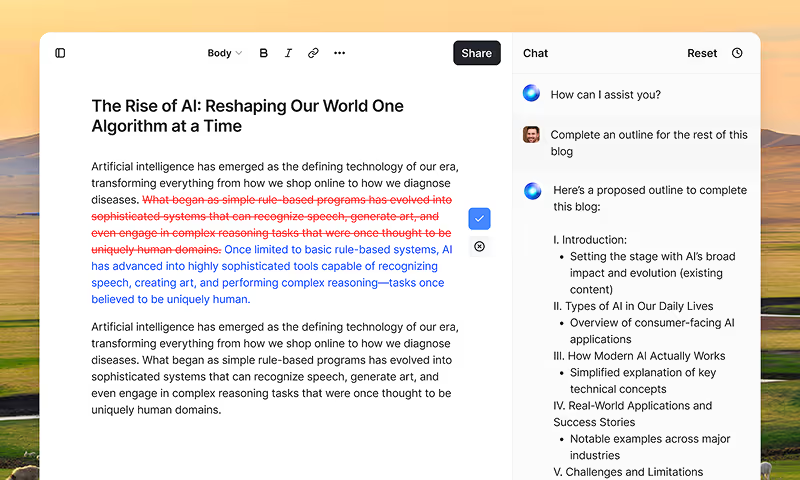
HyperWrite is the AI writing assistant that learns your style. It handles drafting, editing, and researching so you can focus on ideas.
- Autocompletes sentences as you type
- Works inside Google Docs & Gmail
- Adapts to your personal writing style
- 500+ AI tools for any writing task
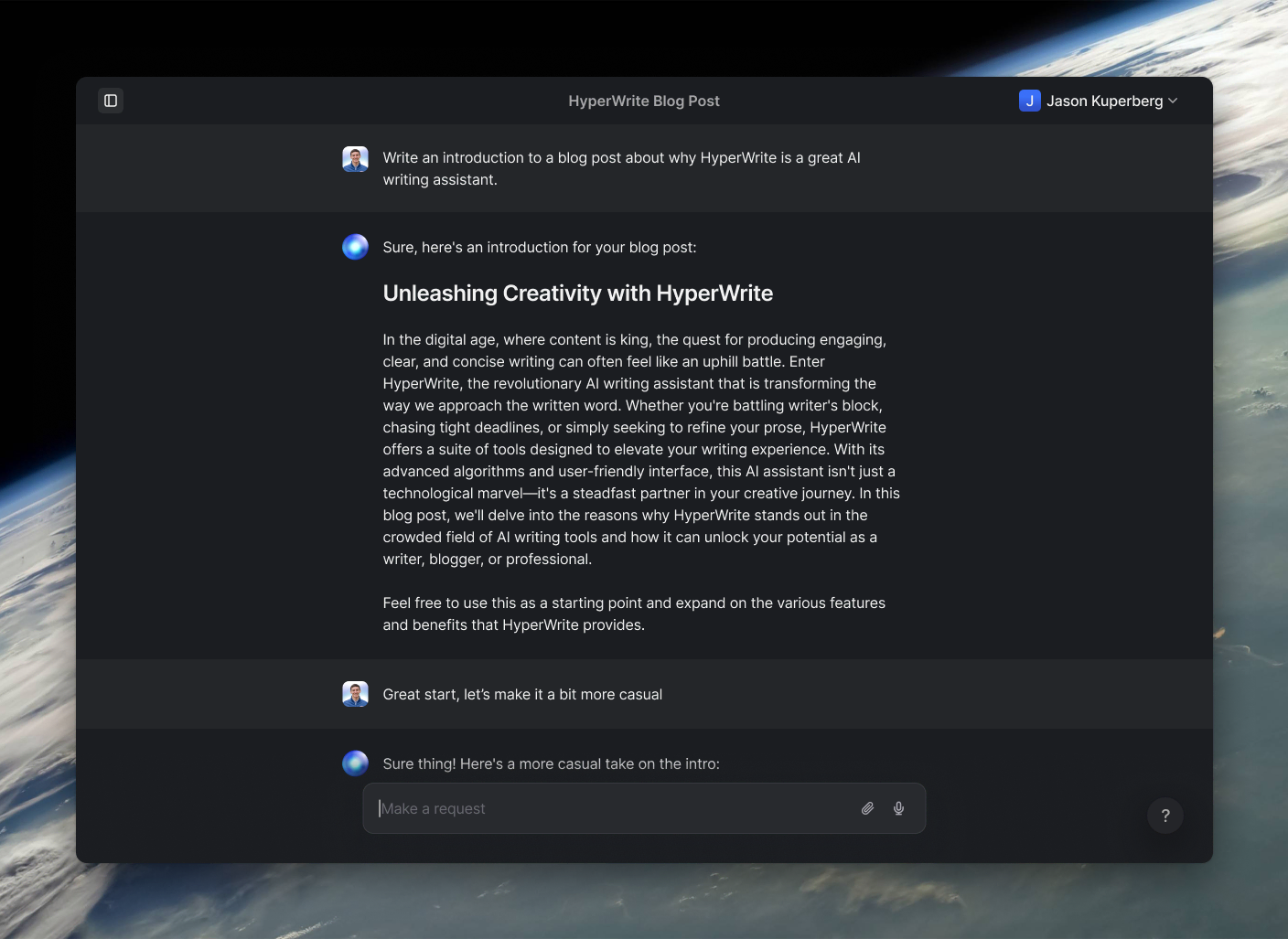
Powerful writing in seconds
Improve your existing writing or create high-quality content in seconds. From catchy headlines to persuasive emails, our tools are tailored to your unique needs.