


Hit send, then spot the typo. It was invisible 60 seconds ago, and now it's the only thing you can see. Editing your own writing is hard because your brain reads what you meant to type, not the words actually on the page.
A self-editing checklist gets around that. It hands you a fixed set of things to look for, in a fixed order, so nothing slips past on autopilot.
This one is built for everyday professional writing: your emails, reports, posts, and articles. Work through it in passes, and you'll catch far more before anyone else sees it.
How to use this self-editing checklist
Self-editing works best when you give yourself distance first, then read in layers.
- Step away before you edit. Even 10 minutes helps, and a few hours or overnight is better. Distance lets you read the words as they are, not as you remember writing them.
- Edit in passes, top down. Fix the big things before the small ones. There's no point polishing a sentence you're about to cut when the whole section needs restructuring.
Then work the checklist top to bottom: structure, paragraphs, sentences, words, tone, and finally proofreading. Each pass looks for one kind of problem.
The self-editing checklist
Run through these six passes in order: structure first and mechanics last.
Pass 1: The big picture
- Purpose is clear. A reader knows what this is and what you want from them within the first few lines.
- Right audience, right level. No jargon they won't know, and no over-explaining what they already understand.
- Everything serves the point. Each section supports the main message, and anything that wanders gets cut.
- Length fits the job. Long enough to cover it, short enough to respect their time.
- Strong open and close. The first line earns the second, and the ending lands the point or the ask, instead of trailing off.
Pass 2: Paragraphs and flow
- One idea per paragraph. If a paragraph covers two things, split it.
- Logical order. Each paragraph follows from the one before, and anything out of sequence moves.
- Smooth transitions. The jump between paragraphs makes sense without a jolt.
- Short paragraphs. On screen, three or four lines is plenty, so break up the walls of text.
Pass 3: Sentences
- Clear on the first read. If you have to read a sentence twice, rewrite it.
- Active voice. "The team shipped it," not "it was shipped by the team," unless passive is deliberate.
- Varied length. Mix short and long so the rhythm doesn't drone.
- One thought per sentence. Break run-ons at the natural seam.
- Point up front. Put the main idea near the start, not after a long wind-up.
Pass 4: Words
- Cut the filler. Delete "just," "really," "very," "actually," and "basically" wherever they add nothing.
- Strong verbs. Swap "make a decision" for "decide" and "give a summary" for "summarize."
- Plain over fancy. The simple word beats the impressive one.
- No redundancy. "End result," "close proximity," and "past history" each say the same thing twice.
- Precise rather than vague. Replace "a lot," "soon," and "things" with the specific version.
Pass 5: Tone and consistency
- Steady voice. The tone matches the reader and holds from start to finish.
- Consistent formatting. Headings, capitalization, lists, and number style follow one pattern.
- Consistent terms. One name for one thing, rather than switching between "client," "customer," and "user."
- Nothing reads as harsh. The reader can't hear your tone, so soften anything that could land wrong.
Pass 6: Proofread
- Spelling and typos. Including the ones spellcheck skips, like their/there and its/it's.
- Punctuation. Commas, apostrophes, and end marks where they belong.
- Grammar. Subject-verb agreement, consistent tense, and parallel lists.
- Facts, names, numbers, and links. Check every one, especially names and figures.
- Formatting holds. Spacing, bullets, and headings render the way you intend.
Self-editing techniques that catch more
The checklist tells you what to look for. These habits help you actually see it.
- Read it aloud: Your ear catches what your eye skims, like clunky rhythm, missing words, and sentences that run out of breath.
- Change how it looks: Switch the font, print it, or paste it somewhere new, so a different layout tricks your brain into reading it fresh.
- Check the reading level: Paste it into a tool like Hemingway App to flag dense sentences and passive voice you glossed over.
- Read it backward: Going sentence by sentence from the end breaks the flow, so typos stop hiding inside the meaning.
- Cut 10% of the content: Challenge yourself to remove a tenth of the words. Almost every first draft survives it and reads tighter.
Common self-editing mistakes to avoid
Even the best checklist fails if the habits around it are off. These four waste the most time, and they're the easiest to fix once you spot them.
- Editing while you draft: Fixing sentences mid-draft kills momentum and wastes effort on lines you may delete. Draft first, edit second.
- Editing too soon: Jumping in while the draft is still warm just re-reads what you hoped you wrote. Give it at least 10 minutes before the first pass.
- Only proofreading: Catching typos while ignoring a muddled structure polishes the wrong layer. Start big, end small.
- Over-editing: Endless tweaking drains the life out of writing and eats your deadline. Once it's clear and correct, stop.
Edit less by drafting cleaner
The cleaner your first draft, the shorter this self-editing checklist gets. HyperWrite's TypeAhead reads the context in your other open tabs and suggests your next sentence in real time, so sentences land closer to final the first time, with fewer filler words and run-ons to hunt down later.
Set up a Persona and those suggestions stay in your voice.
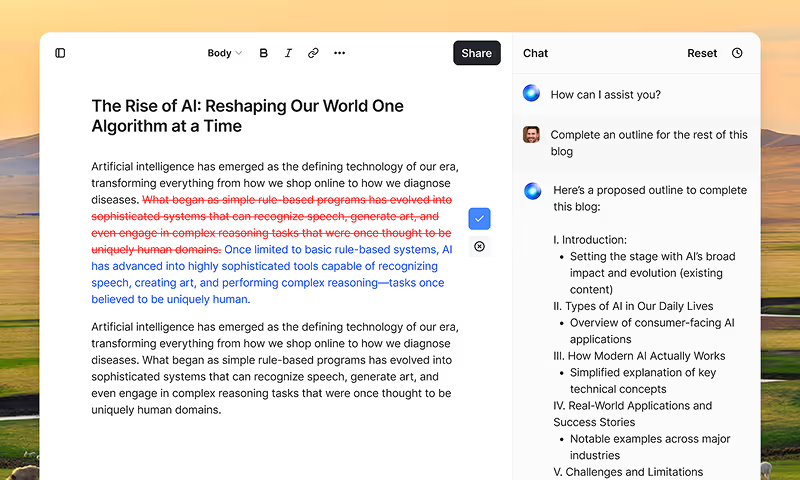
When a passage still needs reshaping, HyperWrite's library of prebuilt AI Tools can tighten, rephrase, or shift the tone of a paragraph.
Tired of hunting the same filler words and run-ons out of every draft? Try TypeAhead free with the HyperWrite Chrome extension. Let it complete your sentences as you draft that next report, then run this checklist and see how little is left to fix.
Frequently asked questions
What is the difference between editing and proofreading?
The difference is that editing and proofreading are different stages. Editing reshapes the content, structure, clarity, and tone, while proofreading is the final check for spelling, punctuation, grammar, and formatting. Proofreading comes last, once the writing itself is settled.
How many times should you read through your writing?
You should read through your writing at least two or three passes. One pass rarely catches structure, sentences, and typos together, since each needs a different kind of attention. Reading in layers finds more than reading the whole thing over and over.
Can AI help you self-edit?
Yes, AI can help you self-edit, as long as the final judgment stays yours. AI is useful for flagging wordy sentences, suggesting tighter phrasing, and catching mechanical errors, which speeds up the tedious passes. You still decide what fits your meaning and voice, so treat its suggestions as options you can take or leave.
HyperWrite is the AI writing assistant that learns your style. It handles drafting, editing, and researching so you can focus on ideas.
- Autocompletes sentences as you type
- Works inside Google Docs & Gmail
- Adapts to your personal writing style
- 500+ AI tools for any writing task
Powerful writing in seconds
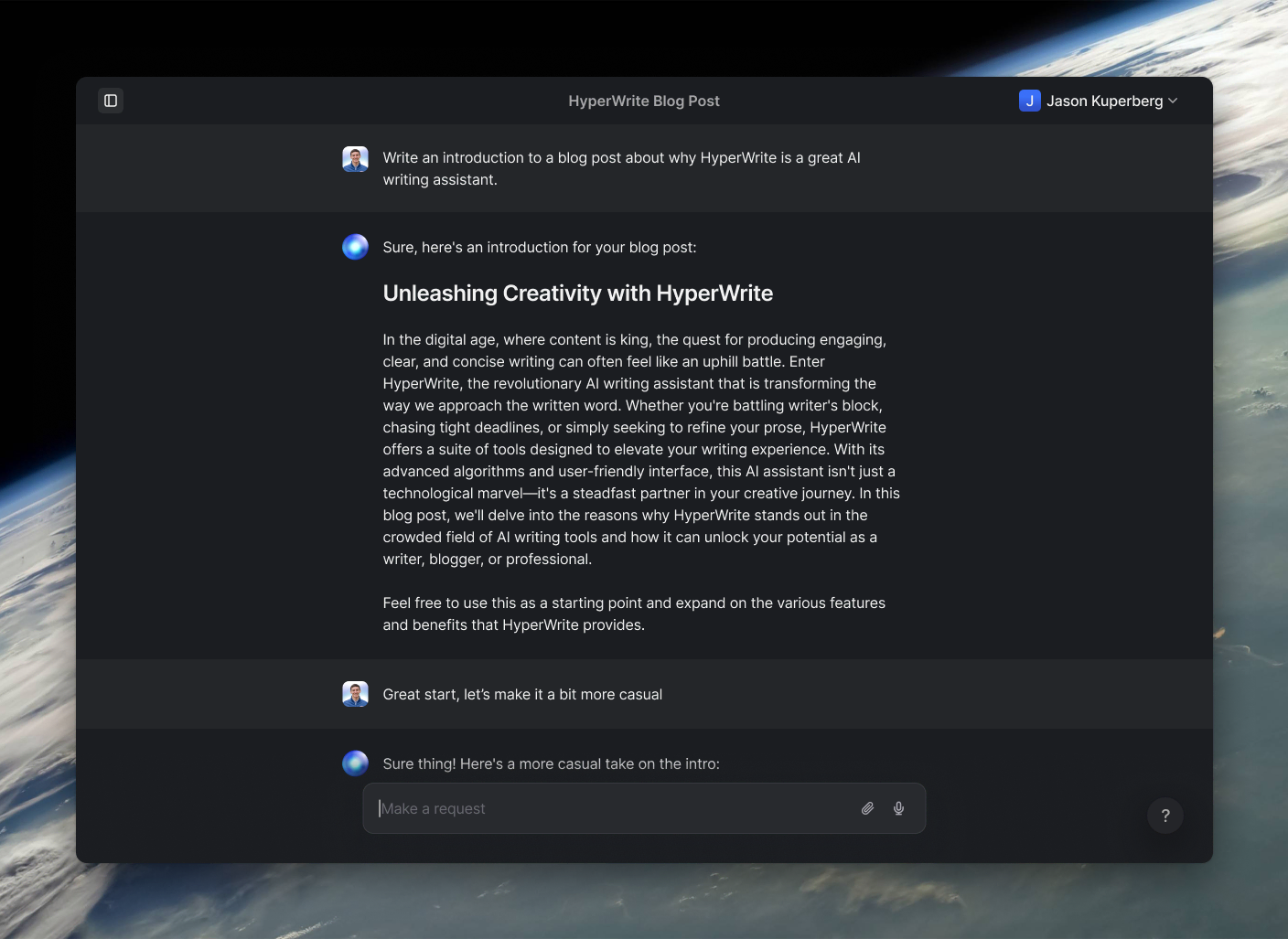
Improve your existing writing or create high-quality content in seconds. From catchy headlines to persuasive emails, our tools are tailored to your unique needs.