


The best professional writing tips have almost nothing to do with big vocabulary or clever turns of phrase. They come down to being clear, being useful, and respecting the reader's time.
That matters more now that AI can draft a competent paragraph in seconds. When passable prose is free, what stands out is the writing a machine can't fake. These 11 tips work whether you're writing an email, a report, a landing page, or a book.
11 professional writing tips
1. Cut every word that isn't working
Most writing is too long. Filler words ("just," "really," "very," "in order to") add length without meaning, and they weaken the words around them. Go through a draft and delete any word you can remove without changing the meaning.
- Before: "In order to really improve, you just need to basically practice a lot."
- After: "To improve, practice."
2. Lead with your main point
Readers decide fast whether to keep going. Put your most important idea first, in the subject line, the opening sentence, the first line of each paragraph.
If someone reads only your first sentence, they should still get the point.
This runs against how most people write, which is to build up to the conclusion. Flip it. State the conclusion, then support it.
In business writing especially, people skim, so burying your point three paragraphs down means it never gets read.
3. Write for one specific reader
Writing aimed at "everyone" connects with no one. Picture a single person: what they already know, what they need from you, and how much time they have. Then write to them.
A message to your CEO reads differently from one to a new customer. Match your vocabulary, tone, and level of detail to the person on the other end, and cut anything they already know or don't need.
4. Use plain words over fancy ones
Simple language isn't lazy. It's harder to write and easier to read. Between two words that mean the same thing, choose the shorter, more familiar one.
- "Use" over "utilize"
- "Help" over "facilitate"
- "Buy" over "purchase"
Complex vocabulary doesn't make you look smarter; it makes readers work harder, and working readers stop reading. Clear writing is a sign of clear thinking, which is far more impressive than a thesaurus habit.
5. Prefer the active voice
Active voice ("the team shipped the feature") is shorter, clearer, and more direct than passive ("the feature was shipped by the team"). It tells the reader who did what. Passive voice has its place when the actor is unknown or unimportant.
Passive voice creeps into most writing by default, and it drains a sentence of energy. When you catch a passive sentence, ask who's doing the action and put them in front.
6. Vary your sentence length
Writing where every sentence runs the same length reads flat. Aim for 12 to 18 words on average, then mix longer, flowing sentences with short ones.
A three-word sentence after a long one lands hard. That contrast is what gives your writing rhythm.
If you run out of breath, the sentence is too long. If everything sounds choppy, you need some longer sentences to smooth it out.
7. Replace telling with showing
Specifics persuade. "The campaign did well" gives the reader nothing to hold onto; "the campaign brought in 1,200 sign-ups in a week" gives them proof. One is a claim, the other is evidence.
So when you catch yourself writing an adjective ("fast," "affordable," "effective"), swap in a number or example. Concrete details do double duty. They persuade, and they make your writing read as if it came from someone who was really there.
8. Structure before you write
Good writing is organized thinking. Before drafting, outline the two or three points you need to make and the order that serves the reader best.
A quick outline saves you from the rambling, circular drafts that come from figuring out your argument as you go.
For anything longer than an email, a structure also helps the reader. Clear headings, short paragraphs, and a logical flow let people find what they need and follow your reasoning without getting lost.
9. Edit in a separate pass from writing
Writing and editing pull in opposite directions, so keep them apart. Draft fast without stopping to fix things, then come back later and edit with fresh eyes.
AI belongs in that first stage. A writing co-pilot like HyperWrite helps turn your notes into a rough draft in seconds.
The edit is where the real work happens: cutting fluff, sharpening the point, making the words sound like you. That judgment stays yours, and it's what separates a professional from a prompt.
10. Read your work out loud
Your ear catches what your eye skips. Read a page aloud, and you'll hear the clunky phrasing, run-on sentences, repeated words, and rhythm drags. If you stumble saying a sentence, your reader will stumble reading it. No grammar checker catches this much.
11. Study the writers you admire
The best way to write well is to read well. Notice how the writers you admire open, transition, and land a point. It trains your instinct for what works.
No single session changes anything, but a steady reading habit slowly raises your ceiling.
Put these professional writing tips to work
Sharpening your writing comes down to reps: draft, cut, read aloud, repeat. The faster you get a first draft down, the more time you have for the editing that makes writing professional.
HyperWrite’s TypeAhead works as a context-aware co-pilot, drafting alongside you in any browser tab so you spend less time staring at a blank page and more time refining. Its Personas learn from your writing samples, so suggestions start closer to your own voice.
Still losing your best hours to the blank page? Try TypeAhead free with the HyperWrite Chrome extension and put that time into the editing that counts.
Frequently asked questions
What are the most important professional writing skills?
The most important professional writing skills are clarity, concision, and knowing your audience. Writing that states its point quickly, cuts filler, and matches the reader's needs outperforms writing that sounds impressive but says little. Strong editing and a clear structure matter just as much as the first draft.
How can I improve my writing quickly?
You can improve your writing quickly by cutting filler and reading aloud. Deleting words like "just," "very," and "in order to" tightens any draft in minutes, and reading aloud catches clunky phrasing and run-on sentences your eye misses. Both take almost no time and produce an immediate difference.
How do I make my writing sound more professional?
You make your writing sound more professional by being clear and direct, not by using bigger words. Lead with your main point, choose plain vocabulary, use the active voice, and back claims with specifics. Professional writing reads as confident and easy to follow, which comes from clear thinking rather than complex language.
Should I use AI for professional writing?
You can use AI for professional writing, as long as the judgment stays yours. AI is useful for producing a rough draft, but the editing (cutting fluff, adding specifics, and shaping the voice) is what makes writing professional, and that part is your job.
How long does it take to become a better writer?
Becoming a better writer takes consistent practice over months. Small habits add up: cutting filler, reading widely, and editing every draft steadily raise your skill. There's no shortcut, but focused reps and honest self-editing move you forward faster than waiting for inspiration.
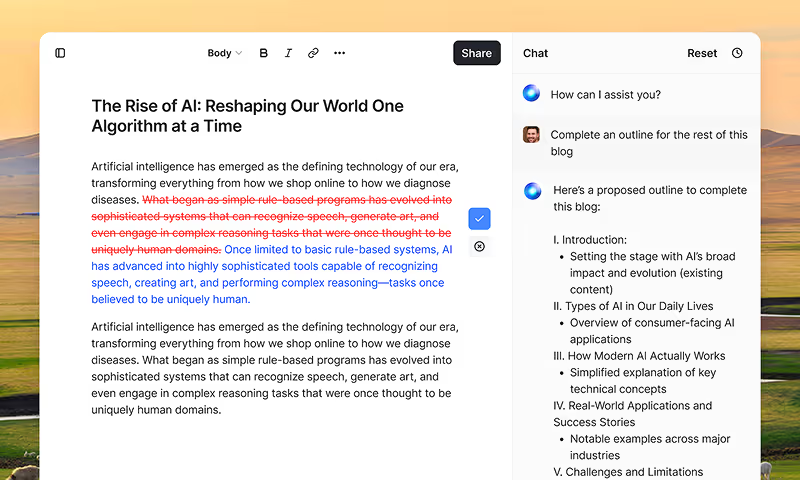
HyperWrite is the AI writing assistant that learns your style. It handles drafting, editing, and researching so you can focus on ideas.
- Autocompletes sentences as you type
- Works inside Google Docs & Gmail
- Adapts to your personal writing style
- 500+ AI tools for any writing task
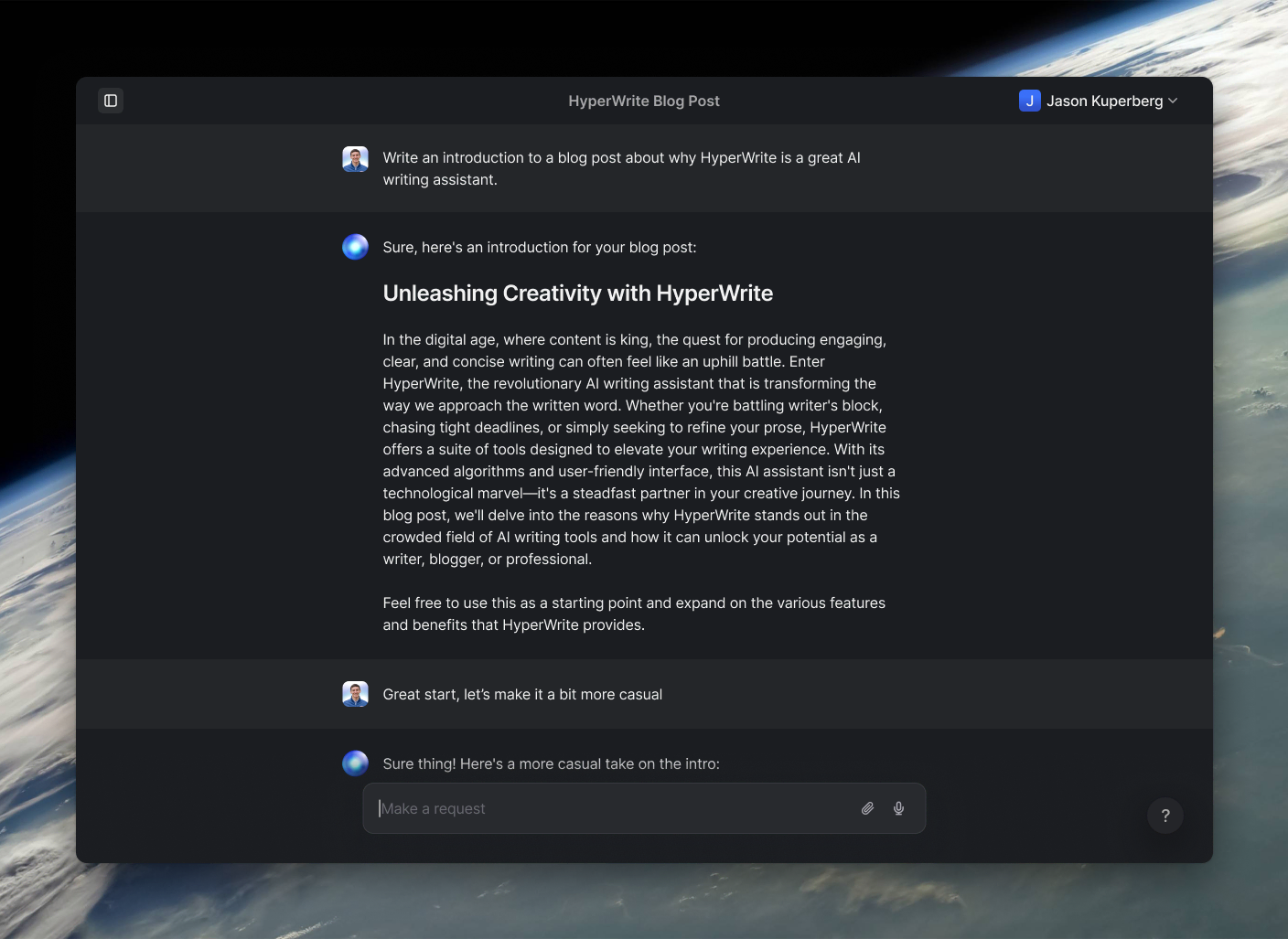
Powerful writing in seconds
Improve your existing writing or create high-quality content in seconds. From catchy headlines to persuasive emails, our tools are tailored to your unique needs.