


Outranking and Rytr both generate AI text, but they're built for opposite jobs. One engineers content to climb Google, and the other turns out fast, budget-friendly copy on demand. Pick the wrong one, and you either burn hours fixing weak articles or overpay for features you never touch.
Here's how their SEO depth, speed, and pricing really stack up, so you can match the tool to the work you do.
Outranking vs Rytr: What's the difference?
Outranking is a dedicated SEO content platform. It reads the SERP, builds optimized briefs, and guides you through writing long-form articles designed to rank on Google.
Rytr is a fast, budget short-form generator. You pick a use case and tone, and it produces ad copy, emails, and social posts in seconds, with light SEO features on the side.
Choose Outranking if your goal is organic traffic and you're writing long-form content built to rank.
Choose Rytr if you want quick, affordable short-form copy and don't need deep SEO.
Meet Outranking
Outranking is designed to create content that ranks. It scans the top-ranking pages for your keyword, turns that data into an optimized brief, and scores your draft in real time. The trade-off is a dense interface, a learning curve, and a price that climbs fast.
Meet Rytr
Rytr is built for speed. You pick one of 40-plus templates, set a tone, and it generates ads, captions, or emails in seconds, at a price that undercuts almost everything. Output turns repetitive on long pieces, though, and its SEO features stay basic.
Outranking vs Rytr: At a glance
Monthly pricing verified from each vendor's official pricing page as of March 2026.
Outranking vs Rytr: Feature-by-feature comparison
SEO and optimization
SEO is the whole reason to pick one of these over a general writer, and it's the widest gap between them.
Outranking:
- Real-time SEO scoring against the top 20 ranking pages, plus NLP topics, People Also Ask targeting, keyword gap analysis, and briefs built from live SERP data.
- The score updates while you write, so you can watch a draft climb toward the target as you add the terms and headings the top pages already cover, which strips most of the guesswork out of a piece.
Rytr:
- Generates SEO meta titles and suggests a handful of keywords.
- Those hints don’t come with a live score or SERP analysis, so you can't tell whether the finished article will rank until you run it through an alternate SEO tool.
Winner: Outranking. It was designed to rank content, while Rytr treats SEO as a small add-on.
Long-form content
Long articles are where AI writers tend to fall apart, so this round matters if blogging is the job.
Outranking:
- A guided workflow for long pieces, moving from title to meta to headings to full sections with optimization checks along the way.
- Because you build the article in stages instead of asking for it all at once, the structure holds across a couple of thousand words. It still needs an editing pass to sound human, but it stays on-topic.
Rytr:
- A "Continue Ryting" feature that extends a piece section by section.
- The writing starts repeating itself and drifting once you push past a few paragraphs, so a long article turns into a lot of cleanup. It's happier with short bursts.
Winner: Outranking. Carrying a full, coherent article is what it's built for.
Speed and ease of use
Not everyone wants a workflow to learn, and this is where the two feel most different day to day.
Outranking:
- A step-by-step process that walks you from keyword to finished draft.
- There's a real learning curve. The screen is busy, the steps take a while to internalize, and the interface feels dated for the price, so your first few articles run slower than you'd expect.
Rytr:
- Pick a template, set a tone, and generate content.
- That's the whole experience. You can sign up and have usable copy inside a few minutes, with nothing to configure first.
Winner: Rytr. It can move from blank page to draft fast.
Templates and versatility
This round comes down to whether you want depth in one area or range across many.
Outranking
- Centers on SEO content workflows rather than a wide template menu.
- It handles long-form SEO content thoroughly, but it's the wrong tool for a quick Instagram caption or a product description.
Rytr
- More than 40 use-case templates and 20-plus tones across ads, emails, social, and product descriptions.
- That range makes it a handy everyday utility for short marketing copy, and paid tiers let you build custom use cases for the formats you write most.
Winner: Rytr. The tool offers a variety of short-form formats that cover far more ground.
Integrations
Where your content goes after it's written decides how much this round matters.
Outranking
- Connects with Google Docs and WordPress.
- Those links fit an SEO publishing routine, so you can research, write, optimize, and push to your CMS without much copy-paste in between.
Rytr
- A Chrome extension and an API.
- There's no native WordPress or CMS integration, so most content is moved by copy-paste. That's fine for a quick social post, slower for a real publishing workflow.
Winner: Outranking. Its integrations align with how SEO content is published.
Pricing
Price is often the deciding factor here, and the two sit at very different points.
Outranking:
- Starts at $19/month (Starter, 4 SEO documents), rising to $79/month (SEO Writer, 15 documents) and $159/month (SEO Wizard, 30 documents), plus a custom plan for agencies.
- The tiers are capped by monthly SEO documents (4 on Starter, 15 on SEO Writer, 30 on SEO Wizard) so a heavy publishing month can push you to a higher plan than the entry price suggests.
Rytr:
- A free plan with 10,000 characters a month, Unlimited at $9/month (billed monthly), and Premium at $29/month (billed monthly).
- Even the paid tiers cost less than Outranking's entry plan, which is why solo writers and freelancers gravitate to it.
Winner: Rytr. It's a fraction of the cost, though the two are priced for different jobs.
What real users say
Outranking
Pros
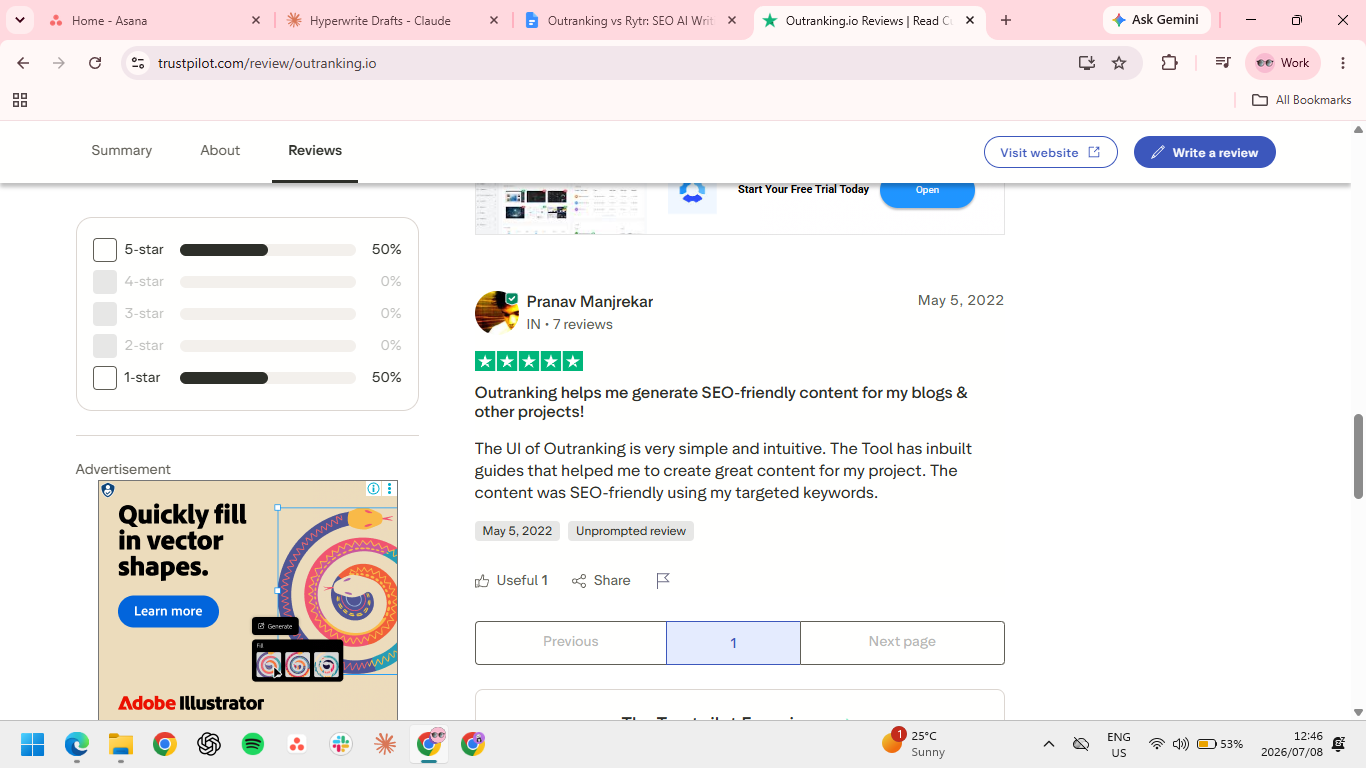
- Simple UI with helpful built-in guides. Pranav Manjrekar shares on Trustpilot that Outranking's interface is "simple and intuitive," with built-in guides that helped him create SEO-friendly content around his target keywords.
- Content optimization is easy. Marco C., a strategic designer, shares on Capterra that he just has to “input the URL, and you'll receive an actionable checklist of improvements.”
Cons

- Steep learning curve. Jesus G., an SEO specialist, notes on Capterra that Outranking "can be difficult to know where to start," and getting comfortable with every feature takes time with the tutorials.
- Struggles on niche topics and fact-checking. Gaia B., an SEO copywriter, notes on Capterra that Outranking's AI "is not factual" and can generate "random things about unrelated topics" when dealing with subjects that are niche or new.
Rytr
Pros

- Templates and options make drafting fast. Taylor A., a small-business CEO, shares on G2 that Rytr's templates are "already set to go" and you just “fill in the blanks with what you need.”
- Fast generation with tone control. Elly Otieno shares on Trustpilot that after a year with Rytr, it generates "emails and newsletters in seconds" and lets you switch the tone of your writing.
Cons

- Longer content gets generic and repetitive. Nichole M. notes on Trustpilot that some Rytr outputs "repeat phrasing or feel generic," especially on longer content, and wishes the trial period were longer.
- The usage cap. David L., a small-business co-founder, notes on G2 that Rytr's "usage cap could be more generous," calling it a bit light for higher-volume work.
How to make your choice
These two tools solve different problems, so the decision comes down to the job you're hiring for. Outranking wins for ranking-focused content operations. Rytr wins for fast, affordable short-form copy.
Outranking is better for:
- SEO specialists and content teams whose success is measured in rankings
- Writers producing long-form articles that have to compete on the SERP
- Anyone who wants SERP data, briefs, and real-time optimization in one workflow
- Publishing setups that lean on WordPress and Google Docs integrations
Rytr is better for:
- Solo writers and freelancers working on a budget
- Fast short-form copy like ads, social posts, and emails
- Anyone who wants a free tier to test before paying
- Writers who value speed and simplicity over deep SEO tooling
For heavier needs, it's also worth comparing Rytr alternatives.
The final verdict
Outranking and Rytr rarely compete for the same buyer. Outranking earns its price when content has to rank, and Rytr makes sense when you just need words on the page quickly and affordably. Match the tool to the job, and neither disappoints.
Where a voice-matched drafting tool fits
Outranking and Rytr both hand you a workspace to write inside. HyperWrite works the other way around. Its TypeAhead co-pilot draws on your other open tabs to suggest your next line right where you're writing.
Personas keep the output in your voice, and the AI Tools Library handles drafts, summaries, and rewrites. It won't score content against the SERP like Outranking or undercut Rytr on price. What it does is keep your voice intact across the everyday writing between the templates and the pipelines.
Tired of editing the robot out of every AI draft? Add TypeAhead to Chrome and see it draft in your voice.
Frequently asked questions
Is Outranking or Rytr better for SEO?
Outranking is better for SEO. It's a dedicated SEO content platform with real-time optimization scoring, SERP analysis, and content briefs built from ranking data. Rytr offers only basic SEO features like meta-title generation, so it's the weaker choice for content that needs to rank.
Can Rytr write long-form SEO content?
Yes, Rytr can write long-form content through its "Continue Ryting" feature, but quality drops past a few paragraphs, where output turns repetitive. For long-form content built to rank, a dedicated SEO platform like Outranking handles the job far better.
Which is easier to use, Outranking or Rytr?
Rytr is easier to use. You pick a template, set a tone, and generate copy within minutes, with almost no learning curve. Outranking is more powerful but denser, with a guided SEO workflow that takes time to learn.
Can I use Outranking and Rytr together?
Yes, you can use Outranking and Rytr together. A common setup is drafting fast short-form copy in Rytr, then running longer, ranking-focused articles through Outranking for SERP data and optimization. It's two subscriptions, though, so most people pick the one that matches their main job rather than paying for both.
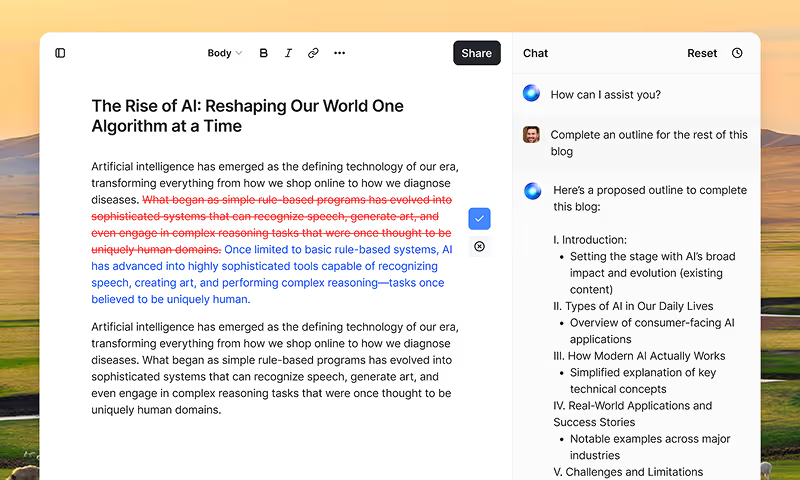
HyperWrite is the AI writing assistant that learns your style. It handles drafting, editing, and researching so you can focus on ideas.
- Autocompletes sentences as you type
- Works inside Google Docs & Gmail
- Adapts to your personal writing style
- 500+ AI tools for any writing task
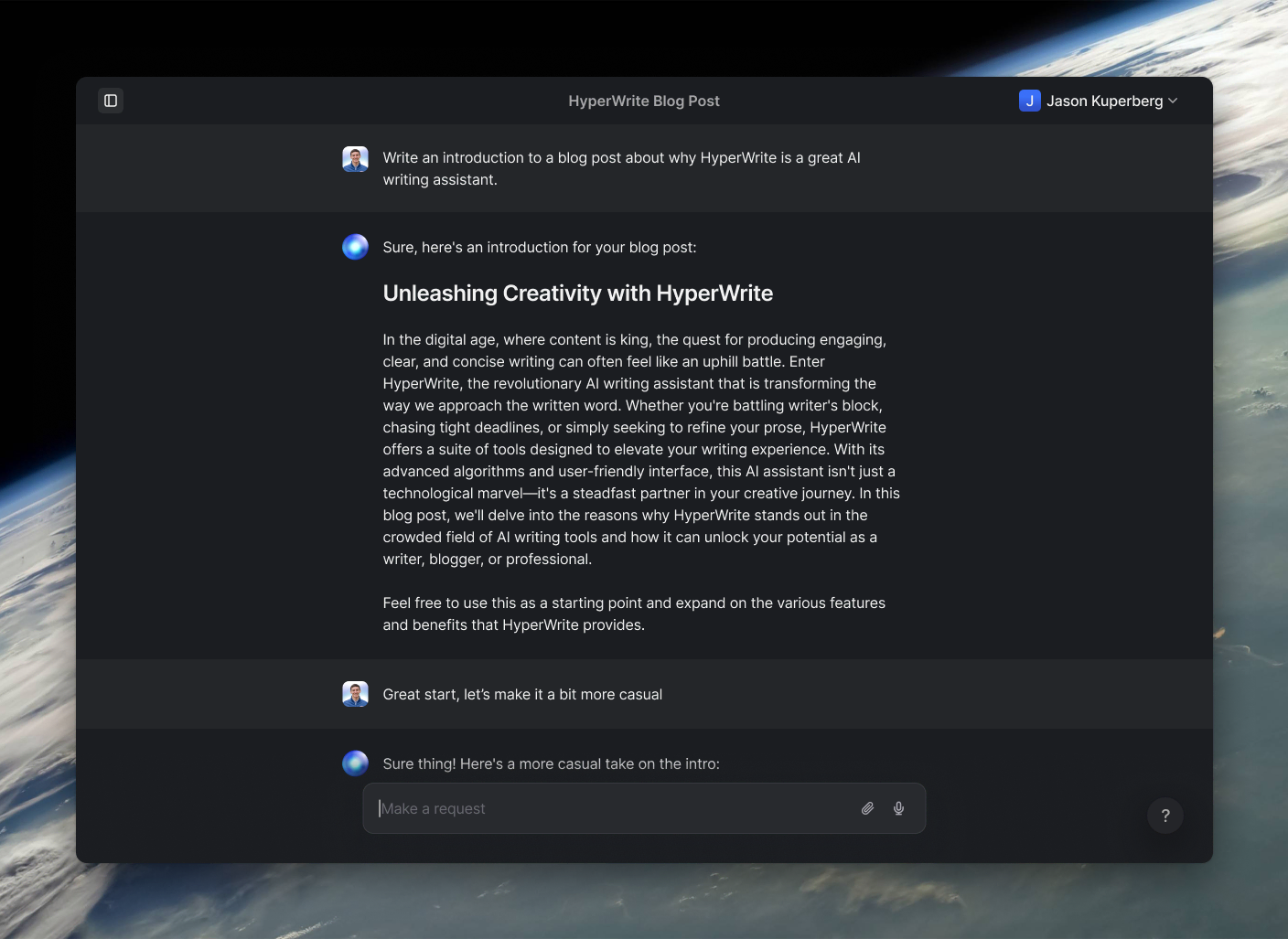
Powerful writing in seconds
Improve your existing writing or create high-quality content in seconds. From catchy headlines to persuasive emails, our tools are tailored to your unique needs.