


Learning how to write a Twitter thread (or an X thread as it's now called) comes down to one thing single posts never deal with: keeping someone reading across all of them. A thread re-earns attention at every post, and most lose people somewhere in the middle, where readers drop off and never come back.
Get the sequence right, and each post builds on the one before it. These six steps walk through building a thread that holds attention from the first post to the last, in the order you'd write it.
How threads earn reach on X
Before the steps, know what you're optimizing for. Threads tend to do well when they hold attention and keep earning engagement across every post, not just the first.
Two things are worth optimizing for:
- Dwell time: Every extra post someone reads is more time spent with your thread, and that's the behavior the format is built to earn.
- Engagement per post: Each post is a fresh shot at a like, reply, or bookmark, and they stack across the whole chain instead of resting on the first.
Both point to the same thing: a thread that keeps people moving to the end. That's why every step below comes back to retention.
How to write a Twitter thread in 6 Steps
Here's the process from blank page to published, six steps in the order you'd write them.
Step 1: Pick one idea and a format
A thread needs a single, clear idea, and one shape to deliver it. Trying to cram three topics into one thread splits attention and loses everyone. Pick the one thing you want the reader to walk away with, then choose the format that fits it:
- Step-by-step: walk through a process, one step per post.
- Listicle: a set of tips, tools, or examples, one per post.
- Story: a personal narrative with a lesson.
- Data breakdown: a surprising result and what it means.
The most shareable threads are the ones a reader can act on, so lean toward formats that hand over something usable.
Step 2: Write a hook that earns the tap
The first post is the only one everyone sees, so it carries the whole thread. It has to open a loop the reader needs closed. Four openers reliably do that:
- The number: "I analyzed 500 cold emails. The replies all shared five traits."
- The contrarian take: "Posting daily is the fastest way to kill your engagement."
- The story cliffhanger: "I lost my biggest client on a Friday. By Monday I'd rebuilt everything."
- The clear promise: "How to turn one blog post into a week of content, step by step."
Cut any throat-clearing. "Here's a thread about content marketing" wastes your most valuable post.
And keep links out of post one: X's former head of product Nikita Bier said that links aren't deboosted, but they still tend to earn less engagement, so let the hook earn the tap before you point anyone off-platform.
Step 3: Prove the payoff in post two
Your hook got them to tap. Post two has to show the thread is worth their time, or they leave. So don't waste it on a slow wind-up; state the problem you're solving or the promise you're keeping, and get into the substance.
Aim to make your first three posts strong enough to stand on their own. Most people won't read all the way to the end, so even a reader who stops early should come away with something useful.
Step 4: Build the body, one idea per post
The middle is where threads sag. The hook lands, the setup holds, and then posts five through 10 blur into a gray wall people scroll straight past. Holding the middle is what separates threads that spread from threads that stall.
- One idea per post. Each post carries a single complete point, a step, a lesson, a data point. If a post has two, split it.
- Vary the texture. Alternate a one-liner, a short list, a screenshot, a longer point, so the thread doesn't read as monotone.
- Plant a re-hook. Drop a curiosity line mid-thread that pulls the eye down: "But the third one is where most people go wrong." A small open loop resets attention deeper in.
Keep each post tight. The free limit is 280 characters, but leave headroom: aim for around 240. This gives you room for line breaks so nothing feels cramped on mobile.
Step 5: Add a visual to break the scroll
A thread of pure text wears out a reader's patience. A visual every few posts, like a chart, a screenshot, or a simple diagram, resets attention and gives the eye somewhere to land. Visuals earn their place twice.
They slow the scroll, and add proof. If you reference a result, a tool, or a number, showing it lands harder than describing it. Use one clean image to support a point.
Step 6: Close with one clear ask
If a reader reaches the last post, they've given you two minutes, and they're the ones most likely to act. Waste that with "hope this helped" and you get nothing back. Pick a single call to action.
One ask gets acted on. Save any link for this final post. Posts with links tend to draw weaker engagement than plain text, so let the thread earn its traction first, then hand off the click at the end.
- Weak: "Let me know what you think."
- Strong: "Which of these five do you already do? Reply with the number."
What high-performing threads actually do
The formulas above are the skeleton. Here's what they look like on threads that actually landed.
Listicle (milestone plus steps)
Few hooks are pure proof, but @thejustinwelsh’s $10M milestone thread is, and it's a clinic in the listicle format:
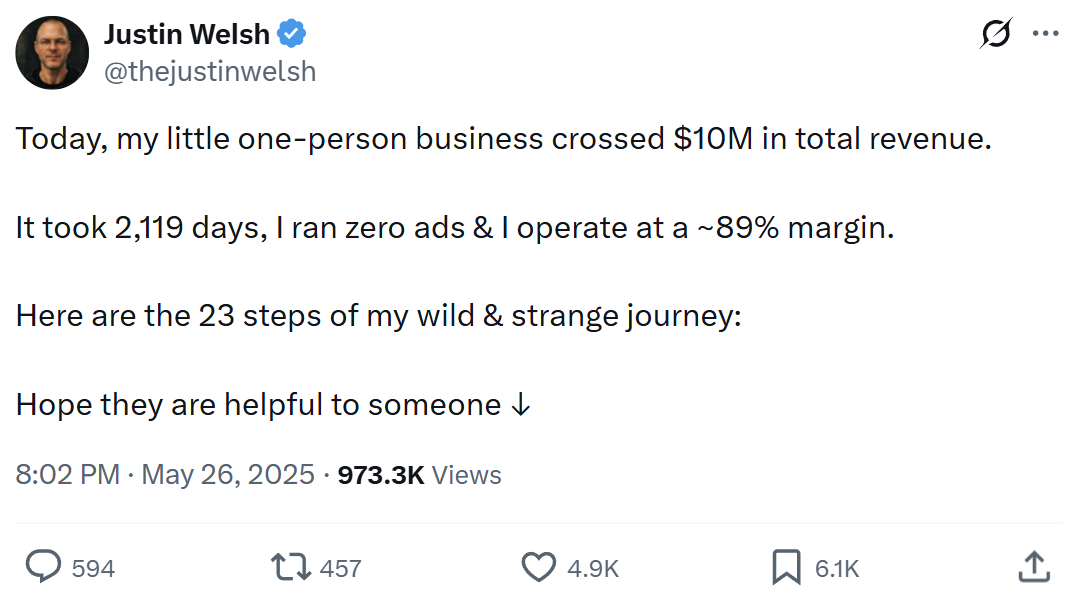
The hook: "Today, my little one-person business crossed $10M in total revenue. It took 2,119 days, I ran zero ads & I operate at a ~89% margin. Here are the 23 steps of my wild & strange journey."
This is the number opener from Step 2, stacked: $10M, 2,119 days, zero ads, 89% margin. The exact figures read as proof rather than boast, and "here are the 23 steps" opens a loop you have to tap to close.
How the middle holds: One step per post across 20+ posts, the listicle format doing exactly what Steps 1 and 4 describe. Each step stands alone as a takeaway, so a reader who stops partway still leaves with something.
The close: The value is the list itself, so the thread pays off on delivery instead of trailing off into "hope this helped."
Story (business origin)
You think diamonds have always been precious. @SahilBloom's De Beers breakdown spends almost 20 posts proving you wrong, and that's exactly why it works:

The hook: "De Beers literally created the global diamond industry… Here's a breakdown of the crazy story."
This is the contrarian take from Step 2. It cuts against something you've never questioned (that diamonds were always valuable) and the gap between what you assume and what he's claiming is the loop you have to tap to close.
How the middle holds: One beat of the story per post: diamonds were nearly worthless until an 1870 supply glut in South Africa threatened prices, so an 1888 Cecil Rhodes–led merger created the De Beers cartel to choke supply; then, to manufacture demand, De Beers hired an ad agency that coined "A Diamond Is Forever" in the late 1940s.
That reveal is the payoff, and it lands in the middle. The thread's center of gravity carries its own climax instead of coasting to the end.
Each post advances the story by exactly one move, the one-idea-per-post rule from Step 4, and an image on several posts does the scroll-breaking work from Step 5.
The close: Once the payoff lands, the final posts turn reflective: "maybe diamonds aren't forever after all?" then end on a single ask to follow and subscribe, with the newsletter link held to the last post.
Draft the whole thread before you post
Publishing straight from the composer is how the sagging middles slip through. You're writing post five with no view of the four above it. Write the thread somewhere you can read it top to bottom first, a doc or notes app, and fix the weak spots before any of it goes live.
Catching a sagging middle only after you've hit post? Draft the whole thread with HyperWrite's co-pilot running right in your browser. It reads your open tabs and, with Personas, writes in your voice instead of a template. Try TypeAhead free with the HyperWrite Chrome extension.
Frequently asked questions
How long should a Twitter thread be?
A Twitter thread should be only as long as the idea needs, usually five to 10 posts. Longer threads see higher drop-off, since every extra post is another point where readers can leave. Cover the idea fully, then stop rather than padding it to look substantial.
Why do people stop reading my thread halfway through?
People stop reading halfway through when the middle posts lose momentum. A sagging middle, dense same-length posts, or ideas that blur together all invite the scroll. Keep each post to one clear point, vary the format, and plant a curiosity line to pull readers deeper.
Should I put a link in my Twitter thread?
Yes, you should put a link in the final post. X's former head of product Nikita Bier said in 2025 that links aren't algorithmically deboosted, but link posts still tend to earn less engagement in practice, so leading with your hook and saving the link for the end lets the thread build traction before sending anyone off-platform.
Do Twitter threads get more engagement than single posts?
Yes, Twitter threads generally earn more engagement than single posts. A thread creates more dwell time and gives you multiple engagement opportunities across several posts instead of one. That stacking effect makes threads one of the strongest formats for reach, as long as the thread holds attention the whole way through.
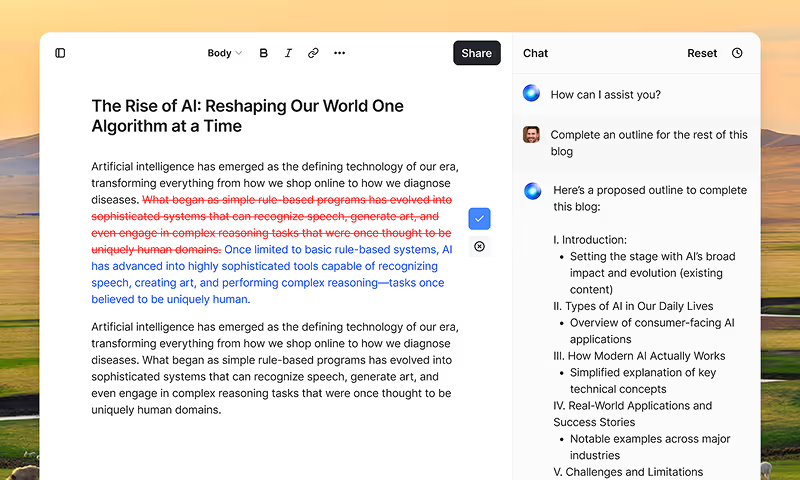
HyperWrite is the AI writing assistant that learns your style. It handles drafting, editing, and researching so you can focus on ideas.
- Autocompletes sentences as you type
- Works inside Google Docs & Gmail
- Adapts to your personal writing style
- 500+ AI tools for any writing task
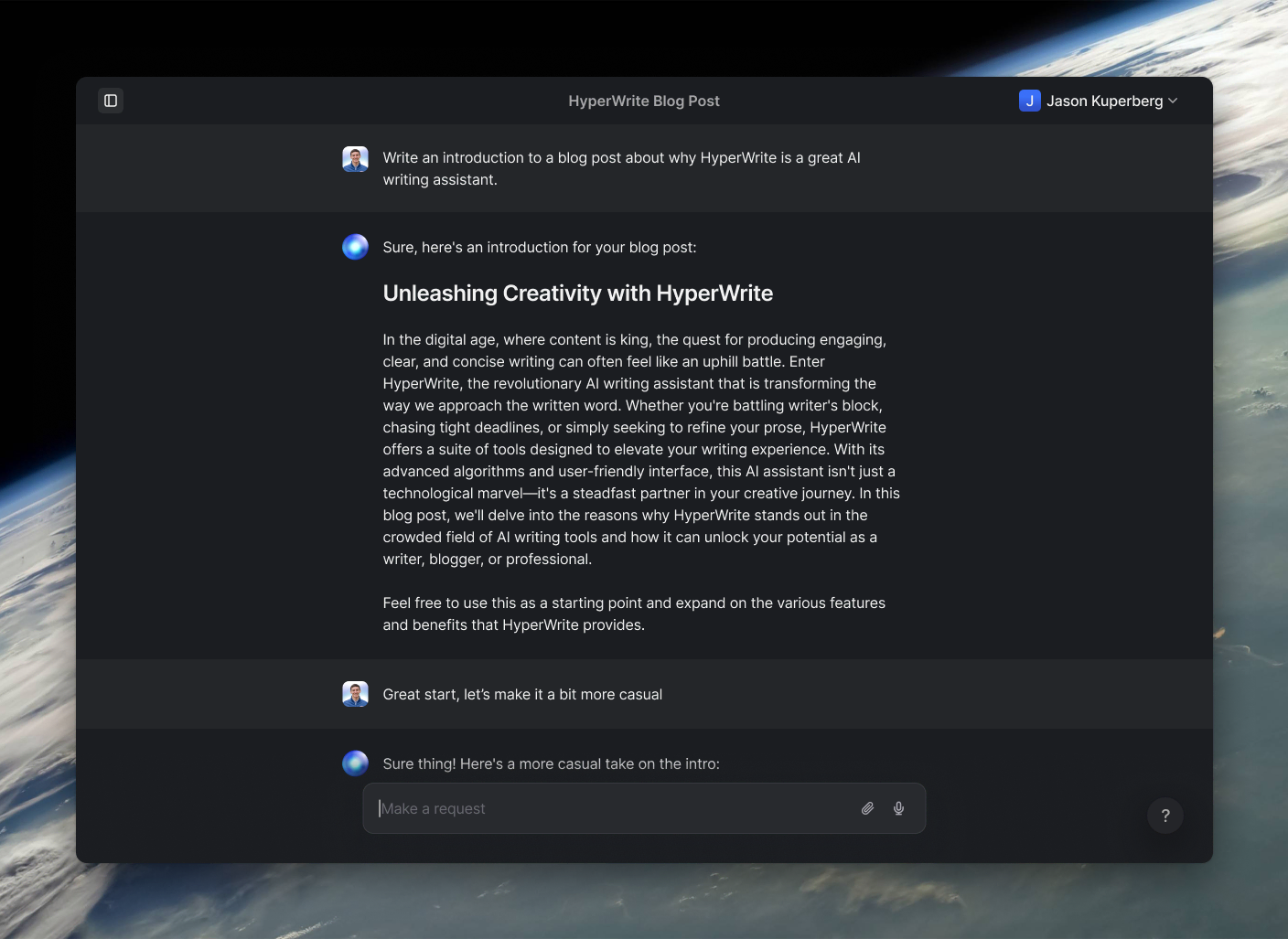
Powerful writing in seconds
Improve your existing writing or create high-quality content in seconds. From catchy headlines to persuasive emails, our tools are tailored to your unique needs.