


Halfway through a project, a client asks for "one more round" that nobody quoted, and the hours you counted as profit turn into unpaid work.
Knowing how to write a scope of work is what lets you point back to the page where that request was already settled, so the job stays on budget.
What is a scope of work?
A scope of work is a document that defines exactly what a project will deliver, who handles each part, and when it will be done. Often shortened to SOW, it sets the boundaries of a project in plain terms: the tasks included, the deliverables expected, the schedule, and the work that sits outside the agreement.
Both sides use it as the reference point they return to whenever a question or a change request comes up. A good SOW answers "what did we agree to?" before that question turns into a dispute.
What to include in a scope of work
A scope of work has a handful of standard sections. You can add or drop parts depending on the size of the job, but most SOWs cover these:
- Project overview: A short paragraph on why the project exists and what problem it solves. This gives everyone shared context before the details start.
- Objectives: The specific outcomes the project is meant to reach, stated plainly.
- Deliverables: The tangible things you'll hand over, such as a report, a website, a building phase, or a set of designs.
- Tasks: The work required to produce each deliverable, broken into pieces small enough to assign and track.
- Timeline and milestones: Start and end dates, plus the key checkpoints that mark clear progress.
- Roles and responsibilities: Who does what, who approves what, and who the main point of contact is on each side.
- Acceptance criteria: The standard each deliverable has to meet to count as finished.
- Assumptions and constraints: The conditions you're planning around (budget, access, tools) and the limits you have to work within.
- Exclusions: The work that is deliberately not part of this project. This section does more to prevent arguments than any other.
- Payment and reporting terms: What gets paid when, and how you'll report progress along the way.
How to write a scope of work in 7 steps
Here's the process in the order you'd write it, from a blank page to a document both sides can sign.
Step 1: Start with the goal
Write down what the project is supposed to achieve before you list a single task.
A goal like "cut checkout abandonment by 20%" shapes every decision that follows, and it keeps the SOW anchored to an outcome instead of a pile of activities.
If you can't state the goal in one sentence, the project isn't ready to scope yet.
Step 2: List the deliverables
Name the concrete things you'll hand over. Be specific: "five blog posts of 1,200 words each" is a deliverable, while "content support" is a future argument.
Each deliverable should be something the client can look at and confirm they received.
Step 3: Break each deliverable into tasks
Under every deliverable, list the work needed to produce it. This is where a project turns from an idea into a plan you can schedule and price.
Keep tasks small enough to hand to one person and check off. For a website deliverable, that might mean wireframes, copy, design, build, and testing as separate lines.
Step 4: Set the timeline and milestones
Add dates to the work. Map out a start date, an end date, and the milestones in between where something concrete is delivered or approved.
Milestones are more important than daily task dates, because they're the points where both sides stop and confirm the project is on track.
Step 5: Assign roles and responsibilities
Spell out who is responsible for each task and each approval. Name the person who signs off on deliverables, the one who supplies inputs, and the single point of contact on each side.
Gaps here are where work stalls, because everyone assumes someone else owns it.
Step 6: Define what "done" looks like
Write the acceptance criteria for each deliverable so completion isn't a matter of opinion.
Instead of "a good logo," specify "three concepts, two rounds of revisions, final files in SVG and PNG." Clear criteria protect you from endless revisions and protect the client from thin work.
Step 7: Write down what's excluded
State plainly what the project does not cover. If website copy is in scope but ongoing SEO is not, say so.
This is the single most skipped section and the best defense against scope creep, because it turns "I assumed that was included" into a conversation you already had in writing.
Scope of work templates
Use these as starting skeletons. Copy the one that fits your work, then fill the brackets with your project's details.
General project scope of work template
Project title: [Project name]
Prepared by: [Your name/company]
Client: [Client name]
Date: [Date]
1. Project overview: [Two or three sentences on why this project exists and what it will accomplish.]
2. Objectives
- [Objective 1]
- [Objective 2]
3. Deliverables
- [Deliverable 1 with a specific description]
- [Deliverable 2 with a specific description]
4. Tasks
- [Deliverable 1]: [tasks required]
- [Deliverable 2]: [tasks required]
5. Timeline and milestones
- Start date: [date]
- Completion: [date]
6. Roles and responsibilities
- Client point of contact: [name]
7. Acceptance criteria
- [Deliverable 1]: [what "done" means]
8. Assumptions and constraints
- [Assumption or limit]
9. Exclusions (out of scope)
- [Work that is not included]
10. Payment and reporting
- Payment terms: [amount and schedule]
- Reporting: [format and frequency]
Freelance and client services scope of work template
Freelancers and agencies feel scope creep hardest, so this version leans on exclusions and a clear revision policy. It works well attached to a freelance proposal or referenced inside a signed contract.
Client: [Client name]
Freelancer/agency: [Your name]
Project: [Short project name]
Scope summary: [One sentence on what you're delivering.]
Deliverables:
- [Deliverable, with quantity and format]
Revisions included: [e.g., two rounds per deliverable]
Timeline: [Start date, delivery dates, final date]
What's included: [Bulleted list of in-scope work]
What's not included: [Bulleted list of out-of-scope work and how extra work is quoted]
Payment: [Deposit, milestones, final payment]
Sign-off: [Space for both signatures and dates]
If you're sending this alongside a pitch, the same discipline applies to your freelance proposal.
Construction scope of work template
Construction SOWs run heavier on responsible parties, sequencing, and inspection points.
Project: [Project name and site address]
Owner/client: [Name]
Contractor: [Name]
Project background: [Site conditions and reason for the work.]
Work breakdown:
Milestones and inspections:
Materials and responsibilities: [Who supplies what.]
Acceptance criteria: [Standards and inspection method per deliverable.]
Exclusions: [Work outside this contract.]
Permits and constraints: [Regulatory limits and working hours.]
Common scope of work mistakes to avoid
A vague SOW invites scope creep. PMI's 2018 Pulse of the Profession found that 52% of projects experienced scope creep.
A tighter document is one of the cheapest ways to protect a budget. Watch for these traps:
- Vague deliverables: "Marketing support" means one thing to you and another to the client. Attach a number, a format, or an example to every deliverable.
- No exclusions: If you never write down what's out of scope, every assumption becomes a free request. The exclusions section is where you head that off.
- Fuzzy acceptance criteria: Without a definition of "done," revisions run forever. Set the standard and the number of revision rounds up front.
- Missing owners: A task with no named owner is a task nobody does. Assign every deliverable and every approval to a person.
- No change process: Projects do change. Add a line explaining how new requests get quoted and approved, so a change is a decision instead of an ambush.
Write your scope of work faster
Writing a SOW is mostly filling in the same sections, project after project, so the slow part is the prose: the overview, the assumptions, the plain-English descriptions of each deliverable.
That's the part a writing co-pilot can take off your plate.
HyperWrite's TypeAhead suggests your next line as you write in Google Docs or your project tool, so a few notes in the overview section turn into full sentences instead of a blank page.
Set up a Persona and those suggestions stay in your voice, so each new SOW reads like you wrote it rather than a generic template.
You still make the calls on tasks, dates, and terms. The tool clears the writing so you reach a reviewable draft sooner.
Staring at a blank overview section on every new project? Try TypeAhead free with the HyperWrite Chrome extension and turn your notes into a first draft you can edit.
Frequently asked questions
What is the difference between a scope of work and a statement of work?
The difference between a scope of work and a statement of work is scope: a statement of work is the full contract covering terms, pricing, and legal conditions, while a scope of work is the section within it detailing tasks, deliverables, and boundaries. Both are abbreviated SOW, and on smaller projects they're often combined into one document.
How long should a scope of work be?
A scope of work should be as long as the project needs and no longer. A simple freelance job might fit on a single page, while a construction or software project can run many pages with tables for tasks, milestones, and responsibilities. Cover every deliverable and exclusion clearly, then stop, since padding adds confusion rather than protection.
Who writes the scope of work?
The scope of work is usually written by the party delivering the work, such as the vendor, contractor, agency, or project manager. The client then reviews and approves it. Writing it yourself is an advantage, because it lets you set clear boundaries and define what falls outside the job before work begins.
What is the difference between a scope of work and project scope?
Project scope is the overall definition of everything a project includes, while a scope of work is the document that records that definition in a shareable, signable form. Think of project scope as the decision and the scope of work as where that decision is written down for everyone to follow.
Can you use AI to write a scope of work?
Yes, you can use AI to draft a scope of work, as long as the details stay yours. AI is useful for turning your notes into full sentences for sections like the overview, objectives, and assumptions, which speeds up the blank-page stage. The deliverables, dates, pricing, and exclusions still need your judgment.
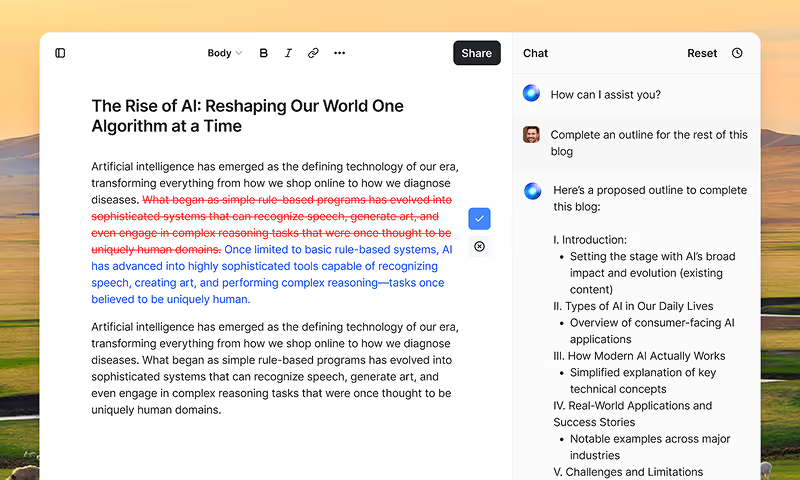
HyperWrite is the AI writing assistant that learns your style. It handles drafting, editing, and researching so you can focus on ideas.
- Autocompletes sentences as you type
- Works inside Google Docs & Gmail
- Adapts to your personal writing style
- 500+ AI tools for any writing task
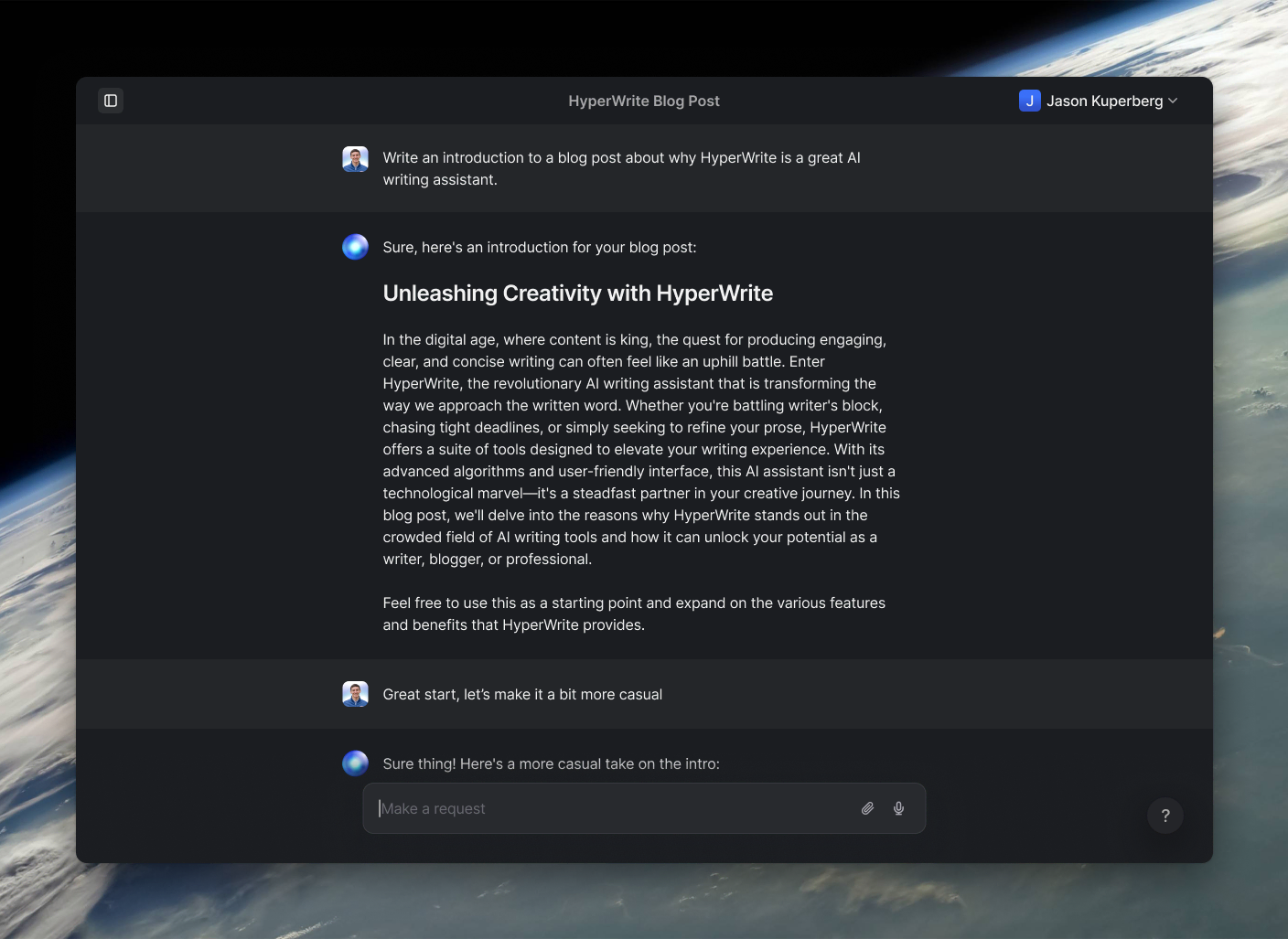
Powerful writing in seconds
Improve your existing writing or create high-quality content in seconds. From catchy headlines to persuasive emails, our tools are tailored to your unique needs.