
Freelance Proposal Template: What to Include + How to Write It


After reviewing hundreds of winning and ghosted proposals across design, writing, and consulting, the differences come down to the same variables, all of which are built into the freelance proposal template below.
Who this template is for
This template works for freelancers and small agencies sending proposals in the $2,000 to $25,000 range. It covers the seven sections every proposal needs to close a deal: the client's problem, the deliverables, the timeline, the price, your relevant experience, and a clear next step.
Freelance proposal template
Copy the template, fill in the bracketed sections, and delete the instruction text as you go:
Proposal: [Project Name]
For [Client Name], [Company] From [Your Name] [Date]. Valid through [Date 30 days out].
Your challenge
[1–2 sentences in the client's own words about the problem you discussed on the call. Avoid translating into industry jargon they didn't use.]
What I'll deliver
Phase 1: [Concrete deliverable tied to an outcome]
Phase 2: [Concrete deliverable tied to an outcome]
Phase 3: [Concrete deliverable tied to an outcome]
Included in scope:
- [Exact files, documents, or assets]
- [Number of revision rounds included]
- [Format and delivery method]
Timeline
Week 1: [What happens]
Weeks 2–3: [What happens]
Week 4: [What happens]
Total project length: [X weeks from kickoff]
Investment
$[Amount] for the full scope above.
Payment terms: [50% on signing, 50% on delivery / Net 14 / etc.]
Why me for this
[2–3 sentences. One credential or past project that maps directly to this client's situation. Skip the marketing copy.]
Next steps
- Reply to this email to accept, or send changes by [date].
- I'll get the contract over the same day.
- We'll pick a kickoff time from there.
Questions? Reply to this email or call [number].
A filled-in example you can model from
Here's the template above with real content, written for a mid-sized brand identity project.
Notice what this version does that most proposals skip: it recaps the client's situation in their own words, names specific outcomes per phase, and ends with a sequenced next step rather than "let me know what you think."
Proposal: Northwind Brand Identity Refresh
For Sarah Chen, Northwind Foods, From Alex Rivera, March 4, 2026. Valid through April 3, 2026.
Your challenge
You're updating Northwind's brand identity because your current logo was designed when the company sold one product to one regional market. Now you're in five categories and 12 states, and the existing mark is creating confusion at retail.
The refreshed identity needs to scale across packaging, digital, and trade marketing without losing the home-kitchen warmth your customers recognize.
What I'll deliver
Phase 1: Discovery and audit (Week 1). Competitor positioning review, retail shelf audit, and two stakeholder interviews with your team. Outcome: a one-page strategic brief you'll sign off on before design starts.
Phase 2: Identity design (Weeks 2–4). Three distinct logo directions presented at the end of Week 2, followed by two rounds of revision on the chosen direction. Outcome: final primary logo, secondary mark, and submark.
Phase 3: Brand system (Weeks 5–6). Color palette, typography system, and brand usage guidelines. Outcome: a 12-page brand book your team can hand to any vendor.
Included in scope:
- Logo files (AI, SVG, PNG, EPS) in three colorways
- Brand book PDF
- Color codes in HEX, RGB, CMYK, and Pantone
- Two rounds of revision included in Phase 2
Timeline
Week 1: Discovery and strategic brief
Weeks 2–4: Logo design and revisions
Weeks 5–6: Brand system development
Final delivery: April 18, 2026
Investment
$14,500 for the full scope above.
Payment terms: 50% on signing ($7,250), 50% on final delivery. Wire or ACH preferred.
Why me for this
I've led brand identity for two CPG brands in your budget, both of which expanded to new categories within 18 months of the refresh. Most recently with Ember & Oak (similar size to Northwind), where the rebrand supported a successful Whole Foods category expansion.
Next steps
- Reply to this email to accept, or send changes by June 18.
- I'll get the contract over the same day.
- We'll pick a kickoff time from there.
Questions? Reply to this email or call (415) 555-0142.
What each section actually does
- Your challenge: Shows the client you were listening. Mirroring their language back signals you understood the problem, which is the fastest way to build trust before they've seen a single deliverable.
- What I'll deliver: Eliminates the ambiguity that causes scope creep. When deliverables are phase-by-phase with outcomes attached, the client is buying a result.
- Timeline: Gives the client something to plan around. Proposals without a timeline stall because the client can't commit to something they can't schedule.
- Investment: Answers the only question most clients are actually asking. Putting the number on the page signals confidence; hiding it signals the opposite.
- Why me for this: Converts credibility from implied to concrete. One relevant past project does more work here than three paragraphs of general experience.
- Next steps: Removes the decision paralysis of "what do I do now." A sequenced next step tells the client exactly what happens when they say yes, which makes saying yes easier.
Three format variations by project type
The template above is the structured-proposal version. Two other formats work better in specific scenarios.
The one-page email proposal
For projects under $5,000 or quick turnarounds, a multi-section PDF feels overengineered. Compress the template into a 200-word email:
Subject: Northwind Identity Refresh Proposal
Hi Sarah,
Here's the proposal we discussed on Wednesday.
Your challenge
[1 sentence recap]
What you’ll get
- [Deliverable 1]
- [Deliverable 2]
- [Deliverable 3]
Timeline: [X weeks from kickoff]
Investment: $[X], 50% upfront
About me: [1 sentence credential relevant to this project]
If you're ready to go, just reply and I'll send the contract.
Happy to adjust scope or timeline before we move ahead.
Alex
The structured PDF proposal
The template at the top of this article is your structured-proposal format. Use it for projects from $5,000 to $25,000, or any time the client asks for a formal proposal.
Most freelancers build this in Google Docs: one section per heading, clean formatting, exported as a PDF before sending. If you send more than a few proposals a month, dedicated tools like Better Proposals, PandaDoc, or Bonsai give you a polished layout without manual formatting, plus open-tracking so you know when the client has read it.
Either way, don't send the PDF as a bare attachment. Paste the client's situation and your next steps into the email body. The client should be able to grasp the scope and take action without opening the file.
The pitch-deck proposal
For projects above $25,000 or competitive bids against agencies, clients often expect a slide-based presentation rather than a document. The content is the same: situation, approach, timeline, investment, case studies, and team. Just one slide per section, built in Google Slides or Canva.
Most freelancers present it live on a call first, then follow up with a PDF version that the client can share internally.
If a client hasn't asked for this format, the structured PDF closes more deals at this price point anyway.
How the template adapts by service type
The structure stays the same across service categories, but a few sections need adjustment depending on the work:
- For designers (graphic, brand, product, web): Specify deliverable file formats and exact revision round limits in the deliverables section. Designers see the most scope creep, and a clear "2 rounds of revision included; additional rounds at $X/hour" line in the proposal heads off most of it. Link a relevant portfolio piece in About Me.
- For writers: Make word counts and deadlines specific. "5 articles, 1,500 to 2,000 words each, delivered weekly over 5 weeks" beats "ongoing content support." Include one or two published samples in About Me, linked rather than attached.
- For developers: Specify the tech stack, define what "done" means, and call out the post-launch support window separately. A line like "Site delivered on staging. 30 days of bug fixes included post-launch. Ongoing maintenance at $X/month" tells the client exactly where your responsibility ends.
- For consultants and strategists: Deliverables tend to be artifacts (a strategic brief, a framework, a workshop) rather than products. Frame milestones around discovery, synthesis, and recommendation phases. Reference a relevant past engagement in About Me with the specific outcome it produced.
Why most freelance proposals get ghosted
A few patterns reliably kill proposals before they can close:
- Leading with yourself. "About me" first signals you're selling a product. The client's situation goes first, every time.
- Vague deliverables. "Help with branding" leaves the client guessing about scope. Specifics like "final primary logo, secondary mark, submark, plus a 12-page brand book" eliminate that guesswork and make the project easier to say yes to.
- No price on the page. "Let's discuss pricing" reads as either insecurity or a sales trap. Put the number where the client can see it.
- No timeline. Clients can't commit to a project they can't schedule. Give specific weeks.
- Generic next step. "Let me know what you think" is the proposal equivalent of "Thoughts?" Sequence the next steps so the client knows exactly what happens when they say yes.
- Length mismatch. Proposal length should track project size. A six-page proposal for a $2,000 project looks overengineered; a two-paragraph email for a $40,000 engagement looks careless.
After you hit send
The follow-up is where most freelance deals close, but most proposal advice doesn't cover what to do after you send the document.
The 24-hour window
Send the proposal within 24 hours of the discovery call, while the conversation is still fresh. Better Proposals' analysis of $120M in closed deals found that proposals sent within 24 hours converted 25.9% better and were signed in 6 days on average, compared to 10 days when sent after 48 hours.
The conversation cools fast, and the client has more time to talk to other freelancers.
The cover note
Don't send the proposal as a bare attachment. The email body should recap the situation in one sentence and give the next step (open the PDF, reply with questions, or sign here).
Sample:
Subject: Northwind Brand Refresh: Proposal Attached
Hi Sarah,
Attached is the proposal for the Northwind identity refresh we discussed Wednesday. The short version: 6-week scope, $14,500, three phases starting with a strategic brief you'll sign off on before design begins.
Open the PDF for the full breakdown. Reply with any changes, or sign at the bottom of page 4 if it's ready as-is.
Alex
The first follow-up
If you don't hear back within three business days, send a short follow-up that adds value rather than asking for an update: a relevant case study, a quick clarifying note about the timeline, or a small refinement to the scope.
Sample:
Subject: Re: Northwind Brand Refresh: Proposal Attached
Hi Sarah,
Quick add-on to the proposal I sent Monday. I pulled the Ember & Oak case study I mentioned on our call: the rebrand timeline and Whole Foods expansion outcomes are close to what we're talking about for Northwind. Linked here: [link].
I can move the brand book delivery up by a week if it would help your trade marketing team. Happy to adjust if useful.
Alex
The close-the-loop message
After two follow-ups with no response, send one final message making it easy for the client to say "not now" without feeling awkward. This often unsticks deals that would otherwise sit forever, and it preserves the relationship for future work.
Sample:
Subject: Re: Northwind Brand Refresh: Proposal Attached
Hi Sarah,
Following up one last time on the Northwind proposal. If the timing isn't right or priorities have shifted, just let me know and I'll get out of your inbox.
If it's still on the table and you need more time or a different scope, let me know what would make it easier to move forward.
Alex
Customize this template for every client without starting over
Most freelancers struggle to balance two opposing pressures: making each proposal feel custom enough that it doesn't read as generic, while keeping enough consistency in voice and structure that proposals don't take all weekend to write.
HyperWrite's Personas trained on your strongest past proposals keeps your professional voice steady across new ones. TypeAhead works across every tab in your browser, so whether you're drafting in Google Docs, filling out a proposal tool, or writing directly in Gmail, it's reading your open tabs and suggesting completions in your voice as you type.
Spending more time customizing proposals than writing them? Install the TypeAhead Chrome extension and see how it handles the fill-in as you type.
Frequently asked questions
What should be included in a freelance proposal?
A freelance proposal should include seven sections: the project name and dates, a recap of the client's situation, specific deliverables, a timeline, the price and payment terms, a short relevant bio, and a sequenced next step. Each section should be specific enough that the client can act without follow-up questions.
How do I write a freelance proposal that wins?
You write a freelance proposal that wins by recapping the client's situation in their own words, naming concrete deliverables tied to outcomes, giving a clear price and timeline, and ending with a sequenced next step. The strongest proposals also get sent within 24 hours of the discovery call, while the conversation is still fresh.
Should a freelance proposal include pricing?
Yes, a freelance proposal should include pricing on the page. Proposals without a number close at a lower rate than proposals with the price clearly stated, because they read as either insecure or as a thinly veiled request for a sales call.
What's the difference between a freelance proposal and a contract?
The main difference between a freelance proposal and a contract is that the proposal is a pre-sale document outlining scope, timeline, and price for the client to approve. The contract is a legally binding agreement that formalizes the engagement once the proposal is accepted.
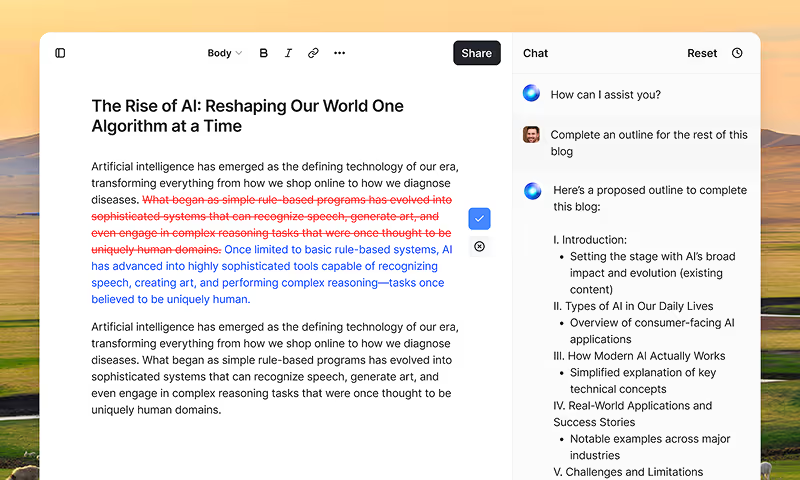
HyperWrite is the AI writing assistant that learns your style. It handles drafting, editing, and researching so you can focus on ideas.
- Autocompletes sentences as you type
- Works inside Google Docs & Gmail
- Adapts to your personal writing style
- 500+ AI tools for any writing task
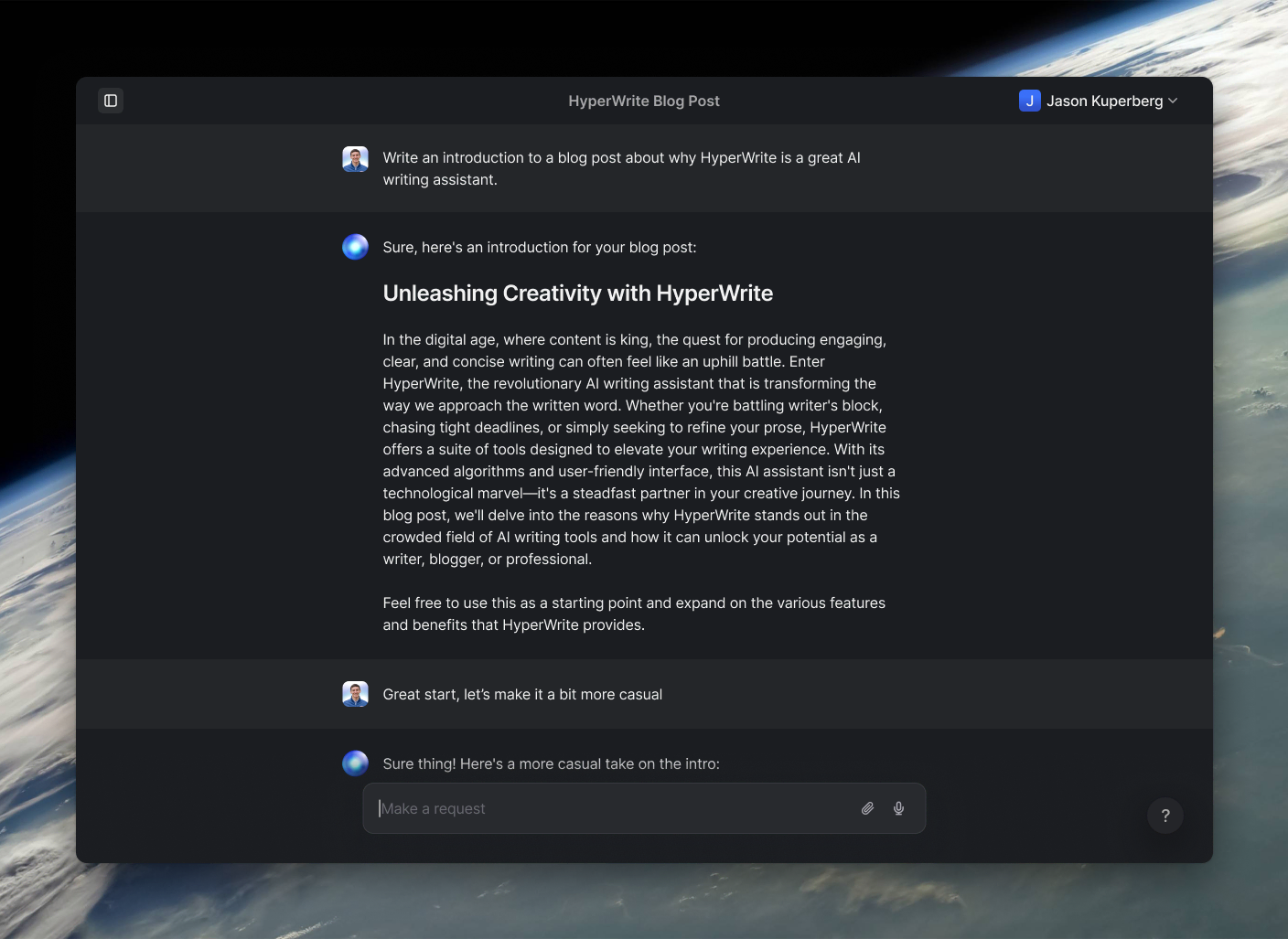
Powerful writing in seconds
Improve your existing writing or create high-quality content in seconds. From catchy headlines to persuasive emails, our tools are tailored to your unique needs.