


Investors spend under three minutes on the average pitch deck. In that window, how you write the deck can matter as much as what you're building. This guide walks through the 11 core slides one by one, with real examples from funded startups and the mistakes to avoid.
What is a pitch deck?
A pitch deck is a short presentation, usually 10 to 12 slides, that a founder uses to raise money from investors. It moves through the problem, the solution, the market, the team, and the ask, giving an investor everything they need to decide whether to fund you. The best decks read like a story with data behind it.
How to write a pitch deck, slide by slide
A funding deck follows a proven order, and each slide has one job. The 11 core slides below are the backbone of the usual pitch deck, so here's what belongs on each one and how to make it work.
1. Cover
Your company name, logo, and a one-line description of what you do, in plain words.
This is the first thing an investor reads, so it has to register in a second, like: "We help small businesses cut logistics costs 30% with AI routing."
Skip the clever tagline and the buzzwords, and if you're raising a specific round, you can note it here. The test is whether a stranger could repeat your one-liner after reading it once.
2. Problem
The specific pain you solve and exactly who feels it.
Name the person or business stuck with it, then show what it costs them in time, money, or missed revenue.
A problem an investor already recognizes is far stronger than one you have to argue into existence. Keep it to two or three clear points, and resist inflating a minor annoyance into a crisis.
3. Solution
How you solve that problem, stated plainly and tied straight back to the pain on the previous slide. Lead with the outcome your customer gets, then add one line on how you deliver it.
Save the technical depth for later conversations, since investors care first that the problem goes away. If you can capture the solution in a single sentence, you understand it well enough to sell it.
4. Market size
How big the opportunity is, sized in three layers: your total addressable market (TAM) is the whole prize, your serviceable market (SAM) is the slice you can realistically reach, and your obtainable market (SOM) is what you can win in the near term.
Build these bottom-up from real pricing and customer counts. "We only need 1% of a huge market" reads as lazy. Investors back markets large enough to return their whole fund, so show the size and why it's growing.
5. Product
How it works, shown more than described. A few screenshots, a short demo video, or a product clip proves it exists and works today, which hits harder than any feature list.
Walk through the one workflow that delivers your core value, and leave the edge cases out. If the product is early, show what you have and be clear about what's still to come.
6. Traction
The proof that it's working, whether that's revenue, active users, growth rate, retention, or signed customers.
Lead with your single strongest number and show the trend behind it, since a line climbing over time beats a static figure.
Named customer logos, letters of intent, or a waitlist all count when revenue is still thin. This is the slide that turns polite interest into real conviction, so put your best evidence up front.
7. Business model
How you make money, with your pricing and the unit economics underneath it.
Spell out what you charge, how customers pay, whether by subscription, transaction fee, or usage, and the margin on each sale.
If you have them, include the figures investors look for, like customer acquisition cost against lifetime value. The aim is to show that each new customer adds more profit than it costs, so growth strengthens the model instead of straining it.
8. Competition
Who you're up against and why you come out ahead.
Name real competitors, including the spreadsheet or manual workaround customers use today, since claiming you have none signals you haven't looked.
Show your edge in a simple side-by-side, and make clear why it's hard to copy, whether that's technology, proprietary data, network effects, or speed. Investors want to see that you understand the market you're entering with clear eyes.
9. Team
Who you are and why you're the ones to build this.
Investors tend to spend more time on the team slide than almost any other, so lead with the experience that maps directly to the problem you're solving.
Include founders plus any key hires or advisors, with a short line on the relevant win each person brings. Founder-market fit, the sense that you were built to solve this exact problem, often tips an early-stage decision.
10. Financials
A three-year projection with the key assumptions written next to it.
Show revenue, your main costs, and the drivers behind the growth, so an investor sees how the model works rather than just a rising line.
Investors pass on hockey-stick charts they don't believe faster than modest ones they do. Tie the numbers back to your traction so the forecast feels earned.
11. The ask
How much you're raising, what it buys, and the milestones it gets you to.
Break down the use of funds across hiring, product, and go-to-market, name the runway it gives you, and state the specific goals you'll hit before the next round.
End on exactly what you want, whether that's a meeting, a term sheet, or an intro, so the investor knows the next step. A clear ask is far easier to say yes to than a vague one.
A deck often travels with a written pitch behind it, so if you need one, it's worth learning how to write a compelling proposal to back yours up.
Real pitch decks that raised funding
All these early decks became ones founders still study, and each won on clarity in a different way.
- Airbnb (2008 seed): It made a single argument per slide, never more than three bullets, and defined a new market in plain language, which is why founders still copy it.
- Uber (UberCab): The first UberCab deck built its market case from the ground up, sizing taxi and limo spend and the breakdown of addressable trips an investor could check, with no filler slides.
- LinkedIn (Series B): Reid Hoffman has said the one thing his 2004 deck got wrong was omitting its risks, so he now urges founders to name their biggest risk factors and how they'll handle them before an investor even asks.
Tips to write a pitch deck that wins funding
A few habits separate a deck that raises from one that stalls.
- Write for a skim. DocSend’s data shows investors now spend only about two and a half minutes on the average deck, down from the 3 minutes 44 seconds its 2015 study first reported, so every slide has to work in seconds. One idea per slide, headline first.
- Follow the 10/20/30 rule. Guy Kawasaki's guideline is 10 slides, 20 minutes, and a 30-point minimum font, which forces you to cut everything that isn't essential.
- Tell a story. String the slides into a narrative that moves from problem to solution to proof, so the deck builds instead of listing facts.
- Lead with your strongest number. If you have traction, pull it forward, because early, specific proof reframes everything after it.
- Cut the jargon. If a slide needs explaining out loud, rewrite it. The deck should stand on its own when it's forwarded without you in the room.
Want to sharpen the writing on every slide? Our professional writing tips cover the plain-language habits that tighten every line.
Mistakes to avoid when writing your pitch deck
Most decks stall for the same few reasons. Check for these before you send.
- Claiming you have no competition. It signals you haven't looked. Name the real alternatives, including the spreadsheet or manual workaround customers use today.
- Inflating the problem. Investors spot a minor annoyance dressed up as a crisis. Keep it specific and real.
- Sizing the market top-down. "We only need 1% of a huge market" reads as lazy. Build TAM, SAM, and SOM bottom-up from real pricing and customer counts.
- Overloading the solution with tech. Lead with the outcome the customer gets and save the architecture for later conversations.
- Fantasy financials. Hockey-stick charts investors don't believe cost you credibility faster than modest ones they do.
- A vague ask. Close on exactly how much you're raising, what it buys, and the milestones it funds.
Write your next pitch deck with HyperWrite
The hardest part of writing a pitch deck is often describing your own company simply. You're so deep in the product that the jargon feels normal, and the plain, 10-word version feels out of reach, even though that's the version an investor needs.
HyperWrite helps you find that plain version.
AutoWrite drafts each slide's copy from your notes, so you have an outsider's first pass to react to. As you refine, TypeAhead suggests the next line in context so you're never stuck on a blank slide, and the AI Text Editor tightens each line until it's clear and skimmable. Personas match your voice, so the wording still sounds like you.
You know the company cold; HyperWrite just helps you say it simply.
Still staring at a blank slide, unsure how to describe your company in 10 plain words? Try TypeAhead free with the HyperWrite Chrome extension and get context-aware suggestions that finish each line in your own voice.
Frequently asked questions
How many slides should a pitch deck have?
A pitch deck should have about 10 to 12 slides. That's enough to cover the problem, solution, market, traction, team, and ask without losing an investor who spends only a few minutes reading. Trim anything a slide doesn't need.
What should be on the first slide of a pitch deck?
The first slide should show your company name and a one-line description of what you do, in plain language. Investors size up a company in seconds, so the opener has to work immediately, clear enough that someone outside your industry gets it on the first read.
How long should a pitch deck be?
A pitch deck should be short enough to read in about three minutes, since that's roughly all the time an investor gives it. Keep each slide to one idea and write for a skim rather than a deep read.
Can you use AI to write a pitch deck?
Yes, you can use AI to write a pitch deck, as long as the numbers and story stay yours. AI is useful for drafting the copy on each slide and tightening it into clear, skimmable lines. The traction, financials, and vision still have to come from you.
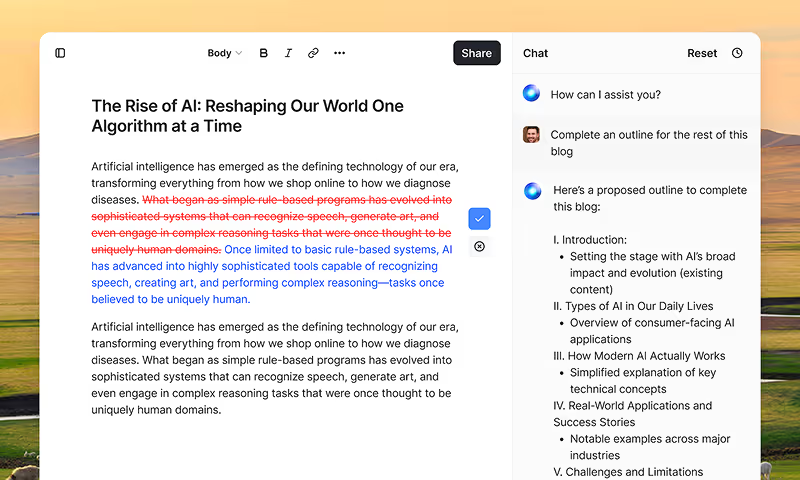
HyperWrite is the AI writing assistant that learns your style. It handles drafting, editing, and researching so you can focus on ideas.
- Autocompletes sentences as you type
- Works inside Google Docs & Gmail
- Adapts to your personal writing style
- 500+ AI tools for any writing task
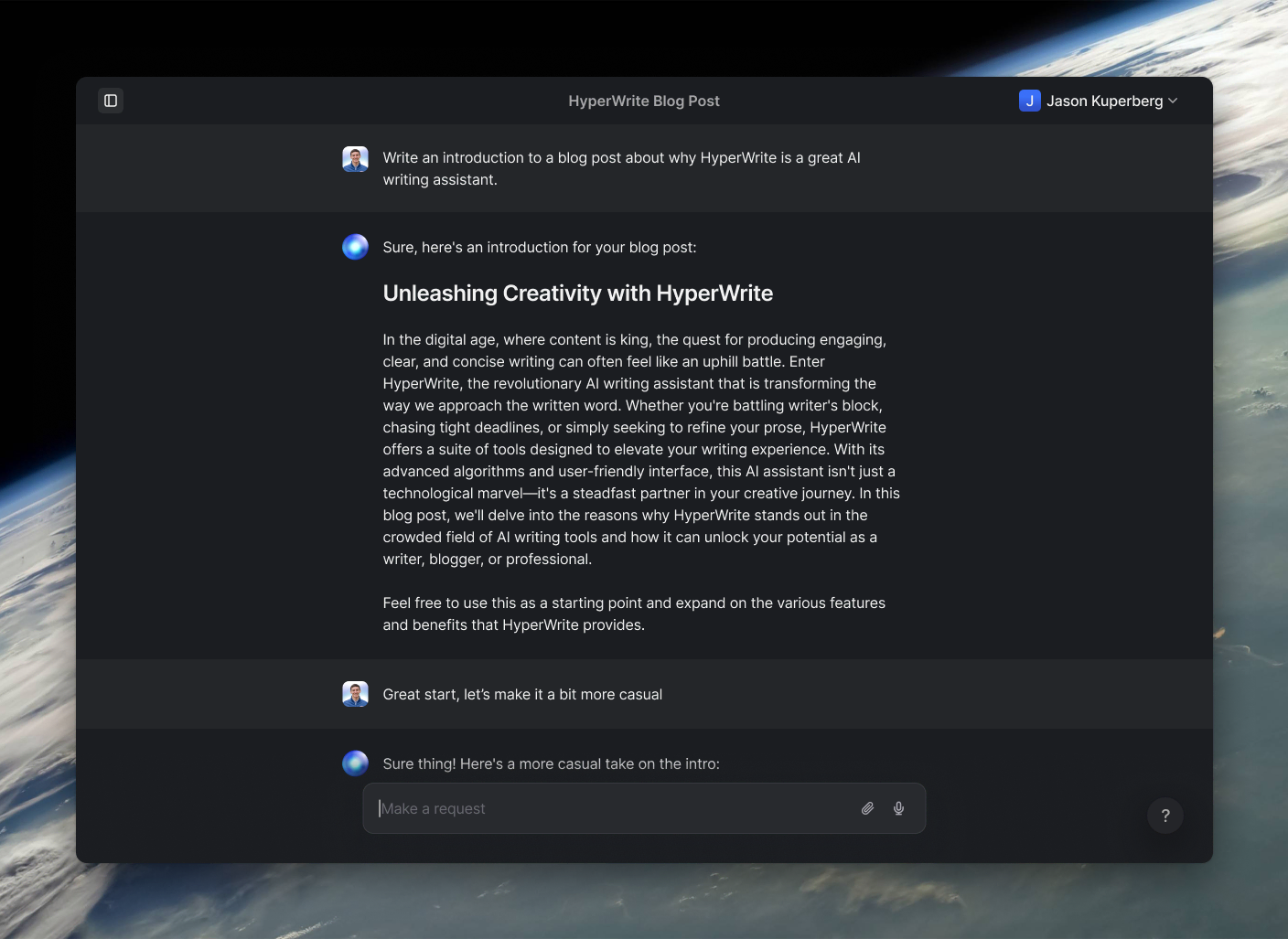
Powerful writing in seconds
Improve your existing writing or create high-quality content in seconds. From catchy headlines to persuasive emails, our tools are tailored to your unique needs.