


Writing a company bio is harder than it looks. You know your business inside and out, which makes it surprisingly tough to explain it clearly to someone hearing about you for the first time. Before long, two short paragraphs turn into a wall of buzzwords that could fit almost any company.
The good news is that a bio isn't a writing contest; it comes down to a simple order. This guide walks you through how to write a company bio, with a fill-in template, original examples, and the mistakes most bios make.
What to include in a company bio
A strong company bio answers a few questions fast, before the reader loses interest. Cover these six things, and you have everything you need.
- What you do: one plain sentence a stranger would understand on the first read.
- Who you help: the specific people you serve and the problem you solve for them.
- Why you exist: the founding reason, mission, or belief behind the company.
- What sets you apart: your edge, described in concrete terms rather than adjectives.
- Proof: numbers, clients, results, or awards that show you deliver.
- A next step: where to go or what to do after reading.
You don't have to treat every detail equally. A five-person studio may rely on its story, while a 200-person firm may lean on its track record. Choose the angle that best supports your case.
If your story is the strongest card you hold, a brand manifesto is a good place to develop that voice.
How to write a company bio: Step by step
Work through these six steps in order. Each one builds on the last, so you finish with a full draft instead of a pile of loose notes.
Step 1: Get clear on who's reading it
Before you write a word, picture the one person you want to reach. A bio for enterprise buyers reads nothing like one for weekend hobbyists. Know what that reader cares about and what would make them trust you. Everything else in the bio bends to fit them.
Step 2: Lead with what you do in one sentence
Open with a plain-English line that says what you do and for whom. If a stranger can't repeat it back after one read, it's too clever.
Skip the buzzwords. "We deliver best-in-class synergistic solutions" tells the reader nothing. "We help dentists fill empty appointment slots" tells them everything.
Step 3: Tell the "why" behind the company
Give the short version of why the company exists. A founding moment, a problem that annoyed someone enough to fix it, or a belief you build around.
This is the part no competitor can copy, because no two companies start the same way. Keep it to a sentence or two.
Step 4: Show what makes you different
Name the thing you do that others in your space don't. Be specific: a method, a guarantee, a focus, a speed.
Vague claims read as filler. "Award-winning quality" means little on its own. "The only bookkeeping firm in the county that files same-week" is a reason to pick you.
Step 5: Back it up with proof
Add one or two facts that prove the claim. It can be customer count, years in business, a recognizable client, or a measurable result. Numbers do the convincing for you.
"Trusted by 4,000 teams in 30 countries" lands harder than "trusted by businesses everywhere."
Step 6: End with a next step, then cut it down
Tell the reader what to do next: visit a page, book a call, or start a trial. A bio without a next step wastes the attention you just earned. Read it out loud, delete any sentence that doesn't earn its place, and stop when every line pulls its weight.
A simple company bio template
Use this as a starting frame, then rewrite it in your own voice so it doesn't sound like a form:
[Company name] helps [specific audience] [achieve a clear outcome]. Founded in [year] by [who] after [the problem or moment that started it], it now [proof: customers, scale, or results]. [What you believe or do differently], so [the payoff for the customer].
The template gets you a rough draft in minutes. The rewrite is what makes it sound human. HyperWrite's Document Editor can speed up that rewrite, but always tailor the output so it matches your brand's voice.
Company bio examples
Here are two examples that follow the steps above. Each one leads with the outcome, works in a human reason for existing, and closes with a nudge.
Short bio (product company):
Planweave helps small marketing teams plan a month of content in an afternoon. Two former agency managers built it in 2019 after one too many messy spreadsheets, and it now supports 4,000 teams across 30 countries. The whole tool runs on one idea: planning should take minutes, not meetings.
Longer bio (local service business):
Merribrook Books is a family-run bookkeeping firm serving tradespeople and small shops since 2008. Amara Whitfield started it after watching her father lose sleep over the taxes for his plumbing business.
She wanted owners to spend less time buried in receipts and more time doing the work they actually enjoy. Today, her team keeps the books for 200 local businesses and files every return within the same week it lands.
If your shoebox of receipts is overdue for a rescue, that's where they come in.
Common company bio mistakes
A few habits sink otherwise good bios. Watch for these:
- Opening with jargon instead of a clear line about what you do.
- Dumping your full history when the reader wanted a quick sense of you.
- Staying vague, with claims like "quality service" that any company could make.
- Talking only about yourself rather than the outcome for the customer.
- Forgetting the next step, so a curious reader has nowhere to go.
- Writing it once and never touching it again as the company grows.
Write your company bio faster with HyperWrite
The hardest part of a bio is usually starting a draft, because you're too close to your own business to summarize it. HyperWrite is a professional's writing co-pilot that helps you get past that.
Feed Flexible AutoWrite a few notes (what you do, the year you started, a proof point), and it drafts a first version you can shape. Its Personas feature matches your voice with a reusable profile you set up once, so the draft sounds like your brand instead of generic AI.
From there, you edit rather than stare at an empty screen.
Too close to your own business to get the first line down? Try TypeAhead free with the HyperWrite Chrome extension, and it suggests your next line in your own voice as you write, no credit card needed.
Frequently asked questions
How long should a company bio be?
Most company bios run 150 to 300 words. Keep social profiles and directory listings shorter, around 50 to 100 words, and save the longer version (up to about 500 words) for a dedicated About page where readers expect more detail.
What should a company bio include?
A company bio should include what you do, who you help, why the company exists, what makes you different, proof that you deliver, and a next step. You don't need all six in equal measure, so lead with whichever makes your case strongest.
Should a company bio be written in first or third person?
Both first and third person work, depending on where it lives. Use third person ("Planweave helps...") for press pages, directories, and formal profiles, and first person plural ("We help...") on your own website, where a warmer voice fits.
How do you start a company bio?
Start a company bio with a plain sentence that says what you do and for whom, not a mission statement or a buzzword. If a stranger can repeat your opening line after reading it once, you've started well.
What's the difference between a company bio and an About page?
A company bio is a short, self-contained summary you can drop into many places, while an About page is a longer story with room for your history, team, and values. The bio is the elevator pitch; the About page is the full tour.
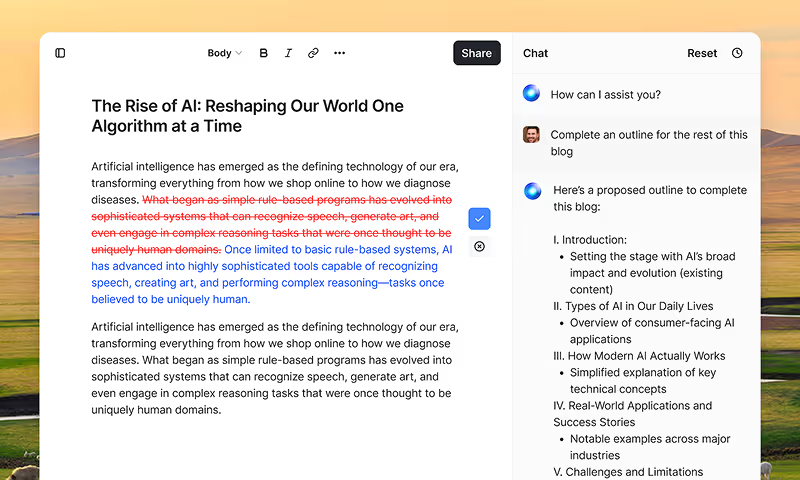
HyperWrite is the AI writing assistant that learns your style. It handles drafting, editing, and researching so you can focus on ideas.
- Autocompletes sentences as you type
- Works inside Google Docs & Gmail
- Adapts to your personal writing style
- 500+ AI tools for any writing task
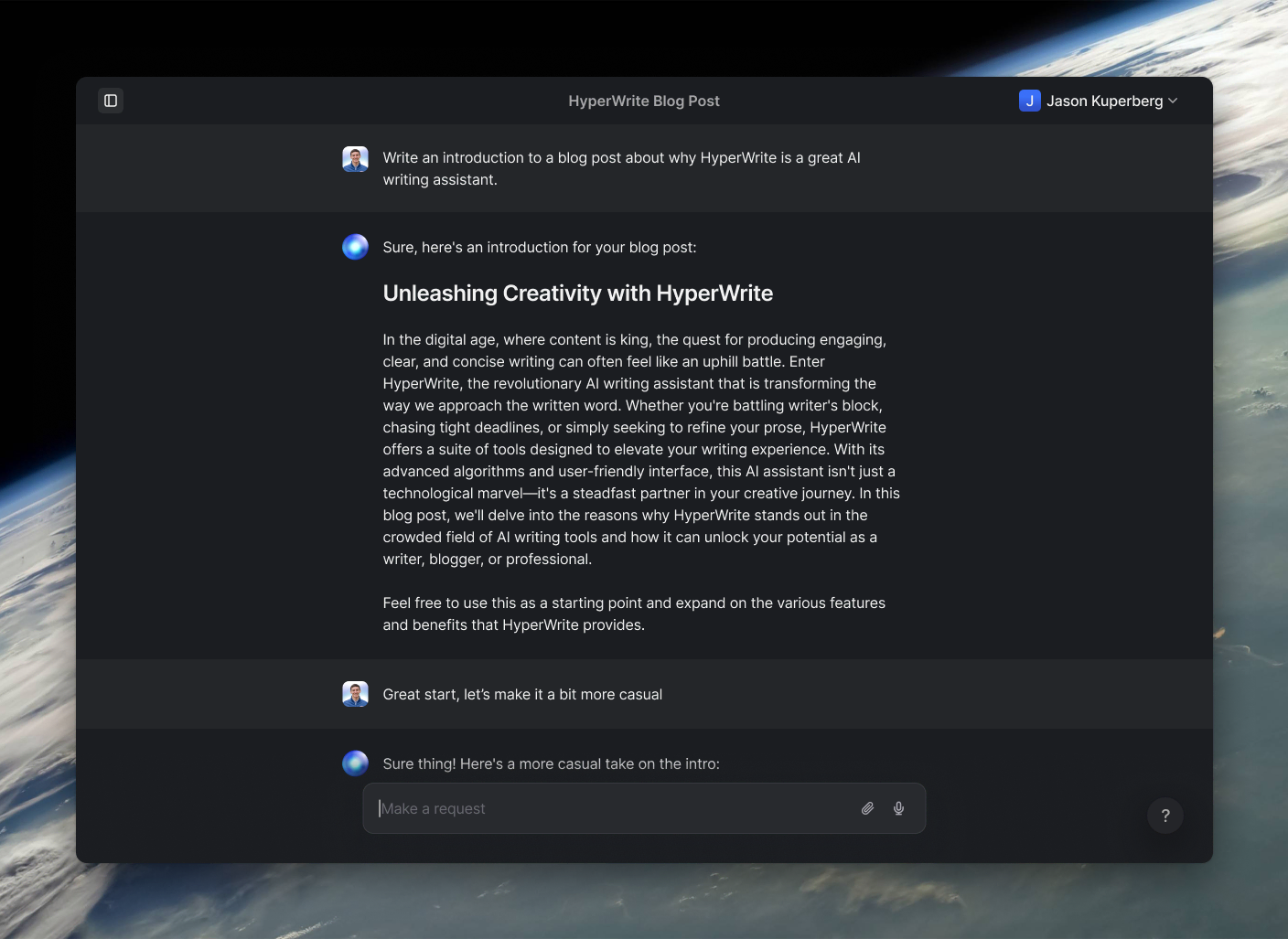
Powerful writing in seconds
Improve your existing writing or create high-quality content in seconds. From catchy headlines to persuasive emails, our tools are tailored to your unique needs.