


When a freelancer gets stiffed on payment, the missing piece is usually the same: no signed contract. This free freelance contract template covers the nine clauses that keep you paid and protected, with a filled-in example you can model from.
Who this freelance contract template is for
This freelance contract template works for independent freelancers and small studios taking on project work, from one-off jobs to ongoing retainers. It includes the nine sections that every agreement needs to hold up when a client disputes it.
It covers the parties, scope, timeline, payment, revisions, intellectual property, confidentiality, termination, and signatures. This template is a solid starting point, but it isn't legal advice. Laws vary by state and country, so have a lawyer review it before you rely on it for high-value work.
Freelance contract template
Copy the template, fill in the bracketed sections, and delete the instruction notes as you go:
Freelance Services Agreement
This agreement is made on [Date] between [Your Full Legal Name / Business Name], "the Freelancer," and [Client Full Legal Name / Company], "the Client."
1. Scope of work
The Freelancer will provide the following services:
[List specific deliverables. Name exact files, formats, quantities, and what "done" means. Specificity here is what prevents scope creep.]
Anything not listed above is outside the scope of this agreement and requires a separate written change order.
2. Timeline
Start date: [Date]
Delivery date: [Date or milestone schedule] [Tie any milestone to a verifiable trigger, e.g., "First draft delivered by [date]; client feedback returned within 5 business days."]
3. Payment terms
Total fee: $[Amount] for the scope above.
Payment schedule: [e.g., 50% deposit on signing, 50% on final delivery / Net 14 from invoice date].
Late payment: Invoices unpaid after [X] days accrue a late fee of [%] per month.
Accepted methods: [Bank transfer, ACH, etc.]
4. Revisions
This agreement includes [number] rounds of revision. Additional revisions are billed at [$X/hour or $X per round].
5. Intellectual property
The Freelancer retains ownership of all work until payment is received in full. On final payment, [the Client receives ownership of the final deliverables / the Client receives a non-exclusive license to use the final deliverables for the agreed purpose]. The Freelancer retains the right to display the work in their portfolio unless agreed otherwise in writing.
6. Confidentiality
Both parties agree to keep non-public information shared during the project confidential for the duration of the engagement and [X] months after. This clause does not prevent the Freelancer from taking on similar work for other clients.
7. Termination
Either party may end this agreement with [X] days' written notice. If the Client terminates early, the Freelancer is paid for all work completed up to the termination date, plus [a kill fee of $X / X% of the remaining balance].
8. Independent contractor status
The Freelancer is an independent contractor, not an employee. The Freelancer is responsible for their own taxes, equipment, and schedule.
9. Signatures
This agreement is legally binding once signed by both parties.
Freelancer: ______________________ Date: __________
Client: ______________________ Date: __________
What each clause does
Every section earns its place by closing a specific gap:
- Scope of work: Defines exactly what the client is buying, which is the single best defense against scope creep. The "anything not listed" line turns "can you just add..." into a paid change order instead of free work.
- Timeline: Gives both sides something to plan around, and tying client feedback to a deadline stops your project from stalling while you wait on them.
- Payment terms: Answers the question the contract exists to settle. A deposit protects your cash flow on new clients, and a stated late fee gives you leverage when an invoice ages past due.
- Revisions: Caps the round of changes before "a few tweaks" becomes 14 unpaid revisions. A specific number plus an hourly rate for extras keeps the project from running forever.
- Intellectual property: Spells out who owns the work and when. Retaining ownership until full payment is your strongest collection tool, and the portfolio line protects your right to show what you made.
- Termination: Tells both parties how to exit cleanly. The kill fee is what stops a client from canceling at 80% done and leaving you with a fraction of the fee.
Freelance contract example
Freelance Services Agreement
This agreement is made on March 4, 2026 between Jordan Lee Writing, "the Freelancer," and Maya Torres, Brightpath SaaS, "the Client."
1. Scope of work
The Freelancer will provide: four blog articles, 1,500 to 2,000 words each, on topics approved by the Client, delivered as Google Docs with suggested meta titles and descriptions.
Anything not listed (additional articles, social copy, design) is outside this agreement and requires a separate written change order.
2. Timeline
Start date: March 10, 2026.
Delivery date: One article delivered per week over four weeks, final delivery April 7, 2026. Client feedback returned within 5 business days of each draft.
3. Payment terms
Total fee: $3,200 for the scope above.
Payment schedule: 50% deposit ($1,600) on signing, 50% on final delivery.
Late payment: Invoices unpaid after 14 days accrue a 2% late fee per month.
Accepted methods: Payment by ACH or bank transfer.
4. Revisions
Two rounds of revision included per article. Additional revisions billed at $75/hour.
5. Intellectual property
The Freelancer retains ownership of all drafts until payment is received in full. On final payment, the Client receives full ownership of the delivered articles. The Freelancer may list Brightpath as a client and link published work in their portfolio.
6. Confidentiality
Both parties keep non-public information confidential for the project's duration and 12 months after. This does not prevent the Freelancer from writing for other SaaS clients.
7. Termination
Either party may end the agreement with 14 days' written notice. If the Client terminates early, the Freelancer is paid for all completed and in-progress articles, plus a kill fee of 25% of the remaining balance.
8. Independent contractor status
The Freelancer is an independent contractor responsible for their own taxes, equipment, and schedule.
9. Signatures
This agreement is legally binding once signed by both parties.
Jordan Lee ______________________ Date: __________
Maya Torres ______________________ Date: __________
The clauses that cost freelancers money
A template protects you only if you read what you're signing, especially when the client sends their own contract.
A few phrasings to catch before you sign:
- "Unlimited revisions" or "revisions until satisfied." This means the project technically never ends. Replace it with a fixed number of rounds and an hourly rate for anything beyond that.
- "All work product is work-for-hire." Broad work-for-hire language can hand the client ownership of tools, processes, and code you reuse across clients, in addition to the deliverables. Limit any IP transfer to the specific work named in the scope.
- "Payment due within 90 days." Net-90 terms are common in big corporate contracts and brutal on freelance cash flow. If you can't negotiate it down, price the delay in or ask for a larger deposit.
- No kill fee. Without one, a client can walk away mid-project and owe you only for finished pieces. A kill fee covers the work in progress and the slot you turned down for them.
How the template adapts by service type
The structure stays the same across freelance work, but a few clauses need adjusting depending on what you do:
- For designers: Specify deliverable file formats and exact revision limits in the scope. Designers see the most scope creep, so a clear "two rounds included, additional rounds at $X" line heads most of it off. Define whether the client owns source files or just the final exports.
- For writers: Make word counts, draft counts, and deadlines specific. "Four articles, 1,500 to 2,000 words, delivered weekly" beats "ongoing content support." Decide upfront whether you keep a byline or write as a ghostwriter.
- For developers: Define what "done" means, name the tech stack, and separate the post-launch support window from the build. A line like "30 days of bug fixes included; ongoing maintenance at $X/month" tells the client exactly where your responsibility ends.
- For consultants: Frame deliverables around artifacts (a brief, a framework, a workshop) rather than products, and tie payment to phases like discovery, synthesis, and recommendation rather than a single final handoff.
Before you send it
A contract isn't binding until both parties sign, so handle these last steps before the work starts:
- Use a free e-signature tool like Docusign, instead of a printed-and-scanned attachment that gets lost. The free tier of most signing tools gives you a dated, tracked signature from both sides.
- Save the signed copy somewhere you can find it. A contract you can't locate is the same as no contract when a dispute starts.
- Get one legal review for high-value or cross-border work. A single review of a template you'll reuse for years is cheap insurance, and IP assignment and governing-law clauses are the ones most worth a professional eye.
Use this freelance contract for every client without rewriting it
The template gets you most of the way there. The time sink is the last stretch: customizing the scope, payment, and tone for each client without rewriting your own phrasing every time.
HyperWrite's TypeAhead is a context-aware writing co-pilot: as you fill in the bracketed sections, it drafts the next line using what's in your open tabs, so the scope can draw on the brief or proposal you have open elsewhere. Personas trained on samples of your own writing keep the wording sounding like you rather than generic legalese.
You can try Typeahead free by downloading the Chrome extension.
Frequently asked questions
What should be included in a freelance contract?
A freelance contract should include nine sections: the parties' legal names, the scope of work, the timeline, payment terms, revision limits, intellectual property ownership, confidentiality, termination conditions, and signatures. Each section should be specific enough that both sides can act on it without follow-up questions.
Is a freelance contract legally binding?
Yes, a freelance contract is legally binding once both parties sign it and it includes clear terms, mutual agreement, and something of value exchanged (the work and the payment). An unsigned contract or one with vague, undefined terms is much harder to enforce, which is why specificity in scope and payment matters.
Do freelancers really need a contract for small projects?
Yes, freelancers need a contract for projects of any size, even small jobs. It's now the law in some places: New York's Freelance Isn't Free Act requires a written contract for freelance work totaling $800 or more, and Illinois, LA, and NYC have similar rules. A short contract covering scope, payment, and ownership protects you from disputes handshake deals can't.
What's the difference between a freelance contract and a proposal?
The difference between a freelance contract and a proposal is that the proposal is a pre-sale document pitching the scope, timeline, and price for the client to approve, while the contract is the legally binding agreement that formalizes those terms once the client says yes. The proposal sells the work; the contract protects it.
Can I write my own freelance contract without a lawyer?
Yes, you can write your own freelance contract from a template for most standard project work, and many freelancers do. For high-value engagements, cross-border clients, or complex IP arrangements, a one-time lawyer review of your template is worth the cost, since you'll reuse the same document across many projects.
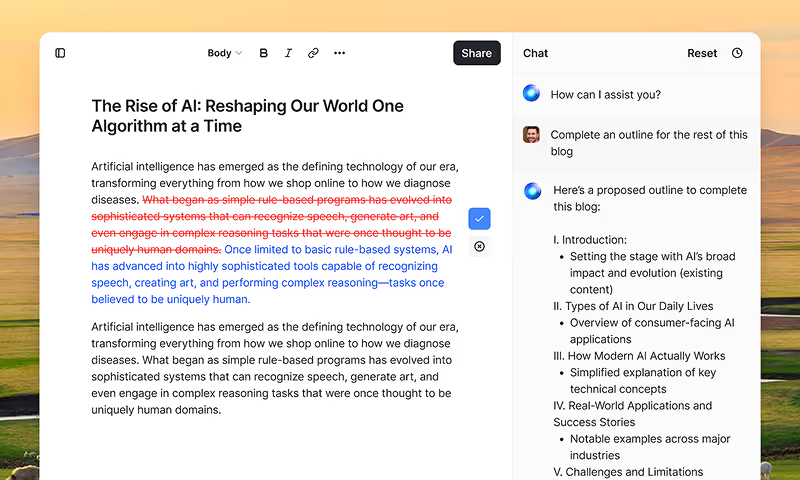
HyperWrite is the AI writing assistant that learns your style. It handles drafting, editing, and researching so you can focus on ideas.
- Autocompletes sentences as you type
- Works inside Google Docs & Gmail
- Adapts to your personal writing style
- 500+ AI tools for any writing task
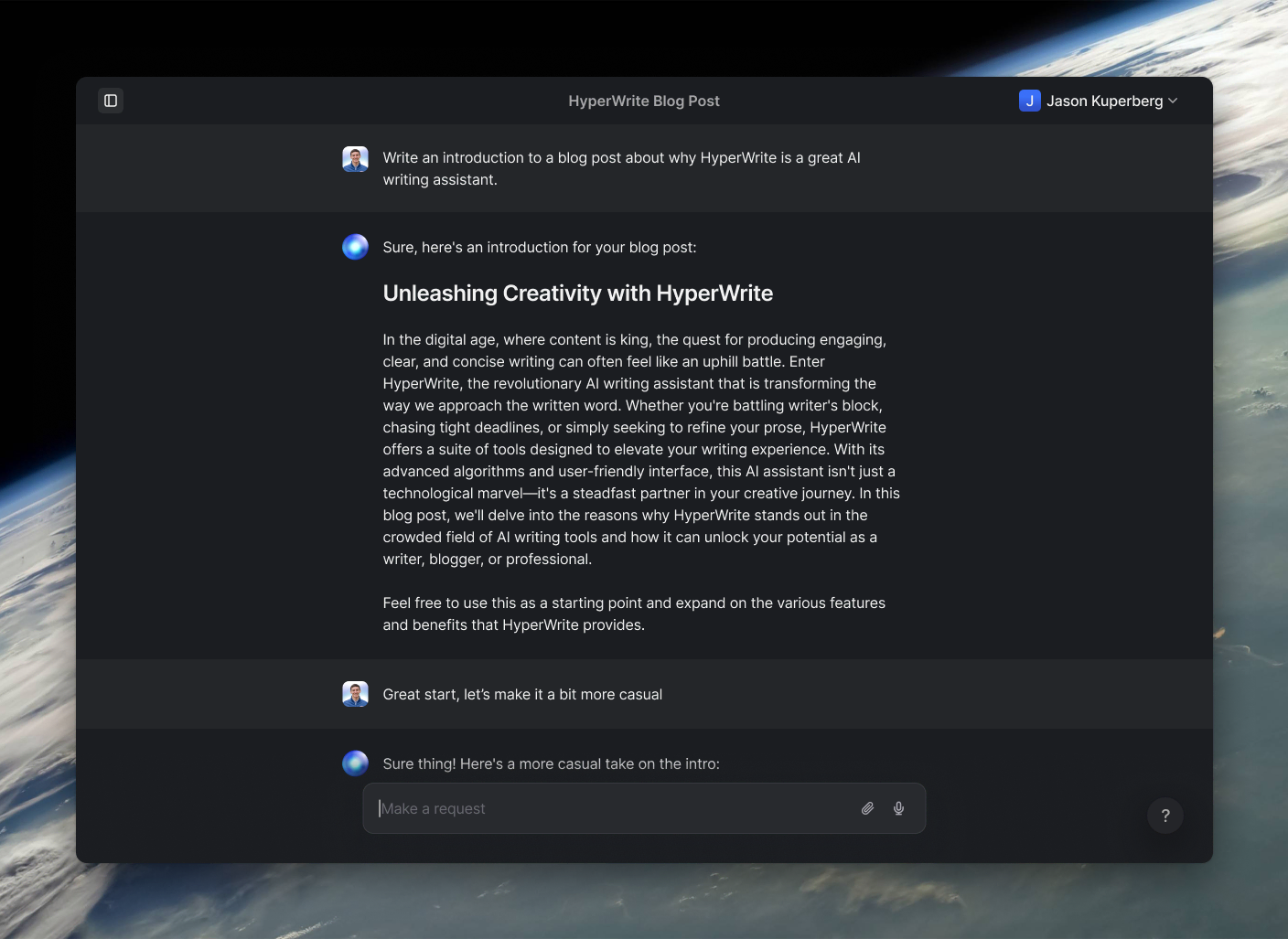
Powerful writing in seconds
Improve your existing writing or create high-quality content in seconds. From catchy headlines to persuasive emails, our tools are tailored to your unique needs.