
Writesonic vs Jasper vs HyperWrite: Which AI Writer Wins?


Pick the wrong AI writer and you'll spend the savings cleaning up output the tool wasn't built for. Writesonic, Jasper, and HyperWrite each solve a different problem. Here's which one matches how you actually write.
Writesonic vs Jasper vs HyperWrite: At a glance
Pricing based on annual billing, verified from official vendor pages as of May 2026.
Choose Writesonic if your team runs an SEO-heavy publishing pipeline and you need research, citations, article structure, and AI search visibility tracking in one platform.
Choose Jasper if you're running a content team or agency producing 20+ pieces a month across multiple channels and need a consistent brand voice across writers.
Choose HyperWrite if you're a founder, marketer, recruiter, or executive who writes across Gmail, Docs, LinkedIn, and a CRM, and you need AI that lives inside the tab you're already in.
Meet the contenders
Writesonic: Ideal for SEO content pipelines
Writesonic is a marketing platform built around how your brand shows up across AI search engines like ChatGPT, Gemini, and Perplexity. The AI Article Writer, SEO & Content AI Agent, and Chatsonic handle long-form drafting and keyword research. It also includes a GEO and citation-tracking layer.
Jasper: Built for content teams at scale
Jasper sits at the team and enterprise end of AI writing. Brand Voice profiles, shared knowledge bases, and structured campaign workflows let multiple contributors produce consistent content across blog posts, ads, emails, and social.
HyperWrite: Designed for professional writing
HyperWrite is a writing assistant with several AI Tools that cover everything from drafting, editing, to researching, and it works inside browser tabs. Its TypeAhead reads context from your open tabs and suggests sentence completions in real time as you draft in any text field. Personas trained on your writing samples match the suggestions to your voice.
Writesonic vs Jasper vs HyperWrite: Feature breakdown
Long-form content generation
Writesonic: The AI Article Writer is purpose-built for this. It produces long-form drafts with research, citations, and supporting structure like FAQs and conclusions. The output requires editing, but the starting point is the closest to a publishable draft of the three tools here.
Jasper: Handles long-form content well, especially when paired with Brand Voice. The output sounds more polished than Writesonic's by default, but it requires more prompt work to match SEO best practices. Better for branded content than SEO-first publishing.
HyperWrite: Dedicated tools like AutoWrite, the AI Writer, and the Blog Post Generator produce full-length drafts, but long-form isn't what HyperWrite is built for. The output is less research- and SEO-structured than Writesonic's, so for a publish-ready 2,000-word article you'll do more shaping yourself.
Winner: Writesonic. Specifically built for long-form publishing with the structure and research support to back it.
SEO and AI search visibility
Writesonic: SEO research, optimization scoring, AI search visibility tracking, and citation monitoring are core features built in. The platform tracks where your brand appears across ChatGPT, Perplexity, and Gemini, which most competitors still ignore.
Jasper: Jasper has SEO mode and integrates with tools like Surfer for optimization, but SEO isn't the platform's center of gravity. You'll get there, but it's not the workflow Jasper is built around.
HyperWrite: No native SEO research, AI optimization scoring, or AI search tracking. If SEO is your priority, this isn't the tool.
Winner: Writesonic. Nothing else in this comparison treats SEO and AI search visibility as the primary workflow.
Brand voice and team consistency
Writesonic: Has brand voice settings that keep article tone and phrasing more stable across pieces. Functional, but lighter than Jasper's implementation.
Jasper: Brand Voice is the flagship feature here. It learns tone, banned phrases, preferred terms, and style rules, then enforces them across every writer on the team.
HyperWrite: Personas trained on samples of your past writing produce output that reads like you wrote it. Strong for individual voice matching, but the tool isn't built for team-wide voice governance.
Winner: Jasper. For team-level brand voice control across multiple writers and channels, nothing in this comparison matches it.
Where the writing happens
Writesonic: The workflow lives inside Writesonic's interface. You produce drafts there, then export to your CMS or publishing tool. For SEO content production, that's the right shape. For everything else, it's a context switch.
Jasper: Same pattern as Writesonic. You work inside Jasper's platform, then move output to where it's published or shared. Has a Chrome extension for shorter content, but the heavy lifting happens in the main platform.
HyperWrite: The TypeAhead Chrome extension can access any browser tab where you write. Gmail, Google Docs, LinkedIn, ChatGPT, your CRM, anywhere with a text field. Writing help shows up where you already work instead of inside another platform you have to open.
Winner: HyperWrite. For professionals whose writing spans tools throughout the day, browser-native suggestions are a different workflow from platform-based content production.
User experience and learning curve
Writesonic: Feature-rich, the platform covers article generation, SEO research, AI visibility tracking, and several other workflows, which makes the interface dense. New users often need a week or two to find where each tool lives.
Jasper: Onboarding is well-designed, the Campaign workflow is intuitive once you understand it, and the documentation is strong. The learning curve comes from setting up Brand Voice and team workflows properly and doesn’t stem from the interface itself.
HyperWrite: Install the Chrome extension, train a Persona, start writing. Most users are productive on day one, though Persona quality improves over the first week as more samples accumulate.
Winner: HyperWrite for ease of getting started; Jasper for ongoing polish.
Pricing and value
Writesonic: Starts at $79/month annually for the Starter plan, jumping to $199/month for Basic. Pricing scales with article volume and feature access. For SEO publishing teams running real production pipelines, the value math works. For occasional content, it's expensive.
Jasper: $59/seat/month annual on the Pro plan, with Business pricing as custom quote. Per-seat pricing adds up fast for teams, but the value shows up at real publishing volume. Not designed to be cost-effective for solo users.
HyperWrite: $16/month annual for Premium, $29/month for Ultra. The free plan is usable for testing before committing. Cheapest of the three by a significant margin, but you're paying for a different product (individual writing tool, not a content production platform).
Winner: HyperWrite for individual users, Jasper for teams, getting real value from the workflow features. Writesonic is a fair value for the SEO use case, but expensive otherwise.
What real users say
Writesonic
Pros
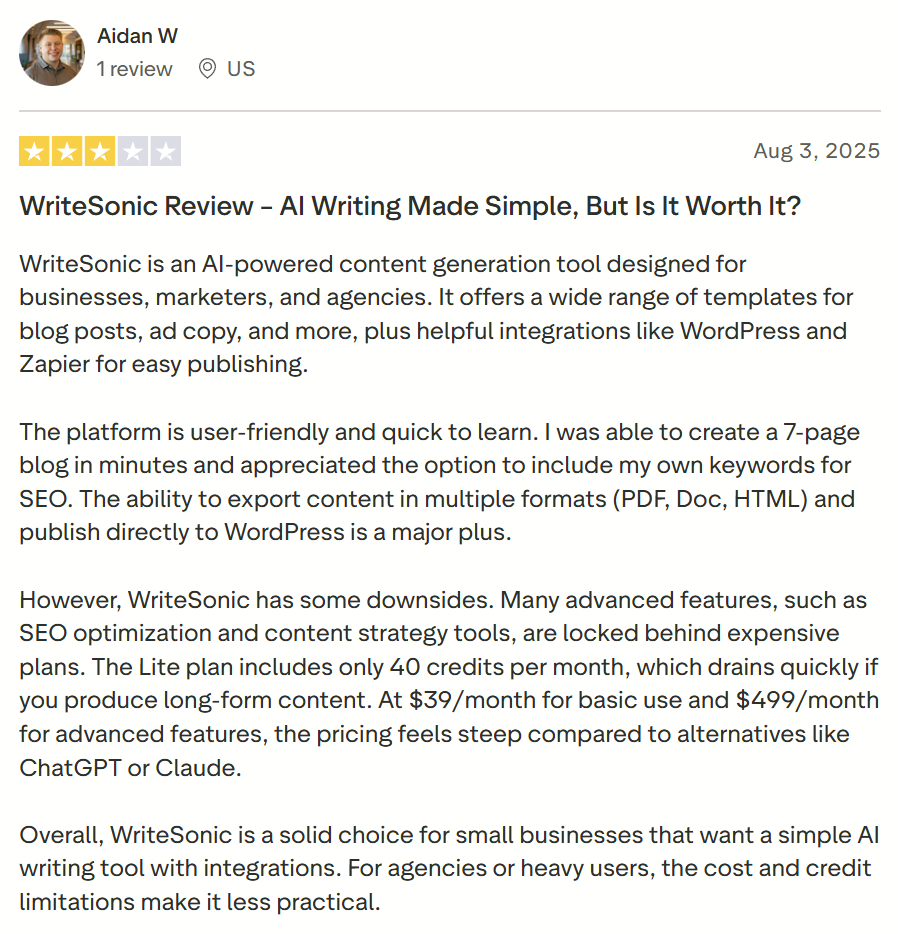
- Writesonic earns strong marks for ease of use and SEO-focused integrations. On Trustpilot, Aidan W praised how he was “able to create a 7-page blog in minutes,” with keyword inclusion, multi-format export, and direct WordPress publishing.
- Sourabh D, an SRE, called the tool "great for quickly creating stuff like blogs, ads, landing pages, and social posts," with keyword ideas, competitor-based suggestions, and auto-generated FAQs and CTAs that enhance content. That range is why solo professionals lean on it for more than one kind of writing.
Cons
- Nitrajan K. flagged the cost head-on, saying "the subscription model is too high" and wishing for a no-card free trial before committing. Credit limits on lower plans also come up often, especially for anyone producing long-form content at any real volume.
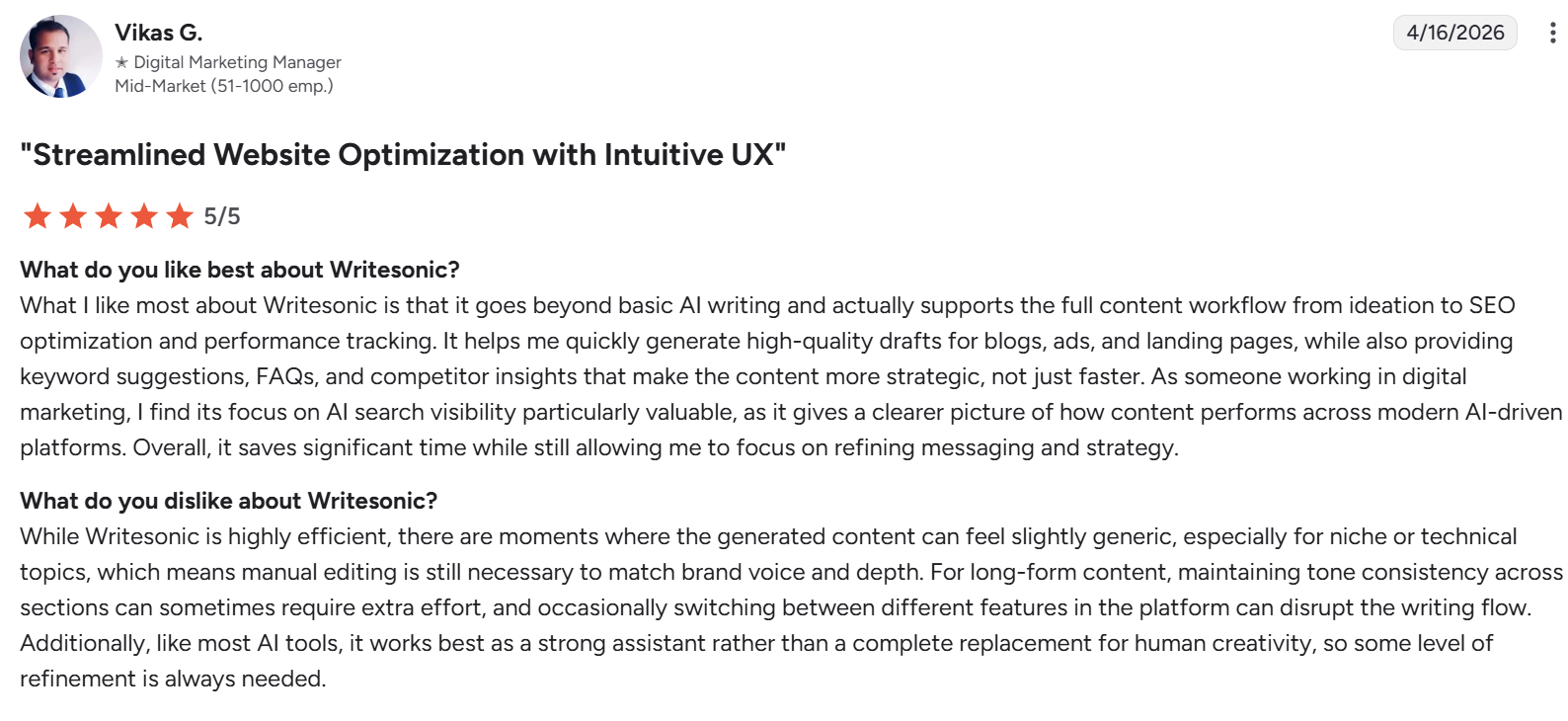
- Vikas G, a digital marketing manager, said output felt "slightly generic, especially for niche or technical topics,” so manual editing is needed to match brand voice and depth. Tone consistency in long-form content also takes extra effort, and switching between platform features can disrupt the writing flow.
Jasper
Pros
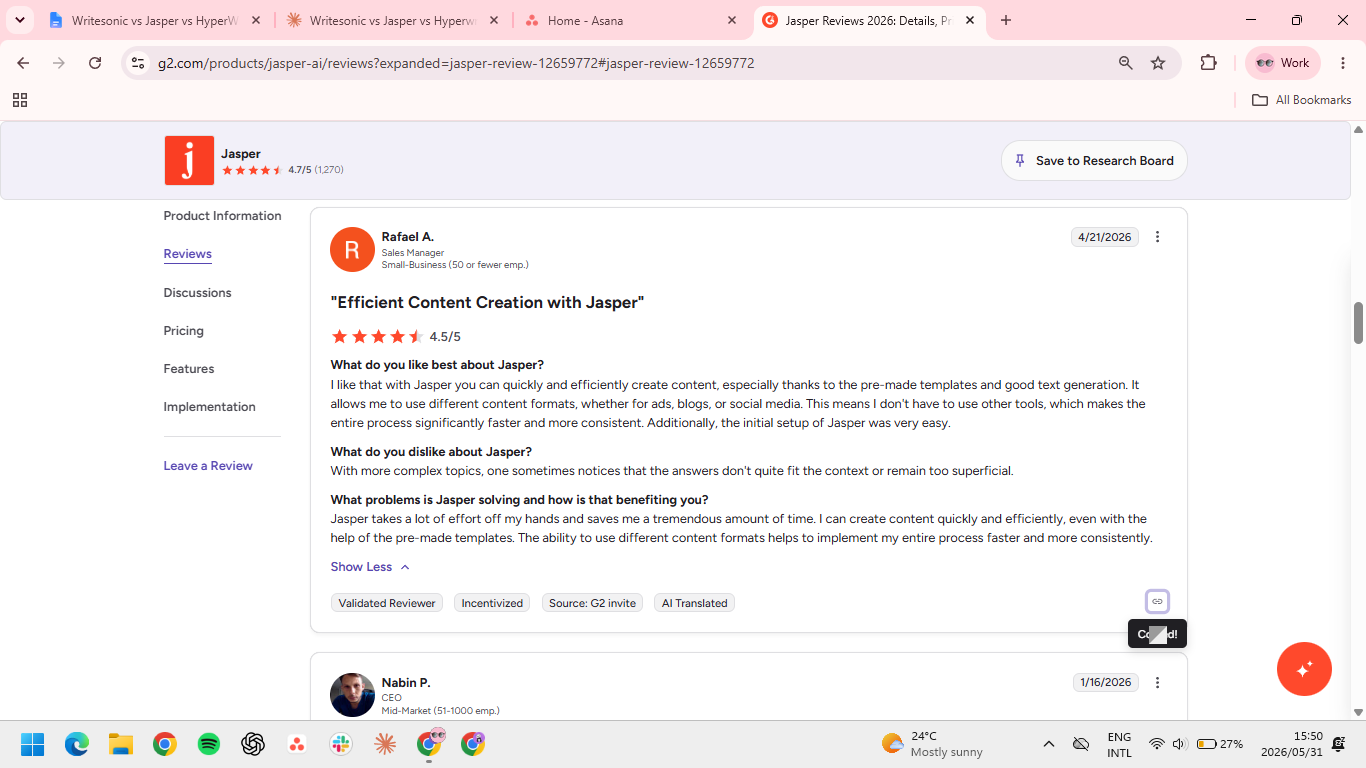
- Rafael A., a Sales Manager, said, "With Jasper you can quickly and efficiently create content, especially thanks to the pre-made templates and good text generation," noting it cut their reliance on multiple separate tools. That all-in-one structure is the main reason content teams scaling output stick with it.
- Stephanie Sagun called it "the best AI writing experience," noting Jasper Chat lets her produce professional articles she can actually direct, where other tools left her unsatisfied. That level of direction is what keeps writers from fighting the tool on every draft.
Cons
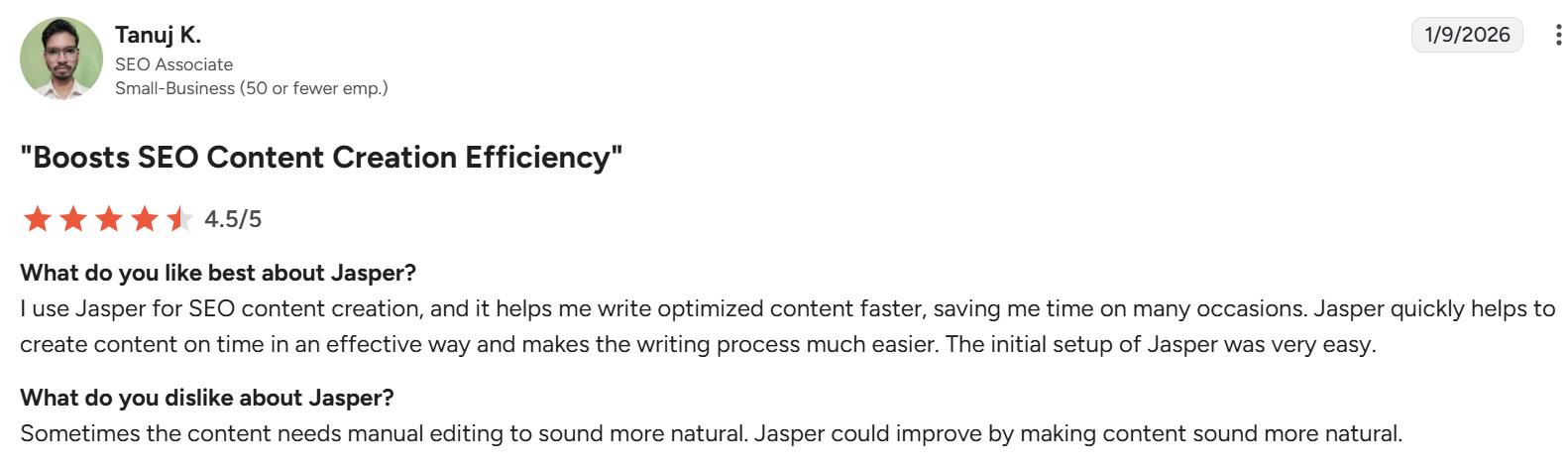
- Tanuj K., an SEO associate, said, "Sometimes the content needs manual editing to sound more natural,” which slows down content volume and adds to team or personal cognitive load.
- Kyle B., an agency owner, warned that hitting "Pause Subscription" will "immediately prevent you from using the product even if you have days/weeks of use paid for already," with support unwilling to help. The platform's value also drops if you're not using the team features, making the per-seat pricing harder to justify for solo use.
HyperWrite
Pros

- Billy Elias calls it "a very dynamic tool" with an ability to search across millions of articles, books, and databases, plus formatting and editing help across writing styles and genres. That range is why solo professionals lean on it for more than one kind of writing.
- Louis D'Angelo wrote that it helps him "get to my daily inbox zero goals much faster" because so many emails are repetitive, and flagged the team's responsiveness to feedback as a real plus. That email-and-tab workflow is exactly the pattern HyperWrite is built around.
Cons

- Callum D, marketing assistant, flagged that the price point is "quite expensive and off-putting." Heavier users also flag credit limits on lower-tier plans as a barrier, particularly for anyone writing across multiple tools all day.
- Rajesh, a daily HyperWrite user, noted that it "doesn't enable you to attach documents or images like ChatGPT or Claude.”
Which tool should you choose?
The right tool depends on what you're producing, who's producing it, and where the writing happens.
Choose Writesonic if you:
- Run an SEO-heavy publishing pipeline producing long-form articles regularly.
- Care about AI search visibility and need to track citations across ChatGPT, Perplexity, and Gemini.
- Want research, drafting, optimization, and analytics in one platform.
Choose Jasper if you:
- Manage a content team or agency producing across multiple channels.
- Need brand voice consistency across multiple writers and clients.
- Want a real content workflow with approval steps, knowledge bases, and team controls.
Choose HyperWrite if you:
- Write daily across Gmail, Docs, LinkedIn, and browser-based tools.
- Want AI suggestions that sound like you, not a generic professional default.
- Care more about workflow integration than long-form content production.
Final verdict
Writesonic and Jasper compete for the same buyer: teams scaling content production. If AI search visibility is the priority, Writesonic wins. If brand voice across multiple writers matters more, Jasper does.
HyperWrite is playing a different game. It's a writing layer that lives inside the apps most professionals use all day. Many of them end up running both: a team tool for production, and HyperWrite for everything written between meetings.
Try HyperWrite on a real workday
The fastest way to know if HyperWrite fits is to use it for a morning. Install the TypeAhead Chrome extension, then reply to emails, draft LinkedIn messages, and write docs the way you normally would.
TypeAhead writes inside whatever tab you're in. Personas keep it sounding like you. A morning is usually enough to know whether it earns a permanent spot in your workflow.
Frequently asked questions
Which is better, Writesonic or Jasper?
Writesonic is better for SEO-heavy publishing workflows and AI search visibility tracking, while Jasper is better for content teams that need brand voice consistency and multi-channel campaign workflows. The choice depends on whether your priority is search performance or team production.
Is HyperWrite a real alternative to Writesonic or Jasper?
Yes, HyperWrite is a real alternative to Writesonic or Jasper, but for a different problem. All three do AI-assisted writing, yet Writesonic and Jasper are content production platforms built for teams, while HyperWrite is a writing co-pilot for individual professionals working across browser-based tools. The right one depends on your workflow.
Can I use Writesonic, Jasper, and HyperWrite together?
Yes, many professionals stack these tools. Writesonic or Jasper handles the team's content production workflow, while HyperWrite supports individual writing across Gmail, Docs, and other browser-based tools. The three tools cover different stages of the writing workflow, so they pair without overlapping.
Which AI writer is best for SEO content?
Writesonic is the strongest of the three for SEO content, with built-in SERP research, optimization scoring, citations, and AI search visibility tracking. Jasper handles SEO content well, but treats it as one workflow among many. HyperWrite is not built for SEO publishing.
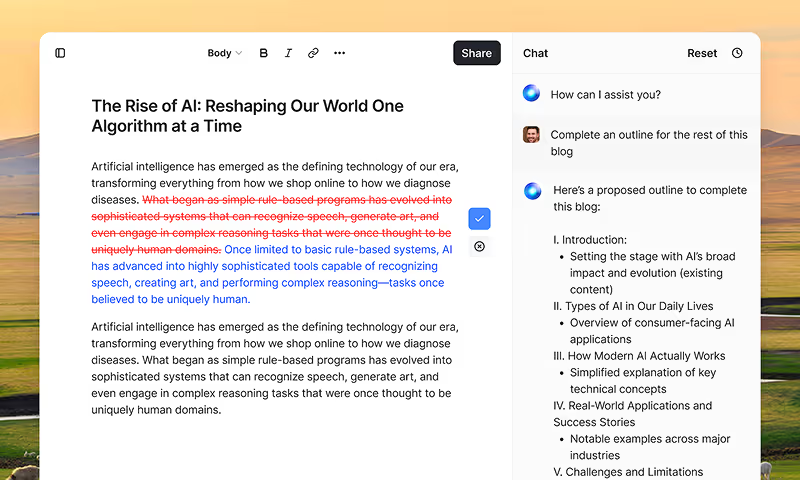
HyperWrite is the AI writing assistant that learns your style. It handles drafting, editing, and researching so you can focus on ideas.
- Autocompletes sentences as you type
- Works inside Google Docs & Gmail
- Adapts to your personal writing style
- 500+ AI tools for any writing task
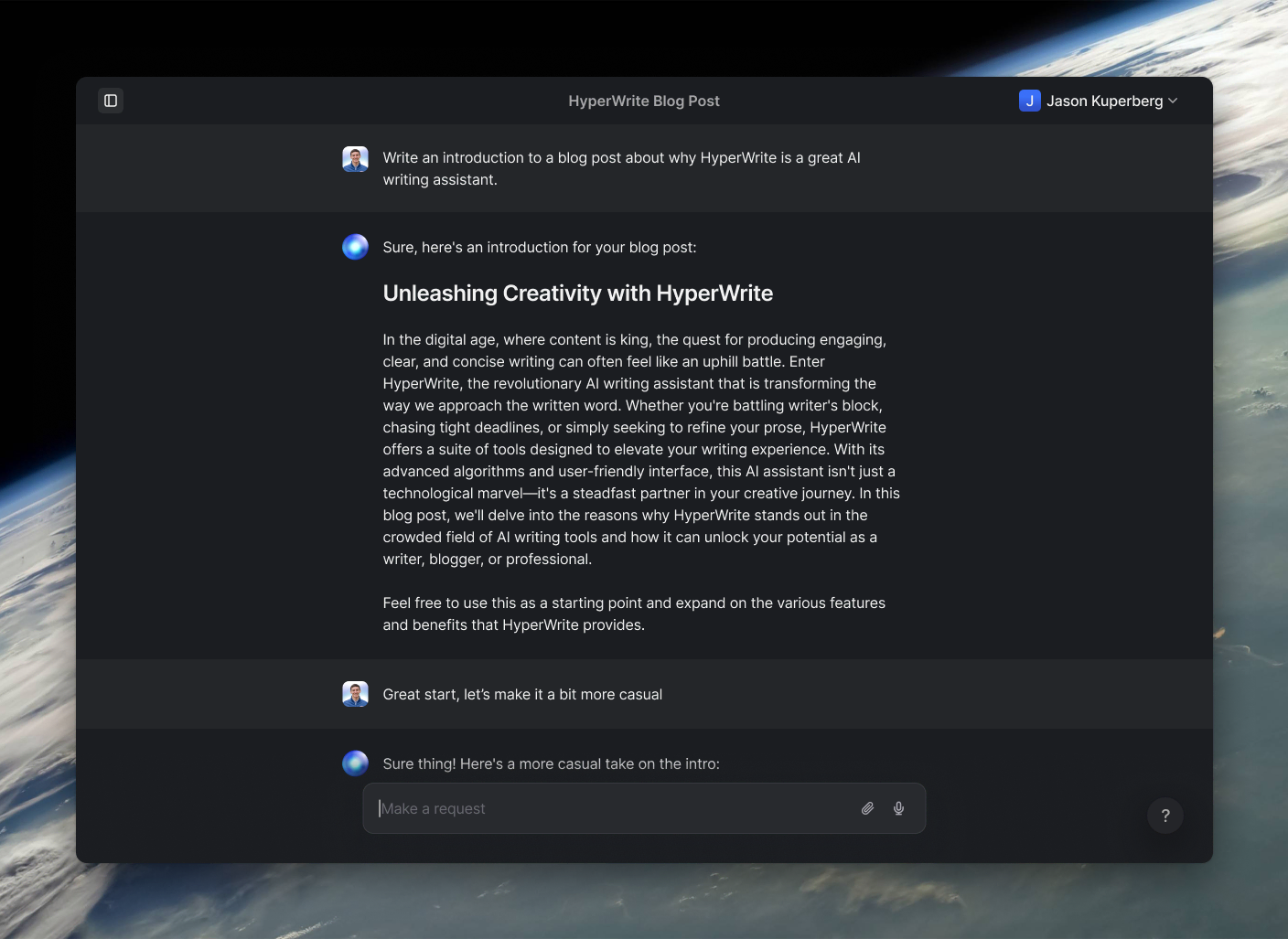
Powerful writing in seconds
Improve your existing writing or create high-quality content in seconds. From catchy headlines to persuasive emails, our tools are tailored to your unique needs.