
How to Start a Newsletter in 2026 in 6 Steps


Most newsletters die before issue 12. The ones that survive get six things right before they publish issue one.
6 steps to starting a newsletter
Step 1: Define who you're writing to
Pick one person and write the newsletter for them.
Examples for the four most common professional contexts:
- Founder building inbound. A Series A founder running content without a content team. They want frameworks they can apply Monday morning instead of roundups of other people's takes.
- Executive thought leader. A VP-level operator who knows their network expects to hear from them. They need short, sharp pieces that take 4 minutes to read.
- Solopreneur or consultant. A senior IC who left their corporate job to consult and needs to stay top-of-mind for buyers without seeming desperate.
- B2B marketer. A content marketer running a newsletter as a distribution channel. They need it to convert, not inform.
Your reader is not all four. Pick one, name them, and write the next issue to them specifically.
The test: If your reader is "anyone in tech," start over. If your reader is "a head of design at a 200-person startup hiring their first content person," you're ready.
Step 2: Choose your angle
Three angles work for most professional newsletters:
- The expert dispatch. You teach what you've learned in your work: frameworks, hard lessons, things you'd tell a peer over coffee.
- The curated digest. You read everything in a niche so your reader doesn't have to, then distill it into what actually matters.
- The strong-take essay. You pick one idea per issue, commit to a thesis, and defend it.
Pick one. Mixing them is what makes most newsletters feel directionless.
Step 3: Choose your frequency and platform
Pick a weekly frequency. Daily is too much to write and too much to receive. Monthly creates no relationship between issues. Weekly is the cadence almost every successful professional newsletter lands on.
For the publishing schedule, Friday morning beats Monday for B2B audiences. Tuesday and Wednesday work for B2C. Pick one and put it on your calendar as a recurring block.
Four platforms cover 90% of professional newsletters in 2026:
- Substack for individual writers building an audience under their own name. Free, 5-minute setup, built-in discovery network.
- Beehiiv for newsletters with a growth or monetization plan. Better analytics, paid recommendations via Boosts, native ad network, 0% revenue share on paid subs.
- Kit (formerly ConvertKit) for creators selling products alongside their newsletter. Strongest automations and segmentation. Paid plans from $33/mo annual.
- Ghost for publishers who want full ownership of their site and email list. Available as managed hosting (Ghost Pro, starting at $15/mo) or self-hosted for free. 0% revenue share on paid subscriptions.
If you're not sure, start on Substack, and you can migrate later.
Step 4: Build your list before you publish
Most newsletter advice tells you to write first and grow later, but that advice is backward. Even 25 subscribers on day one beats publishing into a void for three weeks. Set these up before you draft issue one. Build a signup page. Every platform listed above gives you one for free.
Use this structure:
- Headline: What you publish + who it's for + how often. Example: "A weekly newsletter for founders building inbound without a content team."
- Subhead (one line): What the reader walks away with each week. Example: "Frameworks you can apply Monday morning, not roundups of other people's takes."
- Email field + button. Button copy should say "Get the newsletter" or "Subscribe free." Specific verbs convert better than generic ones like "Sign up."
- Social proof (optional but high-impact): A line like "Read by 200+ founders at [company examples]" once you have it. Skip it on day one rather than fake it.
Email 25 people in your network this week. Send a real, personal email rather than a mass blast.
Use this template:
Subject: Quick favor — would love your read on this
Hey [name], I'm starting a newsletter for [specific reader]. First issue goes out [date]. Would love your read and your honest take after issue one. Subscribe here: [link]. No worries either way.
This single move typically gets 15-20 subscribers and gives you real readers to write toward instead of an imagined audience.
Add a signature line to your work email. One line: "Newsletter: short weekly dispatch on [topic]" with the signup link. Steady, low-effort growth across every email you already send.
Set up one referral mechanism. Three platforms have this built in: Substack for free, Beehiiv and Kit on paid tiers. The simplest version: subscribers get a perk (a guide, a template, a private archive) for referring three friends. Don't overthink this on day one.
Step 5: Write your first issue
Most first issues fail because they introduce the newsletter instead of being the newsletter. Skip the welcome letter. Show, don't tell.
The format that works for issue one (and every issue after):
SUBJECT LINE (8-10 words, specific, no clickbait)
OPENING HOOK (2-3 sentences)
A specific observation, contrarian take, or recent event your
reader cares about. No throat-clearing, no "in today's world."
THE SUBSTANCE (300-500 words)
One framework, one analysis, one breakdown. Something a reader
can save, screenshot, or quote. Use sub-headers if it runs over
400 words. Bold the key claim in each section.
CLOSE (1-2 sentences)
Tell them what's coming next week. Set the rhythm from issue one.
P.S. (Optional)
One line. A link to something you read, a question, or a soft ask
(reply, share, etc). P.S. lines often get more engagement than the
body.
The subject line is the single highest-leverage decision you make every week. A great issue with a weak subject line gets opened by 20% of your list. A medium issue with a sharp subject line gets opened by 50%.
What works:
- Specific over clever. "How Lenny grew his newsletter to 1M" beats "The secret to newsletter growth."
- 8-10 words. Keep the key hook in the first 40 characters. Mobile previews (Gmail, iPhone Mail) cut off around there, so anything past that gets lost. Total subject line can run longer, but front-load the part that has to land.
- A number, a name, or a question. "Why 80% of B2B newsletters die at issue 12" works because it has all three.
- Skip emoji on day one. They work for established lists with a casual voice. They feel forced on a brand-new one.
Here's what this looks like in practice:
Subject: Why 80% of B2B newsletters die at issue 12
Hook: Most newsletter advice tells you to focus on growth. But the biggest predictor of whether a newsletter survives is whether you publish issue 13.
Substance: I tracked 50 B2B newsletters launched in 2024. By issue 12, 41 of them had stopped.
The nine that survived all had one thing in common:
A backlog of at least 5 issues drafted before they published issue one. The ones that died started with one idea and hoped for inspiration to fill the next 11 slots.
The lesson: treat your first month as inventory work.
Before you hit publish on issue one, have issues 2-6 drafted in some form. Bullet points count. Half-finished arguments count. Anything that means you're not staring at a blank page on a Sunday night three weeks in.
Close: Next week: the three subject line patterns that get the highest open rates on small lists.
P.S. Reply with the newsletter you've been meaning to start. I'll tell you which platform fits.
Step 6: Grow consistently between issues 1 and 12
Most newsletters die between issue 5 and issue 12. The ones that survive treat growth as a steady weekly habit.
Do these every week:
- Repurpose every issue into 3–5 social posts. Pull the strongest line, the contrarian take, and a quotable framework into standalone LinkedIn or X posts during the week. Link back to the issue. Most newsletter growth happens outside the inbox.
- Reply to every reply. When a subscriber emails back, reply within 24 hours. This is the fastest way to turn casual readers into people who forward your newsletter to their networks.
- Cross-promote with 2 other newsletters per month. Find newsletters with similar reader profiles but no overlap. A marketing newsletter swapping with a sales newsletter works; swapping with another marketing newsletter cannibalizes your audience. Recommend each other in one issue.
- Post your signup link in one new place each week. Your LinkedIn header. The "About" section of your X profile. A conference bio. A podcast description. These add up over time.
- Track replies more than opens. Open rates measure curiosity. Replies measure connection. The topics that get replies are the topics to write more of.
Don't buy lists, blast strangers, and post in 50 communities at once. Newsletters are built on a permission scale. If they’re built on spam, they won’t recover. The first 90 days are about building the habit. Worry about monetization, sponsorships, and audience research after issue 12.
Real newsletter examples to learn from
The fastest way to write a good newsletter is to study people already running one well. Here are three to read this week:
- Lenny's Newsletter: Lenny Rachitsky writes about product, growth, and career topics in long-form weekly issues. It has strong subject lines, structured frameworks, and a clear point of view. It’s worth studying how he turns interviews into reusable frameworks.
- Marketing Examined: Alex Garcia breaks down one or two brand and marketing case studies a week. It’s tight, scannable, and visual enough that a long issue never feels like a slog.
- The Generalist: Strong-take essay done right. Mario Gabriele writes 5,000+ word deep dives on tech and venture that somehow hold your attention all the way through. The thesis never wavers.
Don't copy them. Read them, screenshot the structural choices that work, and adapt the patterns to your own voice.
Also worth a read: 20 Of The Top AI Newsletters to Follow
How to keep writing past issue 5
It’s easy to write the first issue. The wall hits around issue 5, when the obvious ideas are gone and the initial energy has worn off.
- Keep an idea backlog. Capture every newsletter idea the moment it hits in a single doc or notes app. The hardest part of writing is staring at a blank page. A backlog of 20+ ideas means you never start from zero.
- Write before you feel ready. Most writers wait until an idea feels fully formed. The strongest newsletter writers publish at 70% confidence and refine in public. Polishing usually kills momentum.
- Turn one issue into the next. Every newsletter you publish raises questions you didn't answer, angles you didn't take, and follow-ups readers will ask for. The best idea source for issue 7 is usually issue 6.
Tools that make running a newsletter easier
Three tools cover the actual workflow:
- Your platform (Substack, Beehiiv, Kit, or Ghost) handles sending, subscriber management, and analytics.
- A writing tool that lives where you draft. If you're writing in Google Docs or directly in Substack, HyperWrite's TypeAhead suggests sentence completions inline as you type, and Personas keeps the output sounding like you.
- A scheduling tool for promotion. Buffer or Hypefury handle posting your newsletter across LinkedIn and Twitter without you babysitting it.
You don't need an analytics dashboard, a CRM, or a separate email tool for the first 12 issues. Add them when the work makes them necessary.
Where HyperWrite fits in
Anyone can write the first issue. Writing the sixth one, on schedule, when work was a mess this week, and the idea isn't fully formed yet, is the actual job.
That's where HyperWrite helps. Its Chrome extension suggests sentence completions as you type anywhere in your browser, including Substack, Beehiiv, and Google Docs. Personas let you define your voice and tone so the output stays consistent with how you actually write, not generic AI-speak.
The free plan includes limited monthly AI credits and lets you try TypeAhead in your browser, enough to test it on a draft or two before deciding if it's worth upgrading. Try TypeAhead free with the Chrome extension.
Frequently asked questions
How much does it cost to start a newsletter?
Starting a newsletter costs nothing on Substack, Beehiiv, or Kit's free tier. Substack takes a 10% cut if you eventually charge subscribers. Beehiiv and Kit charge flat monthly fees but keep 0% of your revenue. Most professional newsletters run free for the first 1,000 subscribers, then add a paid tier once there's clear demand.
How many subscribers do you need to make money from a newsletter?
You need roughly 1,000 paying subscribers at $10/month to gross $10,000/month from a paid newsletter. After Substack's 10% cut and Stripe fees, that nets closer to $8,400. Most professional newsletters take 2–4 years to reach paid sustainability. Sponsorships kick in earlier (around 5,000 free subscribers).
How often should you send a newsletter?
You should send a newsletter weekly, just like most successful professional newsletters. Daily burns out both writer and reader, while monthly creates no relationship between issues. Pick a fixed day (Tuesday, Wednesday, or Friday morning) and put it in your calendar.
What is the best platform to start a newsletter on?
The best platform to start a newsletter on is Substack for most individual writers, or Beehiiv for newsletters with a clear growth plan. Both are free, take five minutes to set up, and let you migrate to a more advanced platform later. Kit and Ghost are stronger choices once you're selling products or want full ownership of your audience.
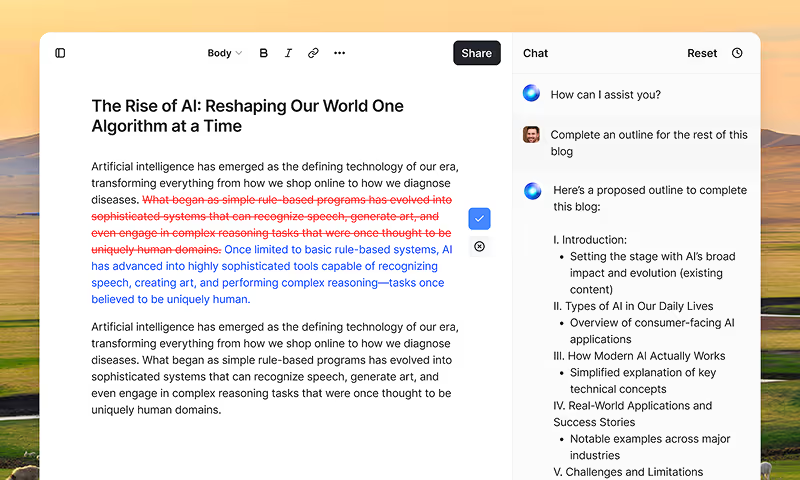
HyperWrite is the AI writing assistant that learns your style. It handles drafting, editing, and researching so you can focus on ideas.
- Autocompletes sentences as you type
- Works inside Google Docs & Gmail
- Adapts to your personal writing style
- 500+ AI tools for any writing task
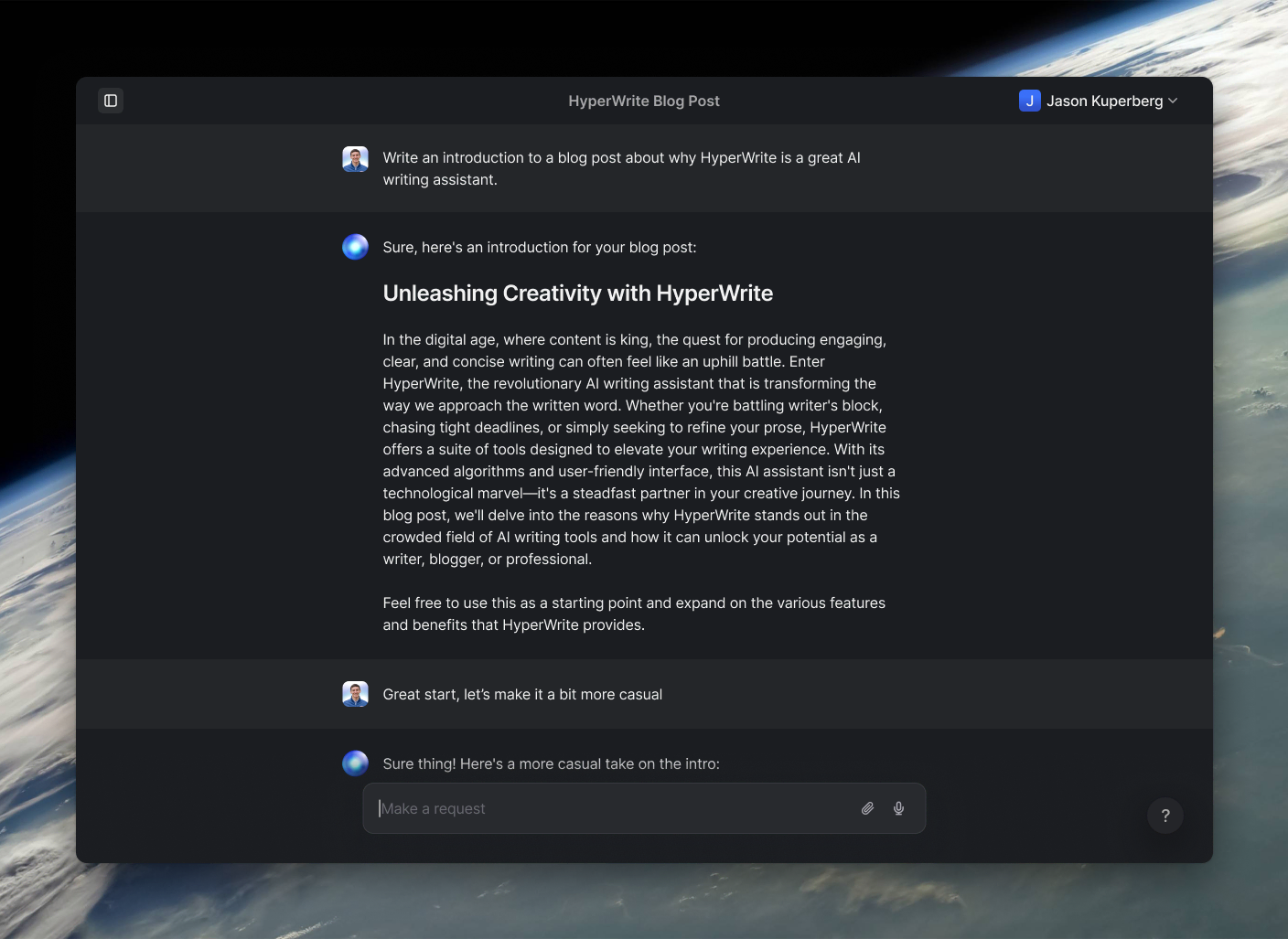
Powerful writing in seconds
Improve your existing writing or create high-quality content in seconds. From catchy headlines to persuasive emails, our tools are tailored to your unique needs.