


Anyword vs Sudowrite is a common comparison, yet these two, and HyperWrite alongside them, barely do the same job. One predicts how marketing copy will perform, one drafts novels, and one writes alongside you in every app. Here, we look at which one matches the writing you actually do.
Anyword vs Sudowrite vs HyperWrite: At a glance
Annual pricing verified from each vendor as of June 2026.
Choose Anyword if you write ads, landing pages, and emails and want data on which version will convert before you ship it.
Choose Sudowrite if you write fiction and want a tool built for scenes, character, and prose rather than marketing or business copy.
Choose HyperWrite if you write across Gmail, Docs, LinkedIn, and other apps all day and want help drafting in your own voice as you type.
Meet the three tools
Anyword sits closest to the media buyer’s desk. It writes ad variants, landing-page copy, emails, and social posts, then uses its Predictive Performance Score to estimate which version is most likely to work.
Sudowrite is an AI writing tool built for fiction. Created by science-fiction writers, it’s shaped around scenes, characters, rewrites, sensory description, and world-building. It’s a tool for novelists and screenwriters who need help moving a story forward without turning the prose into ad copy.
HyperWrite is a professional writing co-pilot that works across every tab in your browser. TypeAhead reads the context around your work and suggests full-sentence completions while Personas help preserve your voice. Its AI tool library handles longer drafts, rewrites, and research when a quick completion isn’t enough.
Anyword vs Sudowrite vs HyperWrite: Feature breakdown
Output quality
Anyword produces clean, conversion-focused copy, and the performance score is the real value: it tells you which version is likely to work. Quality depends heavily on how detailed your brief is, and output can go generic on niche or technical topics.
Sudowrite produces strong, creative prose because Muse is tuned for fiction. It reads with genre awareness that a general model can't match without heavy prompting. Character actions and continuity can drift, though, so careful editing is still required.
HyperWrite produces natural, professional writing that fits the flow of an email or document, backed by an AI Tools library for rewrites, outlines, and summaries. It won't out-write Sudowrite on prose or Anyword on conversion, but for everyday work writing, it holds its own.
Winner: Tie. Sudowrite for creative prose, Anyword for conversion copy.
Voice and personalization
Anyword can learn a brand voice and apply it across copy, helping teams keep messaging consistent, though the voice training applies unevenly across templates.
Sudowrite can mimic a writing style to a degree through its Match My Style feature, but the prose drifts on longer work and needs editing to stay consistent with your own voice.
HyperWrite’s Personas train on your writing so suggestions sound like you, and you can set up separate Personas for different contexts, client emails, posts, and internal docs, each matched to how you write.
Winner: Depends on the kind of voice you need. HyperWrite's Personas for matching an individual writer, Anyword for holding a brand voice across a team, and Sudowrite for shaping a fiction style.
Performance prediction and optimization
Anyword scores every piece of copy against a dataset of real A/B-tested ads, forecasting how a version will convert before you publish. It connects to your ad channels to learn from your own campaign history, so the predictions sharpen over time.
Sudowrite has no performance or conversion features, since it's built for fiction rather than marketing.
HyperWrite helps you write the copy, but doesn't predict how it will perform or tie into ad and analytics data.
Winner: Anyword. Conversion prediction is its defining strength, and neither other tool attempts it.
Real-time and in-workflow writing
Anyword works in its own dashboard. You generate copy there, then move it into your channels, so it sits beside your workflow rather than inside it.
Sudowrite works in its own canvas editor, which makes sense for drafting a manuscript in one focused space.
HyperWrite writes where you already are. TypeAhead suggests completions in real time inside Gmail, Docs, LinkedIn, and other browser fields, so you accept, edit, or ignore as you go without copying between tools.
Winner: HyperWrite. It's the only one that writes alongside you in real time across your daily apps.
Long-form and manuscript handling
Sudowrite is built for book-length work. Its Story Bible tracks characters, plot, and world-building, while the drafting tools move a manuscript forward chapter by chapter so it stays consistent across tens of thousands of words. It exports finished work to DOCX (and Story Bible elements to CSV), though not to PDF or EPUB.
Anyword aims at short-form copy, and long-form output thins out past a few paragraphs without heavy prompting.
HyperWrite is built mainly for short-form tasks and browser-based workflows, but it has expanded into long-form creative writing with its AI Fantasy Writer. Even so, authors still need to handle high-level manuscript structure and cross-chapter continuity manually.
Winner: Sudowrite. Its Story Bible and drafting tools provide manuscript features the others don't have.
Ease of use and learning curve
Anyword has a clean dashboard that marketers pick up quickly, though a few features get fiddly and the workflow can break up as you move between them.
Sudowrite’s Story Bible, credit system, and free-form canvas all take time to learn before the tool clicks.
HyperWrite installs as a browser extension and starts suggesting right away, with little to learn before it becomes useful in your workflow.
Winner: HyperWrite for an instant start with minimal setup.
Pricing and value
Anyword starts at $49/month ($39 annual) for Starter, jumping to $99/month ($79 annual) for Data-Driven with three seats. Every tier includes unlimited copy generation; the price climbs with performance predictions and seats. It's steep for freelancers and small teams.
Sudowrite runs $19/month ($10 annual) for Hobby, $29/month ($22 annual) for Professional, and $59/month ($44 annual) for Max with credit rollover. All tiers unlock every feature; you're paying for monthly credits rather than capabilities. There's no ongoing free plan, just a one-time trial.
HyperWrite has a free plan (10 AI uses plus TypeAhead in the Chrome extension), then Premium at $19.99/month ($16 annual) with 250 messages and 3 Personas, and Ultra at $44.99/month ($29 annual).
Winner: Depends on use. Sudowrite is the cheapest to start; HyperWrite has the only real free plan; and Anyword costs the most but bundles performance data.
What real users are saying
Anyword

Pro: It speeds up everyday copy and shows what works. Roshanlal Y., an assistant to the director of a small business, writes that "the performance scores are also helpful when I'm deciding between different variations."

Con: It struggles with niche terminology. Arnav P., an SDE, praised the setup but flagged "certain limitations in how the software handles highly specialized industry terminology," so niche markets need extra editing.
Sudowrite

Pro: Idea generation and consistency. Nubwa J., a virtual assistant, writes that "its story feature is exceptional for developing a full novel."
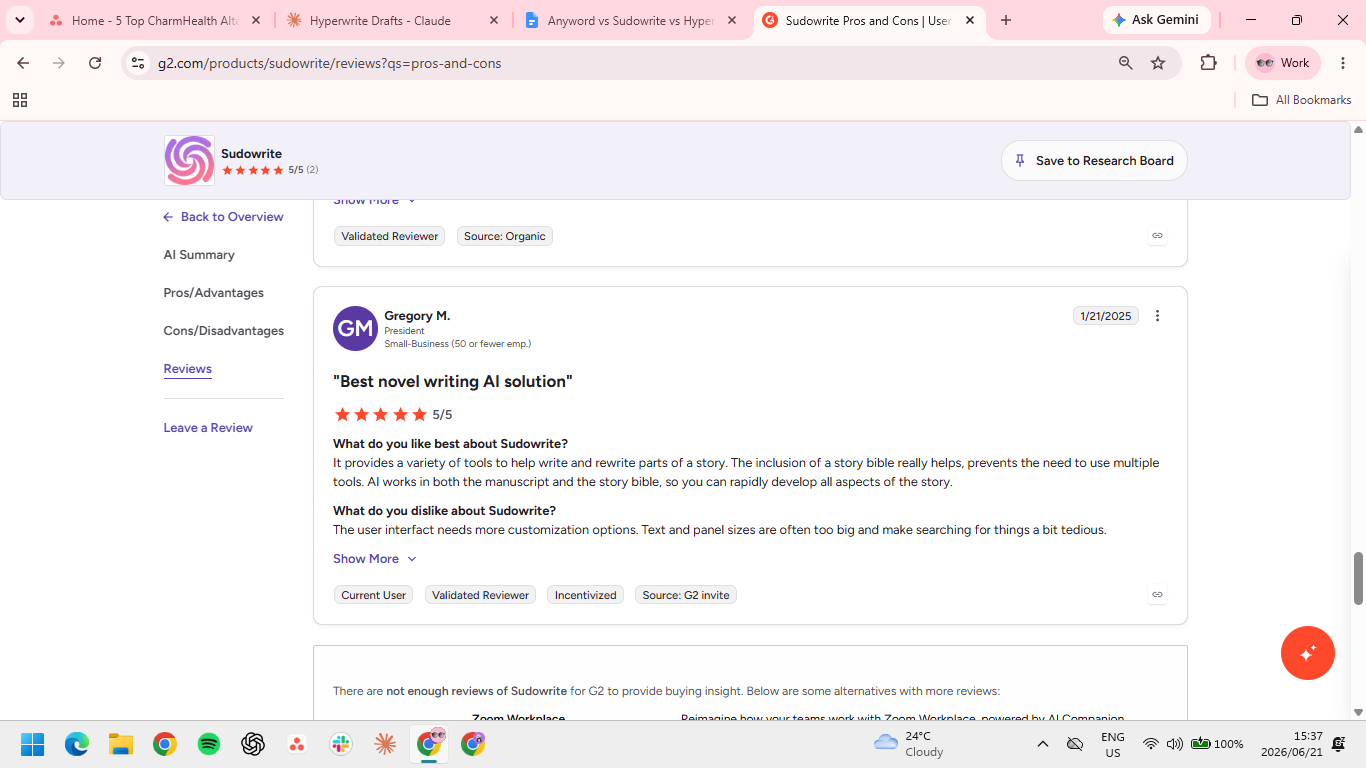
Con: The interface needs more customization. Gregory M., a company president, says the "text and panel sizes are often too big and make searching for things" tedious.
HyperWrite
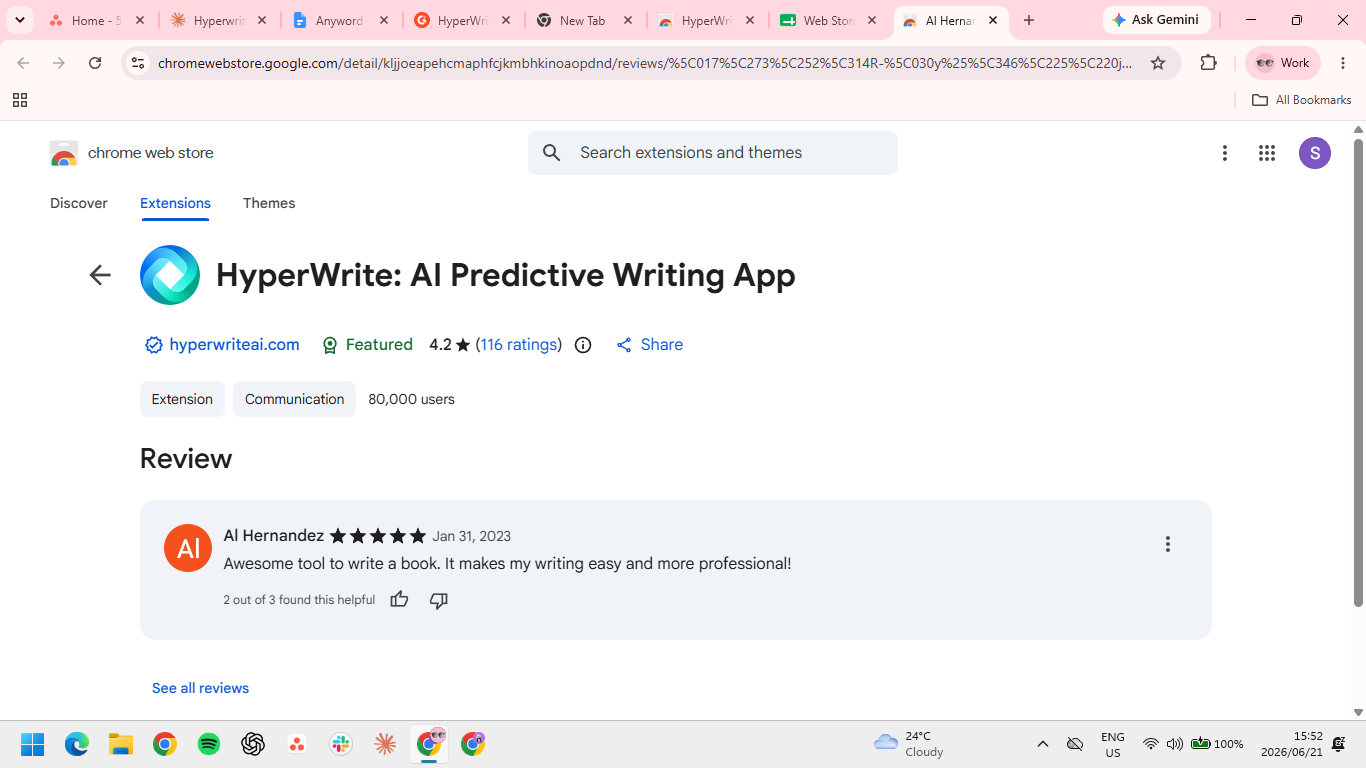
Pro: It makes writing easier and more refined. Al Hernandez calls HyperWrite an “awesome tool to write a book,” making his writing more professional.

Con: Its power is split across separate tools. Konjengbam M. likes the platform but wishes for "a single AI that could do all the task done by different tools." HyperWrite spreads work across its AI tool library, where each job runs in its own dedicated tool rather than one catch-all prompt.
Which tool should you choose?
These tools solve different problems, so the right pick depends on what you write most.
Choose Anyword if you:
- Write ads, landing pages, emails, and social copy for a living
- Want data on which version will convert before you publish
- Work on a marketing team that has to justify content decisions
- Care more about performance than creative range
Choose Sudowrite if you:
- Write fiction: novels, short stories, or screenplays
- Want prose tools tuned for scenes, character, and description
- Need to keep continuity across a long manuscript
- Value creative output over marketing or business writing
Choose HyperWrite if you:
- Write across email, docs, LinkedIn, and other apps all day
- Want AI that drafts in your actual voice, not a generic register
- Need help writing inside your workflow without switching tools
- Are a founder, executive, marketer, or professional writing high-stakes everyday content
The final verdict
Anyword is the call for performance marketers, with conversion prediction, nothing else matches. Sudowrite is the pick for fiction writers, with prose and continuity tools that no general tool offers. For everyday writing, HyperWrite is the fit: it drafts in your voice, inside the apps you already use, in real time, which is what turns writing faster into a habit.
If most of your writing spans emails, docs, posts, and replies across a dozen tabs, HyperWrite is the one built for it. TypeAhead suggests full-sentence completions inside whatever tab you're in, and Personas keep it sounding like you.
The real test is a normal workday: spend a morning writing the way you always do with the Chrome extension running, and you'll know quickly whether it fits.
Tired of switching to an AI tab every time you need to write something? Try TypeAhead free with the Chrome extension and draft in your own voice wherever you type, no credit card needed.
Frequently asked questions
Is Anyword or Sudowrite better?
Anyword and Sudowrite are better at different things. Anyword is better for marketing copy, with predictive performance scoring for ads, emails, and landing pages. Sudowrite is better for fiction, with prose tools built for novels and screenplays.
What is the main difference between Anyword, Sudowrite, and HyperWrite?
The main difference is the job each tool is built for. Anyword predicts how marketing copy will perform, Sudowrite drafts fiction with a story-focused AI model, and HyperWrite writes everyday professional content in your voice across your browser apps.
Which AI writing tool is best for fiction?
Sudowrite is the best AI writing tool for fiction. It runs on Muse, a model fine-tuned on novels and short stories, and its Story Bible, Describe, and Brainstorm tools are built for scenes, character development, and long-form continuity.
Which is the most affordable?
The most affordable is Sudowrite. It’s the cheapest to start at $10/month on annual billing. Next to that HyperWrite offers the only genuine free plan, with 10 AI uses plus TypeAhead in the Chrome extension.
Can one tool replace all three?
No, one tool can't fully replace all three, because they specialize in different writing. A marketer might pair HyperWrite for everyday writing with Anyword for campaign copy; a novelist would lean on Sudowrite. Most writers only need the one that matches their main work rather than all three at once.
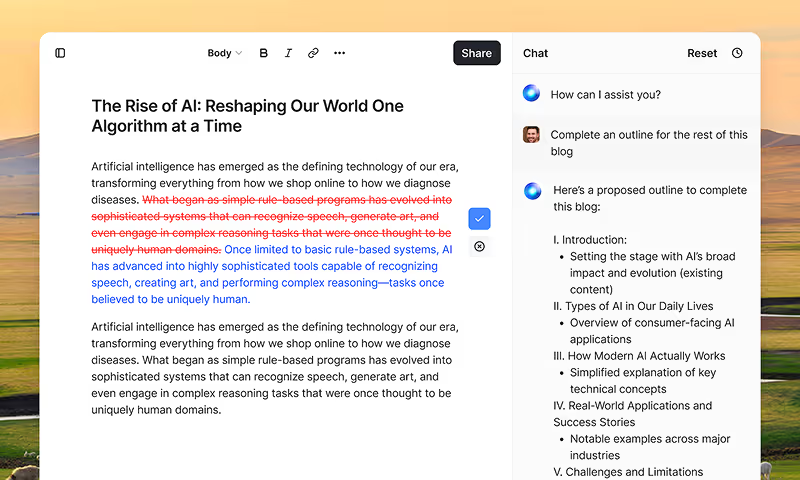
HyperWrite is the AI writing assistant that learns your style. It handles drafting, editing, and researching so you can focus on ideas.
- Autocompletes sentences as you type
- Works inside Google Docs & Gmail
- Adapts to your personal writing style
- 500+ AI tools for any writing task

Powerful writing in seconds
Improve your existing writing or create high-quality content in seconds. From catchy headlines to persuasive emails, our tools are tailored to your unique needs.