
How Long Does It Take to Write a 5-Page Paper? 5-12 Hours


It's 9 p.m., the paper is due at 8 a.m., and the only thing on the page is your name and the date. Been there. What you need to know is how many hours to block out so you're not still typing at 3 a.m.
Most people need about 5 to 12 hours of focused work to write a 5-page paper, and it goes faster on a topic you already know. I've written plenty of these against a deadline, and the hours almost always track how much research you still have to do.
Below is the time broken down by stage and by situation, plus the tactics that shave real hours off (no all-nighter required).
How long does it take to write a 5-page paper?
Writing a 5-page paper usually takes about 5 to 12 hours of focused work. On a familiar topic with your sources ready, you can be done in four or five. On a research-heavy paper with a strict citation style, plan for closer to ten or twelve, spread across a few days. A full research paper can run past 15 hours.
Four things move that number more than anything else:
- How well you know the topic. Familiar material skips most of the research.
- How much research the paper needs. Reading and note-taking can take 30 minutes or 4 hours.
- Spacing, double or single. A double-spaced paper is about half the words of a single-spaced one.
- Your writing speed and focus. A quiet hour beats three distracted ones.
If you can, spread the work over two or three days. Drafts get better when you sleep on them, and the version you grind out in one 3 a.m. sitting is usually the weakest one you'll turn in.
How long is 5 pages in words?
Before you can guess the hours, you need to know the word count you're actually writing. A page count is a format, so the words behind it depend on spacing and font.
As a rough rule, one double-spaced page runs about 250 words, and a single-spaced page about 500.
So a 5-page paper is roughly:
- 1,250 words double-spaced, the most common assignment format.
- 2,500 words single-spaced.
Check the formatting guidelines for the spacing, font, and margins, since all three shift the count. The practical takeaway: a double-spaced 5-page essay drafts about twice as fast as a single-spaced one, because you're writing half the words.
Time breakdown by stage: research, outlining, drafting, and revising
Drafting takes the most hours in a 5-page paper, but research is what swings the total. Here's a realistic breakdown, with a familiar topic in one column and a research-heavy paper in the other.
If you build a tight outline before you draft, the drafting stage shrinks, because every paragraph already knows its job.
How long it takes based on your situation
Your timeline depends mostly on which writer you are tonight.
The last-minute sprint works, and plenty of us have pulled it off (not proudly). The catch is quality: a one-sitting draft reads like a one-sitting draft, and readers notice. If you're staring at a blank screen and can't get the first line down, that's a sign to switch tactics instead of grinding.
Can you write a 5-page paper in 2 hours, 3 hours, or one day?
Short version: yes for some of these, if you already know what you want to say. At an average typing speed of about 52 words per minute, measured across 168,000 typists, putting 1,250 words on the page takes under half an hour. The rest of the time goes to thinking through the argument.
Here's the realistic read on each:
- In an hour? You can fill the pages, but it'll be a first draft at best. Fine for low stakes, risky for anything important.
- In 2 hours? Doable only if you know the topic cold and skip real research. Expect a rough draft.
- In 3 hours? Tight but possible on a familiar topic with your sources already open.
- In one day? Comfortable, even with a little research. Enough time for a solid paper, though two days is better.
How to write a 5-page paper faster
The fastest paper I've ever written started with 20 minutes of outlining before I wrote a word. Speed comes from front-loading your decisions. Six tactics that work, plus a one-day plan that puts them together:
Outline and gather sources first
Decide your argument and pull your sources before you write a sentence. With those two things settled, drafting stops feeling like invention.
For a 1,250-word paper, a simple split works: roughly 175 words of introduction, three body sections of about 300 words each, and a 175-word conclusion. Write one sentence per body section stating its claim, and note which source backs it. Any section without a source is where your research time should go.
Take notes and cite as you go
Drop quotes, page numbers, and citation details straight into your draft while you research. Hunting down a source at 2 a.m. for a quote you already read is the worst kind of rework.
If you write in Google Docs, its built-in citations tool (Tools > Citations) formats in-text citations and a bibliography in MLA (8th ed.), APA (7th ed.), or Chicago Author-Date (17th ed.). Add each source as you read, and insert the bibliography once you've finished citing.
Don't chase the word count in draft one
Aim for about 80% of the length, then stop. Drafts grow as you edit and add examples, so a four-page rough draft often lands at five after a real revision pass. Write the body first and the introduction last, once you know what the paper actually argues.
Draft in one pass, edit in another
Editing while you write is what slows a draft down most. Get the ugly version down first, then switch to fixing it (your future self at 2 a.m. will thank you). Your brain is faster when it does one job at a time.
When you switch to editing, work from big to small: the argument and section order first, then paragraphs, then sentences, with citations and formatting last. Polishing a paragraph you later cut is time you don't get back.
Dictate or start from an AI draft
Speaking is faster than typing, and a rough AI first draft removes the blank page. Google Docs has free voice typing under Tools > Voice typing in Chrome, Edge, and Safari, which helps when you can explain a point out loud but can't get it onto the page. For the AI route, Scholar AI in HyperWrite speeds up the source hunt, and AutoWrite drafts paragraphs from your outline. Its AI Writing Assistant then tightens sections, so you spend your hour editing instead of staring.
Take short breaks
Short breaks help, but mostly with energy. A 2022 meta-analysis in PLOS One found that breaks of 10 minutes or less made people feel a little more energetic and less tired. They didn't significantly improve overall performance, though, and longer breaks helped performance more.
So take a quick walk when you stall mid-draft to stay focused, and save a longer break, ideally a night's sleep, for before you revise.
A one-day plan for a familiar topic
Put together, the tactics fit the familiar-topic times from the stage table above:
- Research (30 minutes): pull your sources and drop quotes and citations into the doc.
- Outline (20 minutes): write your thesis and one claim per body section.
- Draft (2 to 3 hours): write the body sections, then the introduction and conclusion.
- Break (as long as you can spare): step away before you reread anything.
- Revise (1 hour): run the big-to-small edit pass from above.
Want more ways to shave off time? Our guide on how to write faster goes deeper.
Common mistakes that slow you down
A few habits quietly add hours. Avoid these and the whole thing goes faster.
Fix even two of these and you'll win back real hours on the same paper.
5 pages vs. 3, 4, and 10 pages: a quick comparison
Once you know the five-page math, the other lengths are easy to estimate. Research is still the swing factor, so treat these as familiar-topic ballparks.
A 10-page paper rarely takes exactly twice as long, since your research and outline already carry over. The extra pages are mostly more drafting.
Write your next paper faster with HyperWrite
Whether it's a 5-page paper or a 5-page proposal, the hours go to the same three places: finding sources, getting a first draft down, and revising it until it sounds like you.
HyperWrite covers each of those stages:
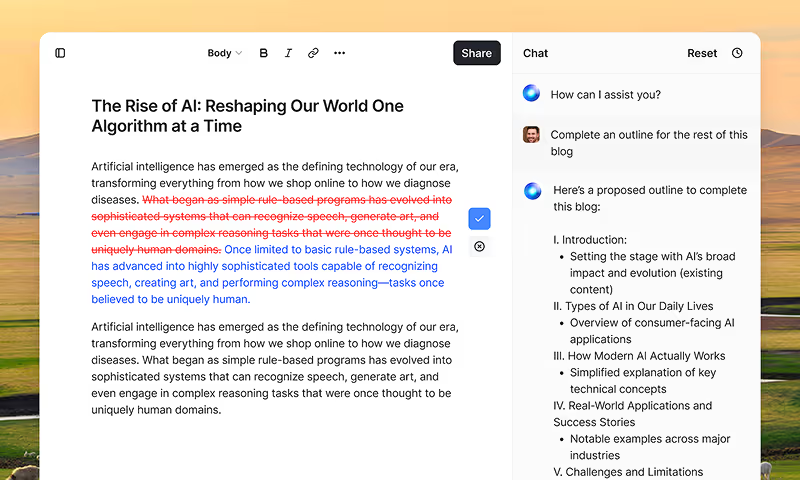
- Research inside your draft: the AI Document Editor finds relevant sources and citations through a chat that sits next to your writing.
- Pull peer-reviewed evidence: Scholar AI searches millions of peer-reviewed articles and summarizes the key findings.
- Get past the blank page: give AutoWrite your thesis and outline as the task, and it writes a rough version you can build on.
- Keep it in your voice: on Premium or Ultra, set up a Persona once, and HyperWrite's writing matches how you sound.
- Finish sentences anywhere: TypeAhead in HyperWrite for Chrome completes your sentences in context in Google Docs, Gmail, and the rest of your browser.
Get started with HyperWrite for free and open your next paper in the AI Document Editor, where the assistant can give feedback and apply edits for you.
Frequently asked questions
How long does it take to write a 5-page paper?
Writing a 5-page paper usually takes about 5 to 12 hours of focused work. A familiar topic with sources ready can take four to five hours, while a research-heavy paper with strict citations runs closer to ten or twelve, ideally spread over a few days.
How many words is a 5-page paper?
A 5-page paper is about 1,250 words double-spaced or 2,500 words single-spaced. Font, margins, and spacing shift the exact count, so confirm the required format before you start.
Can I write a 5-page paper in 2 hours?
Yes, you can write a 5-page paper in 2 hours, but only if you know the topic well and skip deep research. The result will be a rough draft, so expect lower quality than a paper you spread over a couple of days.
Can I write a 5-page paper in one day?
Yes, you can comfortably write a 5-page paper in one day, even with light research. One day gives you time to outline, draft, and revise, which is enough for a polished result.
Can I write a 5-page paper in 2 days?
Yes, two days is plenty of time to write a 5-page paper well. It leaves room to research and draft on day one, then sleep on it and revise with fresh eyes on day two.
How long does it take to write a 5-paragraph essay?
A 5-paragraph essay usually takes 1 to 2 hours since it runs about 400 to 500 words. Most of that time goes to outlining your thesis and three supporting points, since the typing itself is quick.
HyperWrite is the AI writing assistant that learns your style. It handles drafting, editing, and researching so you can focus on ideas.
- Autocompletes sentences as you type
- Works inside Google Docs & Gmail
- Adapts to your personal writing style
- 500+ AI tools for any writing task
Powerful writing in seconds
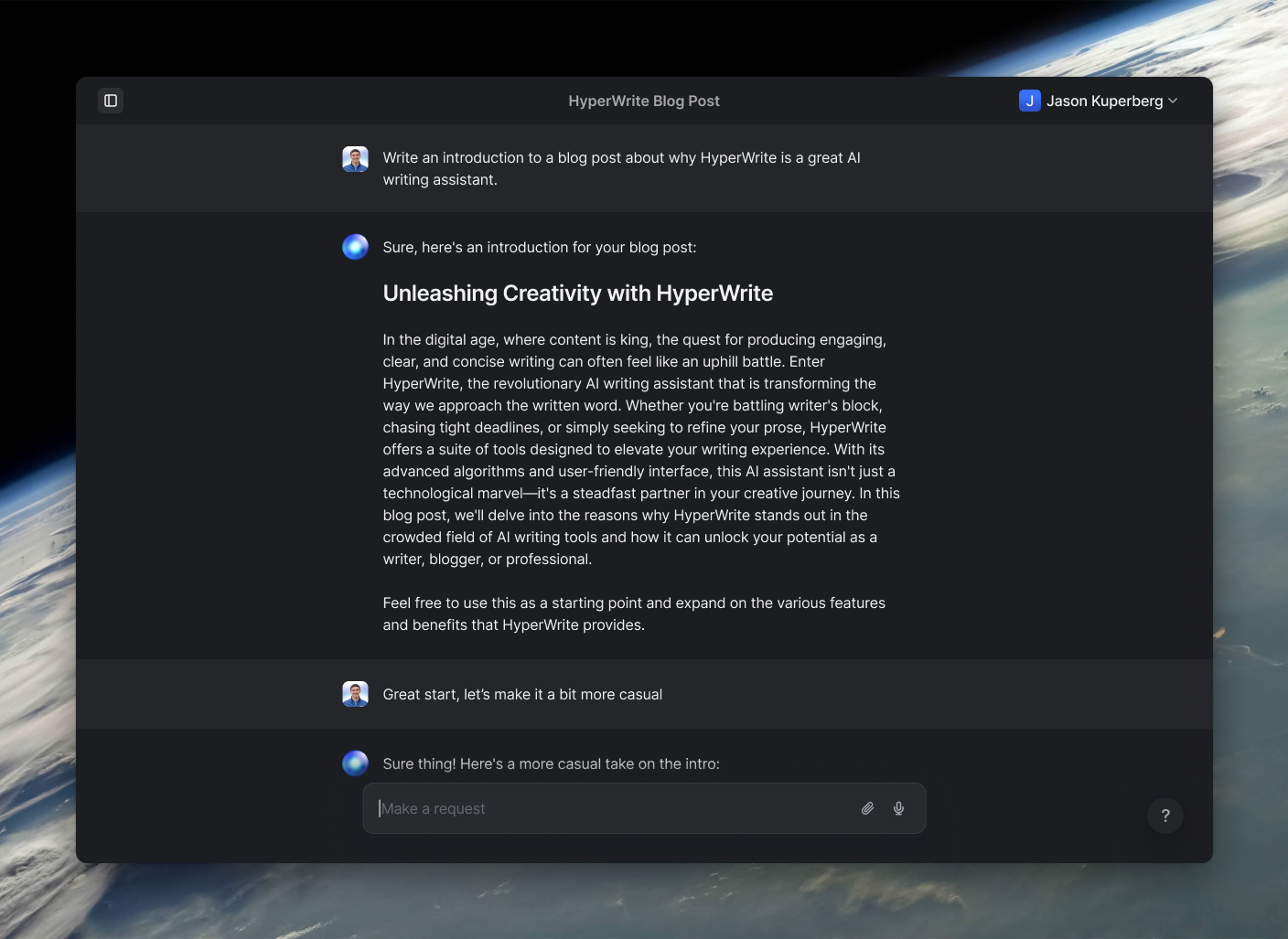
Improve your existing writing or create high-quality content in seconds. From catchy headlines to persuasive emails, our tools are tailored to your unique needs.