


Journalists delete most press releases before finishing the first paragraph. These six press release templates are built around what makes them stop.
The structure of a press release
Every press release follows the same structure with nine standard parts:
Release notation
The line at the top of every release, in all caps: FOR IMMEDIATE RELEASE.
If you want journalists to hold the story until a specific date, replace it with EMBARGOED UNTIL [DATE] [TIME] [TIME ZONE]. This tells reporters when the news can go public.
Headline
The headline is the news in one line. It should use an action word, include a specific number where it fits, and skip adjectives like "exciting" or "innovative." A good headline could be a news article's headline on its own.
Bad headline: "Acme Launches Innovative New Tool."
Good headline: "Acme Launches AI Tool That Cuts Email Drafting Time by 60%."
Subheadline
A single sentence that adds the "why it matters" angle that the headline can't carry on its own. Use it when the headline alone doesn't fully convey the significance of the news. Skip it when the headline already says everything.
Dateline
The city, state, and date that open the lead paragraph. Format: CITY, State, Month Day, Year, followed by the first sentence.
Example: AUSTIN, Texas — June 15, 2026 — Acme today announced…
The dateline tells journalists where the news originated and when it was issued.
Lead paragraph
The lead answers who, what, when, where, and why, ideally in 1–2 sentences. It's the most important paragraph in the release.
If a journalist only reads this, they should still understand the news. Front-load the most surprising or specific fact, and keep it under 40 words.
Body
The body fills in the supporting details using the inverted pyramid: most important information first, supporting context second, background last.
Journalists rarely read past paragraph three, so anything critical needs to be in the top half. Include data, customer numbers, or specifics that make the news feel real.
Quote
The quote adds a human voice. The strongest quotes either give context the lead can't carry or explain the decision behind the news.
Avoid generic excitement. "We are thrilled to announce" gets cut from articles every time. "Our customers told us they wanted X" gets pulled in.
Boilerplate
The boilerplate is a 2–3 sentence "About [Company]" paragraph at the bottom of every release. It covers what you do, when you started, where you're based, and one credibility marker (funding raised, customer count, notable clients).
Journalists copy it directly into their articles, so write it once carefully and reuse it across releases.
Contact information
A name, email, and phone number at the top of the release for the PR or comms contact. This is who journalists reach out to with follow-up questions. Without it, reporters who want to cover your story can't reach you.
6 press release templates for the most common announcements
1. The general press release template
Use this for any announcement that doesn't fit a more specific type. It's the base format every press release follows.
FOR IMMEDIATE RELEASE
Contact: [Your name]
Email: [your.email@company.com]
Phone: [Your phone number]
[HEADLINE: ONE LINE, ACTIVE VOICE, INCLUDES THE NEWS]
[Subheadline: One sentence adding the "why it matters" angle]
[CITY], [STATE] — [Month Day, Year] — [One-paragraph lead answering who, what, when, where, and why. Front-load the most newsworthy fact. Aim for 25-40 words.]
[Body paragraph 1: The biggest supporting detail. Include data or specifics that make the news real.]
"[Quote that says something specific about the impact, not generic excitement. Avoid 'we are thrilled to announce.']" said [Name], [Title] at [Company].
[Body paragraph 2: Background context, timing details, or what comes next.]
About [Company Name]
[2-3 sentence boilerplate: what your company does, when founded, where based, and one credibility marker (funding, customer count, year founded).]
###
Pro tip: Use this template when the news doesn't fit one of the more specific types below: corporate announcements, policy changes, office moves, or anything that's important to your audience but doesn't have a standard format.
2. Product launch press release template
Use this when announcing a new product or a major feature. Lead with the problem your product solves, not the product itself.
FOR IMMEDIATE RELEASE
Contact: [Name, email, phone]
[HEADLINE: Product name + what it does + specific benefit]
[Subheadline: Who it's for and why it matters now]
[CITY, STATE] — [Date] — [Company] today launched [product name], [one-sentence description of what it does]. The [product] is designed for [target user] who currently [pain point], and is available [where and when].
[Paragraph 2: What makes it different from existing solutions. Include one concrete metric: speed, cost, scale, or outcome.]
"[Quote explaining the problem you saw and why this product solves it. Skip the excitement, focus on the customer insight.]" said [Name, Title].
[Paragraph 3: Pricing, availability, and how to access it. Include a link to the product page.]
About [Company]: [2-3 sentence boilerplate]
###
Pro tip: Send 1–2 weeks before public availability. Journalists need lead time to prepare coverage, and you want stories to drop the day your product goes live, not three weeks after.
3. Funding announcement press release template
Use this for seed, Series A/B/C, or any major investment round. The amount and the lead investor are the news. Everything else is context.
FOR IMMEDIATE RELEASE
Contact: [Name, email, phone]
[HEADLINE: Company name + amount raised + lead investor + what it funds]
[Subheadline: One sentence on what the funding enables]
[CITY, STATE] — [Date] — [Company], [one-line company description], today announced it has raised $[X million] in [round type] funding led by [lead investor], with participation from [other investors]. The funding will be used to [specific use: hiring, expansion, product development].
[Paragraph 2: Traction or growth metrics that justify the raise. Customer count, revenue growth, or expansion milestones work well here.]
"[Quote from the lead investor explaining why they invested. Investor quotes carry more weight than founder quotes in funding stories.]" said [Investor name, Title at fund].
[Paragraph 3: What's next. Hiring plans, product roadmap, or market expansion. Include specific numbers where possible.]
About [Company]: [2-3 sentence boilerplate, including total funding raised to date]
###
Pro tip: Coordinate timing with your lead investor's PR team. Most VCs have a preferred announcement window and will push your story to their press contacts if you align with theirs.
4. Executive hire press release template
Use this for senior hires, board appointments, or major internal promotions. Focus on the person's track record and what they're bringing to the company.
FOR IMMEDIATE RELEASE
Contact: [Name, email, phone]
[HEADLINE: Company + appoints + name + new title + most credible past role]
[Subheadline: What they'll lead or change]
[CITY, STATE] — [Date] — [Company] today announced the appointment of [Name] as [New Title], effective [date]. [Name] joins from [previous company], where they [most relevant accomplishment with a metric].
[Paragraph 2: Background and credentials. Previous roles, notable achievements, and why their experience matters for the company's current stage.]
"[Quote from the new hire about what drew them to the company and what they plan to do. Skip humility theater, focus on the work.]" said [Name].
[Paragraph 3: Quote from CEO or board chair on why this hire matters strategically. What gap does this person fill?]
About [Company]: [2-3 sentence boilerplate]
###
Pro tip: Send the release to publications connected to the hire's background. Their hometown paper, alumni magazine, or trade publication from their previous industry often picks up executive hire stories that national outlets skip.
5. Partnership announcement press release template
Use this for strategic partnerships, integrations, or co-marketing deals. The news isn't that you're working together. It's what the partnership enables that neither company could do alone.
FOR IMMEDIATE RELEASE
Contact: [Name from both companies, email, phone]
[HEADLINE: Both company names + what the partnership delivers to customers]
[Subheadline: Specific new capability or benefit]
[CITY, STATE] — [Date] — [Company A] and [Company B] today announced a partnership to [specific capability or product the partnership creates]. The collaboration will [concrete customer benefit] starting [date].
[Paragraph 2: What each company brings to the partnership. Be specific about which capabilities come from which side.]
"[Quote from Company A leader on why this partnership matters to their customers. Focus on outcomes, not the relationship.]" said [Name, Title at Company A].
"[Quote from Company B leader that complements the first quote rather than repeating it. If A talked about customer impact, B should talk about strategic fit or industry direction.]" said [Name, Title at Company B].
[Paragraph 3: How customers can access the partnership. Pricing, availability, integration details.]
About [Company A]: [boilerplate]
About [Company B]: [boilerplate]
###
Pro tip: Get full approval from your partner before sending. Distribute the release simultaneously through both companies' channels for maximum reach.
6. Company milestone press release template
Use this for anniversaries, customer milestones (1,000th customer, 1 million users), revenue benchmarks, or expansion announcements. Milestones build credibility with investors and prospects even when there's no product news to share.
FOR IMMEDIATE RELEASE
Contact: [Name, email, phone]
[HEADLINE: Company + specific milestone + the number that proves it]
[Subheadline: What the milestone signals about the company's trajectory]
[CITY, STATE] — [Date] — [Company] today announced it has reached [specific milestone with a number]. The milestone reflects [growth metric or business outcome], up from [previous benchmark] in [timeframe].
[Paragraph 2: Context for the milestone. What it took to get here, who contributed, and what it means for customers or the industry.]
"[Quote tying the milestone to a specific customer outcome or business trend. Avoid 'we're proud to announce' language.]" said [Name, Title].
[Paragraph 3: What's next. The milestone is a checkpoint, not an endpoint. Tell readers what the company is doing with this momentum.]
About [Company]: [2-3 sentence boilerplate]
###
Pro tip: Pair milestones with original data when possible. A customer count is news; a customer count plus a survey of those customers about industry trends is a story journalists will actually write about.
4 mistakes that kill press releases
Journalists simply close bad press releases. These four mistakes are usually why:
1. Burying the lead. If your first paragraph doesn't deliver the news, journalists move on. Most reporters spend just 5–10 seconds deciding whether to read past the lead. Front-load the specific, newsworthy fact. Add context after.
2. Generic quotes that say nothing. "We are excited to announce" tells the journalist nothing. Specific quotes get pulled into articles. Generic ones get cut. Replace "thrilled to share" with "this changes how X works" or "our customers told us they wanted Y."
3. No real news. A press release that says "company continues to exist" or "we updated our website" isn't news. Test before you write: would a stranger outside your company care about this? If the answer is no, it's not a press release.
4. Skipping the boilerplate. The boilerplate is what journalists copy into their articles to describe your company. Without one, they'll either skip your release or describe you incorrectly.
The Associated Press Stylebook is the standard reference for press release writing if you want to go deeper on format.
5 best practices for press releases that get picked up
Avoiding the four mistakes above keeps your release from getting deleted. These five practices give it a real shot at coverage.
1. Write the headline last. You don't know what the news really is until the body is done. Drafting the headline first locks you into an angle that may not be the most newsworthy one. Write the body, then look at it and ask: what's the single most surprising fact in here? That's your headline.
2. Send to specific journalists who cover your beat. Blanket wire distribution is expensive and gets mostly ignored. A short, personalized email to a handful of journalists who actually cover your industry will outperform a wire blast every time. Use tools like Muck Rack or a quick Google search to find reporters who've covered similar news recently.
3. Time the release strategically. Tuesday–Thursday mornings get the most journalist attention. Avoid Mondays (inbox cleanup), Fridays (story queues are closed), and the dead week between Christmas and New Year. For product launches, send 1–2 weeks before going live. For funding announcements, coordinate with your lead investor's PR team on timing.
4. Include multimedia assets. A release with photos, demo videos, or executive headshots gets picked up more often than one with just text. Journalists are working on tight deadlines, and giving them ready-made visuals removes friction. Link to a shared folder with high-resolution images rather than attaching files that clog inboxes.
5. Optimize the release for SEO. Press releases often live on your company's newsroom page and rank for searches like "[your company] funding" or "[your company] new product." Include your target keywords naturally in the headline and lead paragraph. Link to relevant product pages so the release does double duty, earning coverage and building search authority.
How HyperWrite helps write PRs faster
Press releases follow the same structure every time. The work isn't the format. It's writing the lead, the quote, and the body fast without sounding generic. HyperWrite is built for exactly this kind of work.
- TypeAhead writes alongside you in any tab. TypeAhead is HyperWrite's Chrome extension. It suggests the next sentences as you fill in your template, based on what you've already written. Open the template in Google Docs, draft the headline, and it starts predicting the lead. Switch to Gmail to pitch a journalist, and it follows you there.
- Personas match your company voice. Train HyperWrite on your existing writing, and it stops sounding like every other AI-generated release. Useful when the quote needs to sound like your CEO, not a chatbot.
The free plan gets you started, with no credit card required, which is enough to test TypeAhead on a draft and see how it fits your workflow. The paid plans (from $16/month annual) unlock unlimited TypeAheads and persona training for regular press release writing.
Still rewriting the same lead paragraph for the third time? Try TypeAhead free with the Chrome extension and see how much faster a release comes together when the next sentence is already waiting.
Frequently asked questions
What is the standard press release format?
The standard press release format includes a headline, subheadline, dateline (city, state, date), lead paragraph with the five Ws, body paragraphs with supporting details and a quote, a boilerplate about your company, and contact information. Most press releases follow Associated Press (AP) style and stay between 300–500 words.
How long should a press release be?
A press release should be 300–500 words on a single page, but around 400 words is the sweet spot. Journalists receive hundreds of releases daily and skim everything past paragraph three. Anything longer than 500 words risks getting deleted before the news gets through.
What's the main difference between a press release and a news article?
The main difference between a press release and a news article is who writes it and why. A press release is written by the company being covered to pitch a story to journalists. A news article is written by a journalist to inform readers, often using press release information as a starting point.
Do I need to send a press release through a wire service?
No, you do not need to send a press release through a wire service. Wire services cost $350–$800 for basic distribution and $1,500–$3,000+ for national campaigns. For most startups and small businesses, sending personalized email pitches to journalists who cover your beat works better than blanket wire distribution.
What is a press release boilerplate?
A press release boilerplate is a 2–3 sentence paragraph at the end of every release describing your company. It typically includes what you do, when you were founded, where you're based, and one credibility marker like funding raised or customer count.
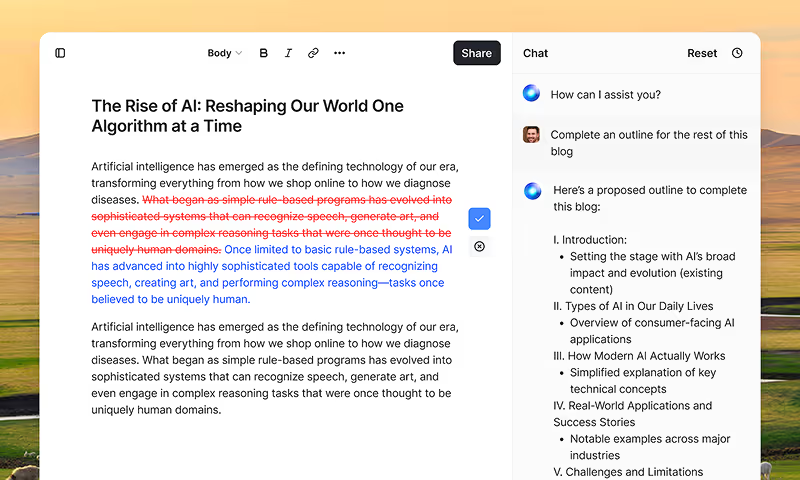
HyperWrite is the AI writing assistant that learns your style. It handles drafting, editing, and researching so you can focus on ideas.
- Autocompletes sentences as you type
- Works inside Google Docs & Gmail
- Adapts to your personal writing style
- 500+ AI tools for any writing task
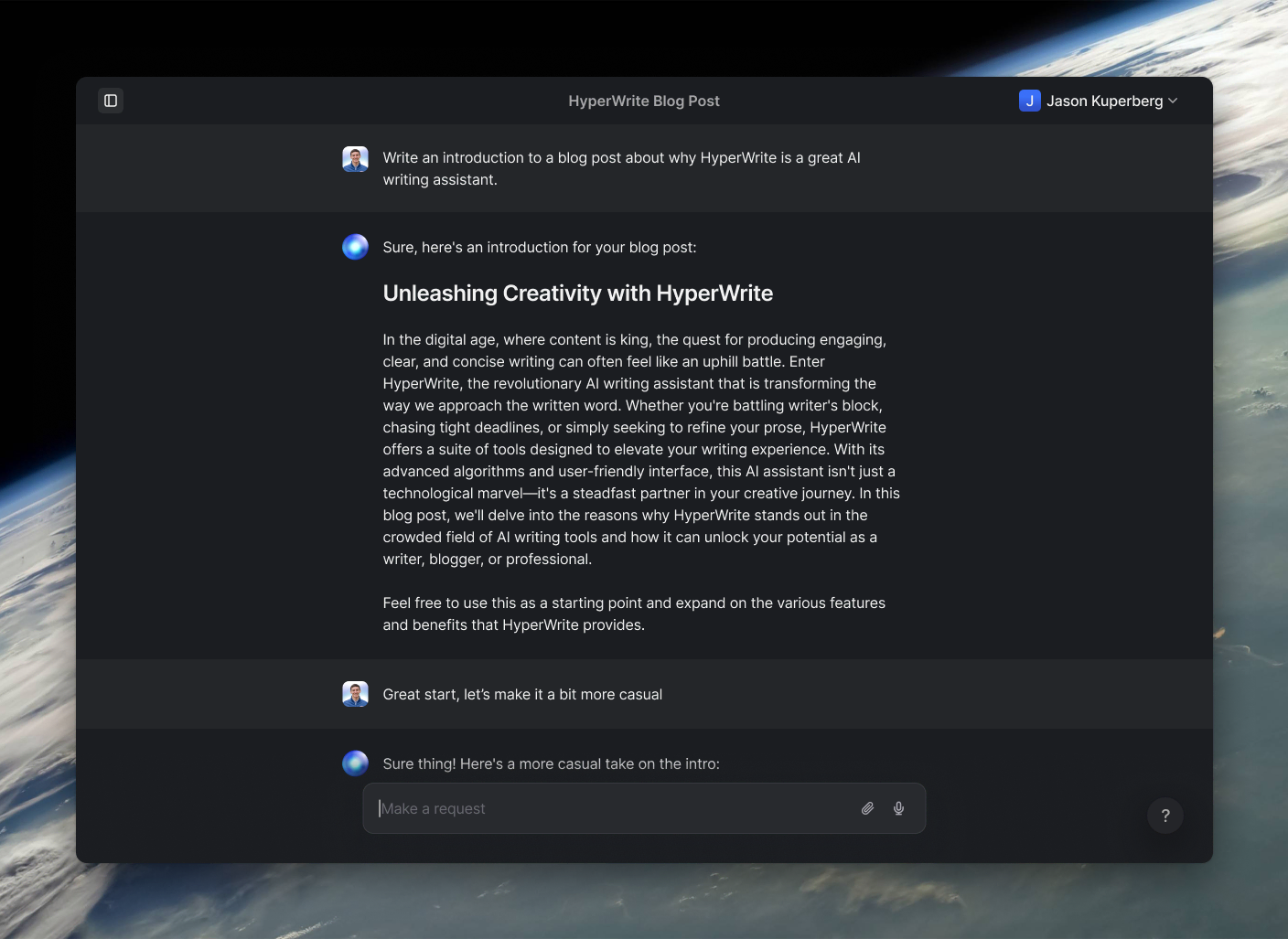
Powerful writing in seconds
Improve your existing writing or create high-quality content in seconds. From catchy headlines to persuasive emails, our tools are tailored to your unique needs.