


A product description has one job: closing the buyer's "yes." After analyzing hundreds of high-converting product descriptions across e-commerce categories, these are the four moves that consistently get it done, with examples at three price points.
The 4 moves behind a high-converting description
The buyer's brain runs the same checklist every time: Is this for me? What does it do? Can I trust it? What's the catch? High-converting descriptions answer those four questions in that order.
Move 1: The hook
The first line decides whether the next four get read. Most product descriptions waste it on a restatement of the product name or a generic claim like "premium quality." Those don't earn the second line.
Hooks that earn the read tend to do one of three things:
- State a specific outcome: "Coffee that's ready before you finish brushing your teeth."
- Name a specific pain point: "Stop reaching for a second pillow."
- Make a distinctive claim: "The only chef's knife forged from a single piece of Japanese VG-10 steel."
The hook should fit in one sentence. If it takes two sentences, the second one is the actual hook.
Move 2: The specific outcome
After the hook, name what changes for the buyer when they own the product. Features can wait until the proof section. The outcome line is where you tell the buyer what their daily life looks like with this thing in it.
Examples:
- Feature: "100% merino wool."
- Outcome: "Wear it five days in a row without it smelling."
- Feature: "1080p webcam with auto-focus."
- Outcome: "Look sharp on calls without fiddling with settings between meetings."
The outcome should be sensory or behavioral. If you can't picture someone using the product in a specific moment, the outcome line needs more work.
Move 3: The proof
This is the specific evidence that the outcome is real. Specs, materials, testing data, reviews, awards, results. Anything an unconvinced buyer would need to believe the promise.
Specifics beat general claims. "Tested in 200+ restaurant kitchens" is more useful than "rigorously tested" because the buyer knows the scale. "Trusted by 50,000 customers" works for the same reason: the number does the trust work. Specifics don't have to be huge to work. The number just has to be real and meaningful to the buyer.
Move 4: The friction-killer
The last move handles the main reason someone hesitates at checkout. The reason varies by category:
- For clothing: sizing, fit, return policy.
- For appliances: installation, durability, warranty.
- For software: onboarding, support, contract length.
- For high-priced items: financing, trial period, comparison to alternatives.
A good friction-killer is specific. "Free 60-day returns" gives the buyer a concrete promise they can verify. Specific shipping timeframes like "Ships in 24 hours, arrives in 3 business days" let the buyer plan around delivery.
Vague language like "satisfaction guaranteed" or "fast shipping" doesn't do the same work.
In practice, the moves often blend. A single sentence can do outcome and proof at once when the spec is the outcome. The order matters more than the separation. As long as the hook lands first and the friction-killer lands last, outcome and proof can interweave.
How the 4 moves shift by price point
The four moves stay the same across every price point. What changes is how much copy each move needs: buyers spending $500 want more proof than buyers spending $20.
Under $50
Short and punchy. Hook, outcome, proof, and friction-killer can all fit in four sentences. Buyers don't need extensive convincing at this price.
Example:
"Coffee that's ready before you finish brushing your teeth. The AeroPress Go brews single-cup pour-over in 90 seconds, with the same setup that pros use in barista championships. Fits in a backpack. Free shipping over $40."
Teardown:
The opening line is a hook with the outcome baked in: the sensory reference (brushing teeth) makes the speed concrete. The line that follows combines proof with outcome by naming a specific time (90 seconds) and a credibility marker (barista championships).
Portability handles one friction-killer in the third sentence, and shipping cost handles another in the fourth. All four moves, 36 words.
$50 to $500
More substance per move. Each one needs more copy because buyers are doing more comparison shopping at this tier. Proof becomes the most important section.
Example:
"A knife that earns its place on the counter. The Magnusson Chef's Knife is forged from a single piece of Japanese VG-10 steel, with a 70-layer Damascus pattern that holds its edge through three full prep sessions before needing a touch-up.
Tested in 200+ restaurant kitchens before launch. Free 60-day returns if it doesn't replace your current chef's knife within the first week."
Teardown:
The hook ("earns its place on the counter") leads with utility. The outcome line earns its specificity: "three full prep sessions before needing a touch-up" is measurable and immediately pictured.
Proof stacks three credibility markers (single piece of steel, 70-layer Damascus pattern, 200+ restaurant kitchens), each verifiable. Note that "70-layer Damascus pattern that holds its edge through three full prep sessions" does double duty: the spec is the outcome, so proof and outcome land in the same line.
The friction-killer ties the return policy to a specific outcome rather than a time window, which handles the "is this worth $200?" objection more directly than "free 60-day returns" alone would.
$500+
Storytelling and proof both expand. Buyers at this price point need to feel the purchase. Proof goes longer (testimonials, video, expert endorsements), and the friction-killer often includes financing or trial periods.
Example:
"Built once, used for decades. The Riverside Lounge Chair is the one you'll read in every Sunday morning for the next thirty years. It's the same chair your kids will fight over when you downsize.
Its frame is solid white oak, joined the way furniture was made before staples and glue: hand-cut mortise and tenon, secured with dowels and dovetails.
Tested through 50,000 simulated sit-cycles before leaving the workshop in Portland. Free white-glove delivery and a 100-day in-home trial. If it doesn't become the chair you reach for every day, send it back."
Teardown:
The hook ("built once, used for decades") is a values claim that aligns with the buyer's reason for spending at this tier. The outcome line gets specific and emotional: "Sunday morning for thirty years" and "kids will fight over when you downsize" turn the values claim into two concrete moments the buyer can picture.
Proof spans three dimensions: craftsmanship (mortise and tenon joinery), testing (50,000 sit-cycles), and origin (workshop in Portland). For the friction-killer, white-glove delivery handles the "this is expensive to ship" objection, while a 100-day trial handles the "what if I don't love it" objection.
Mistakes that affect conversion in product descriptions
A few patterns reliably tank conversion, even on otherwise solid products:
- Restating the product name in the first line. "The Acme Wireless Headphones are wireless headphones..." wastes the strongest position in the description.
- Adjective stacking. "Premium, high-quality, top-tier, professional-grade." Each adjective without specific evidence behind it makes the product feel cheaper, regardless of intent.
- Burying the proof at the bottom. Testing data, materials, and credentials work harder in lines 3-5 than they do under a "specs" tab. Front-load the best proof.
- Generic CTAs. "Buy now" works, but "Add to cart for free 60-day returns" integrates the friction-killer with the action and tends to convert better.
How to know if a description is actually working
A new product description is worth running through actual data. Here's what to measure on each one:
- Add-to-cart rate on the product page. If you change the description and watch this metric, you've isolated the description's effect.
- Time on page. Longer time means the description is being read, which suggests the hook worked. Very short time means the buyer bounced before reaching the proof.
- Cart abandonment rate for that SKU. High abandonment usually means the description created intent but failed to kill friction at checkout.
- Customer service questions. If buyers keep asking the same thing about a product, your description didn't answer it. Add it to the next revision.
For e-commerce stores with the ability to A/B test, run the new description against the old one for at least 1,000 page views per variant before drawing conclusions.
Try this on your highest-traffic page first
Pick the product page with the most traffic but the lowest add-to-cart rate. That's where rewriting the description has the biggest revenue impact.
Run it through the 4-move structure: hook, specific outcome, proof, friction-killer. Publish the new version and watch the add-to-cart rate for the next 1,000 page views.
If it goes up, work backward through your top 10 pages and apply the same framework to each. If it doesn't move, the description probably wasn't the bottleneck on that page. Check shipping costs, product photos, and page load speed before rewriting more copy.
Write 100 product descriptions without losing your brand voice
Product descriptions tend to drift as catalogs grow. By the time a brand has 100 SKUs, the voice flattens, brand-specific phrases get replaced with generic ones, and the latest descriptions rarely sound like the first ones.
HyperWrite solves the drift problem directly. Custom Personas train on samples of your existing high-converting descriptions and keep the voice steady, whether the next draft is for a $20 candle or a $200 cookware set.
Where the TypeAhead Chrome extension earns its place is inside the tools your team already uses: Shopify, BigCommerce, WooCommerce, or any CMS that runs in the browser.
TypeAhead reads what's on the page and suggests the next sentence in your brand's voice as you type, so the description you write for product #437 sounds like the description you wrote for product #1.
The Chrome extension is free to try, with unlimited TypeAheads on the paid plan starting at $16/month (annual).
Frequently asked questions
How long should a product description be?
Product description length depends on price point. Under $50, 50–100 words is usually enough. Between $50 and $500, plan for 100–200 words as buyers do more comparison shopping and need more proof. Over $500, several paragraphs plus supporting media like video or testimonials; the friction-killer alone often needs 2–3 sentences at this tier.
What makes a good product description?
A good product description converts browsers into buyers by following a clear structure: a hook that earns the read, a specific outcome the buyer can picture, concrete proof, and a friction-killer that handles the main objection. The strongest descriptions also match the brand's voice consistently, so the page feels native to the store rather than generic.
How do you write a product description that sells?
You write a product description that sells by following four moves in order: hook attention with the first line, name a specific outcome the buyer can picture, back it up with concrete proof, and close the biggest objection. Generic adjectives and restated product names waste the first sentence, which is the description's most valuable real estate.
Should product descriptions be in first or third person?
Product descriptions can work in either first person ("we forge every blade by hand") or third person ("each blade is hand-forged"), as long as the choice matches the brand's overall voice across the catalog. The bigger mistake is switching between the two within the same description, which makes the brand voice feel unstable.
How do you write product descriptions for SEO?
You write product descriptions for SEO by including your main keyword naturally in the first paragraph, using relevant variations in the proof and friction-killer sections, and avoiding duplicate manufacturer copy. Unique titles, meta descriptions, and structured data carry significant ranking weight too; the description text alone won't get you there.
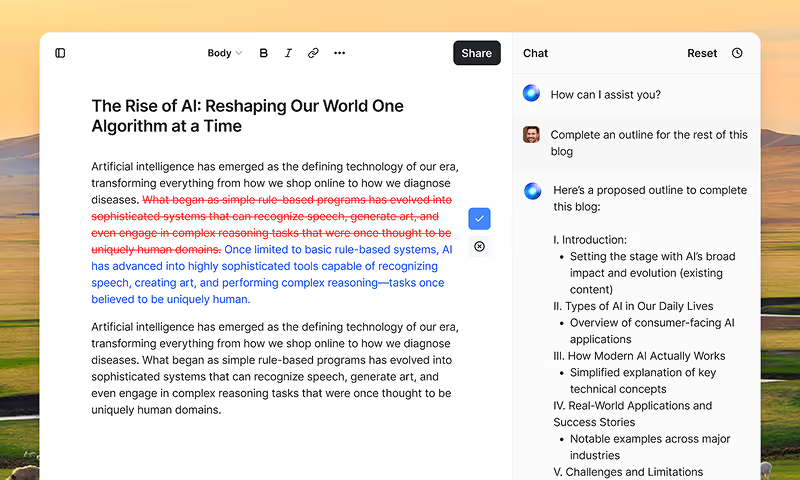
HyperWrite is the AI writing assistant that learns your style. It handles drafting, editing, and researching so you can focus on ideas.
- Autocompletes sentences as you type
- Works inside Google Docs & Gmail
- Adapts to your personal writing style
- 500+ AI tools for any writing task
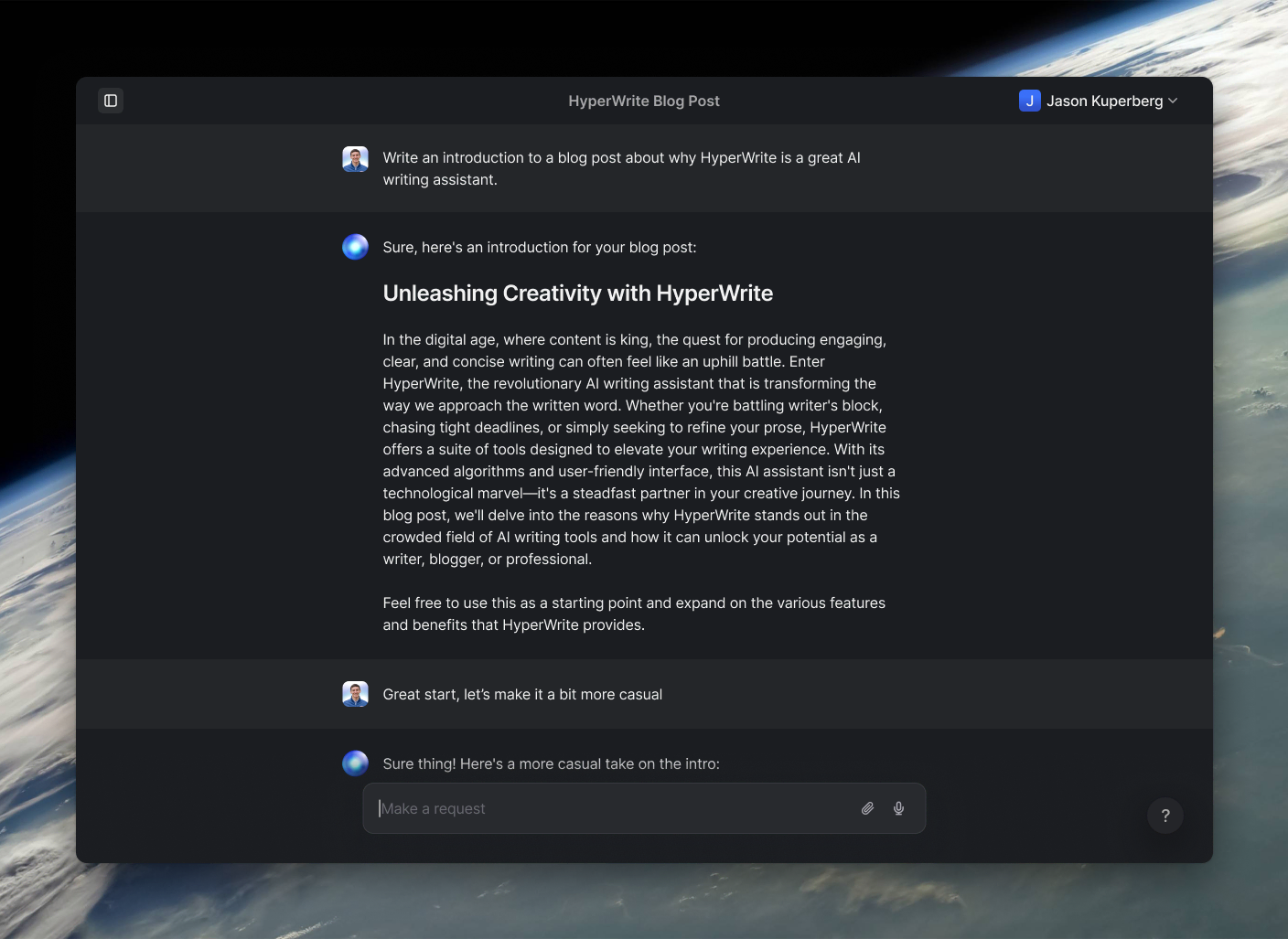
Powerful writing in seconds
Improve your existing writing or create high-quality content in seconds. From catchy headlines to persuasive emails, our tools are tailored to your unique needs.