


Corporate job postings now average around 250 applicants per opening, yet most still miss the people they actually want. Here's how to write a job description in 8 steps, with a free template and the common mistakes that filter out top candidates.
What is a job description?
A job description is the document that defines a role for both the candidate reading it and the hiring team filling it. It covers the role's purpose, the work the person will do, the qualifications they need, and the compensation they can expect.
Done well, it pre-qualifies the right candidates and screens out the wrong ones before they ever hit your inbox. Done poorly, it draws the wrong people, repels the right ones, or both.
Why most job descriptions fail to attract top talent
Most job descriptions read like internal HR documents instead of an invitation. They list every task the role might touch, pile on every qualification someone might want, and skip the parts a real candidate cares about.
This approach was successful in the past when the job market was tighter, but it doesn't work now. These days, top candidates can pick and read a description in under a minute and decide whether to keep reading or close the tab.
The language and requirements in your job description actively shape who applies. Three patterns show up in job descriptions that underperform:
- Kitchen-sink requirements list: 12 must-haves, 8 nice-to-haves, and a tone that says "we don't know what we actually need."
- Internal language: terms only your team uses, written by someone who forgot the candidate doesn't work there yet.
- Missing context: no salary, team description, or sense of what success in the role looks like in 90 days.
How to write a job description in 8 steps
Follow these eight steps in order. Each one is short, and earns its place in the description.
1. Lead with a plain job title
Use the plain title for the role, not a "creative" version.
✅ "Marketing Manager" works.
❌ "Marketing Ninja" doesn't.
Standard titles win because candidates search by them, ATS systems index by them, and recruiters filter by them. Save your brand voice for the body of the description.
2. State the role's purpose in one sentence
State what the role exists to do, in one sentence using plain English.
"This role owns paid acquisition for our SMB segment, with a $400K monthly budget." This sentence does more work than three paragraphs of corporate context. It tells the candidate what they'd actually be doing.
3. Describe the team in two to three sentences
Add two to three sentences on the company and the team the role joins. Skip the founding story. Focus on what makes this role and this team specifically interesting to someone evaluating it against five other offers.
4. Write 5–7 outcomes that don’t sound like tasks
Create bullets describing outcomes instead of tasks.
✅ Try phrasing like "Own quarterly demand-gen targets"
❌ Not "Responsible for activities related to demand generation."
Outcomes tell the candidate what success looks like, while tasks read like a job posting written by a committee.
5. Cut must-haves to 3–5 real non-negotiables
Three to five hard requirements. If something isn't a real must-have, it doesn't go here. Inflated requirement lists are one of the top reasons qualified candidates self-select out. Be honest about what the role actually needs on day one.
6. Add 2–3 clearly labeled nice-to-haves
Clearly labeled and short. Two or three items maximum. The job of this section is to signal preference without making it look like another wall of must-haves.
7. Post the salary range and benefits
Pay transparency is now law in a growing number of states, including California, Colorado, New York, and Washington, and increasingly expected everywhere else. A posted range attracts more qualified applicants and fewer mismatches. Include benefits that are actually distinctive, not the standard ones every company offers.
8. Make the application path one sentence
One sentence: where to apply, what to include, who reviews it. Friction at this step is a top reason qualified candidates drop off.
Job description template you can copy
Adapt the template below to your role. The brackets show what to replace.
[Job title]
Location: [city, remote, hybrid]
Compensation: [salary range], [equity if applicable], [bonus structure]
About the role
[One-sentence purpose. What does this role exist to do? Example: "This role leads paid acquisition for our SMB segment, with a $400K monthly budget and a remit to grow it 3x in the next 12 months."]
About [team name]
[Two to three sentences on the team. Who they are, what they own, why this role is opening now. Skip the founder story unless it's directly relevant.]
What you'll do
- [Outcome 1: what this person owns, framed as a result]
- [Outcome 2: what they'll deliver in their first 90 days]
- [Outcome 3: who they'll partner with cross-functionally]
- [Outcome 4: what they'll measure success against]
- [Outcome 5: a stretch outcome for someone strong in the role]
What we're looking for
- [Hard requirement 1: experience or skill that's genuinely non-negotiable]
- [Hard requirement 2: same standard]
- [Hard requirement 3: same standard]
Nice to have
- [Preferred but not required experience or skill]
- [Preferred but not required experience or skill]
Compensation and benefits
- Salary: [posted range]
- [Equity, if applicable]
- [Benefits that are actually distinctive at your company]
- [PTO, parental leave, learning budget, or anything else worth naming]
How to apply
Send your resume and [one specific deliverable, like a short note on a relevant project] to [application link or email]. [Who reviews it and the rough timeline.]
Example job description you can learn from
Content Strategist
Location: Remote (U.S.)
Compensation: $85,000–$105,000 base + equity
About the role
This role owns content strategy for Arcflow, a project management tool for creative teams, building the editorial engine that turns organic search into our primary acquisition channel.
About the Arcflow team
Arcflow's marketing team is four people, moving fast, and tired of thin content that ranks for nothing. You'd be the first dedicated content hire, reporting directly to the VP of Marketing, with a real budget and a clear mandate: build something that lasts.
What you'll do
- Own the editorial calendar from keyword research to publishing, with a target of 8–10 high-quality pieces per month
- Write and edit long-form content that ranks: comparisons, guides, and use-case articles targeting mid-funnel buyers
- Build and manage relationships with two to three freelance writers, including briefs, feedback, and quality control
- Develop a content measurement framework and report monthly on organic traffic, leads, and assisted conversions
- Identify content gaps competitors have missed and turn them into our highest-performing pages within 12 months
What we're looking for
- 3+ years writing and editing long-form content in a B2B SaaS environment
- Demonstrated ability to grow organic traffic
- Comfortable working without a large team or established playbook
Nice to have
- Experience with project management or creative ops tools as a user, not just a writer
- Familiarity with programmatic SEO or content-led growth strategies
Compensation and benefits
- Salary: $85,000–$105,000
- 0.1–0.2% equity with a standard 4-year vest
- $1,500 annual learning budget
- Fully remote, async-first culture with no meeting Fridays
How to apply:
Send your resume and two writing samples you're proud of to careers@arcflow.io. We review applications on a rolling basis and aim to respond within two weeks.
Common mistakes that filter out top candidates
Even strong job descriptions trip on one or more of these:
Listing 10+ "must-have" requirements
Most "must-haves" are really not. If you'd hire someone who's missing one of them, it isn't a must-have.
Cut the list to 3 to 5 genuine non-negotiables and move the rest to nice-to-haves, or cut them entirely. Long requirement lists reduce qualified applicants. Top candidates read them and assume the role is poorly scoped.
Hiding the salary range
Candidates increasingly skip postings without compensation ranges. According to Glassdoor research, salary and benefits are the top two factors candidates look for in a job ad, ahead of location and brand. Posting a range earns you more aligned applicants and fewer mismatched ones.
Using internal jargon
If a candidate would need to be on your team for six months to understand a sentence, rewrite it. Industry terms are fine. Internal terms (your codename for a project, your in-house acronyms, your specific tool stack named without context) belong in onboarding, not in the JD.
Writing 12 bullets of tasks instead of 5 bullets of outcomes
Long task lists feel exhaustive but read as exhausting. Outcomes are shorter, easier to scan, and signal that the company actually knows what success in the role looks like.
Coded language
Words like "rockstar," "ninja," and "aggressive" skew the applicant pool. So do unrelated tone choices ("must thrive in chaos"). Write the way you'd describe the role to someone you respect.
How to write a better job description with AI
HyperWrite can draft a job description alongside you. The TypeAhead Chrome Extension reads your open tabs (the role brief, your team's past JDs, or the LinkedIn profile of the hire you're trying to replace) and writes context-aware completions in your voice as you type.
Personas trains on your past writing, so the draft sounds like your company, not a generic AI. It works across every tab too, which matters because the JD is only one part of the hiring writing load.
Outreach to passive candidates on LinkedIn, follow-ups in Gmail, interview debriefs in your ATS, rejection emails, and offer-stage messages are all part of the hiring process.
Each one is short on its own, with hours of writing every week in total. The AI Tools library has several tools like AutoWrite for a full first draft from a brief, plus rewrite tools to tighten requirements, soften coded language, or convert task lists into outcome bullets.
TypeAhead is free to get started with. Install the Chrome extension and try it on your next JD and candidate outreach.
Frequently asked questions
What should a job description include?
A job description should include eight sections: job title, one-sentence purpose, company and team context, what the person will do, must-have requirements, nice-to-have requirements, compensation and benefits, and how to apply. Each section should be short and written in plain English.
How long should a job description be?
A job description should be 300 to 500 words for most roles. Long enough to cover all eight sections clearly, short enough that a candidate can read it in under two minutes. Longer descriptions correlate with fewer applicants because top candidates skim.
Should you include salary in a job description?
Yes, you should include salary in a job description. Salary and benefits are the top two factors candidates look for in a job ad, according to Glassdoor research, and pay transparency is now legally required in many U.S. states. Posting a range increases qualified applicants and reduces mismatched ones.
How do you write a job description that's inclusive?
To write a job description that's inclusive, cut coded language ("rockstar," "ninja," "aggressive"), trim must-have requirements to genuine non-negotiables, post the salary range, describe the team and the work specifically, and write in plain English instead of internal jargon.
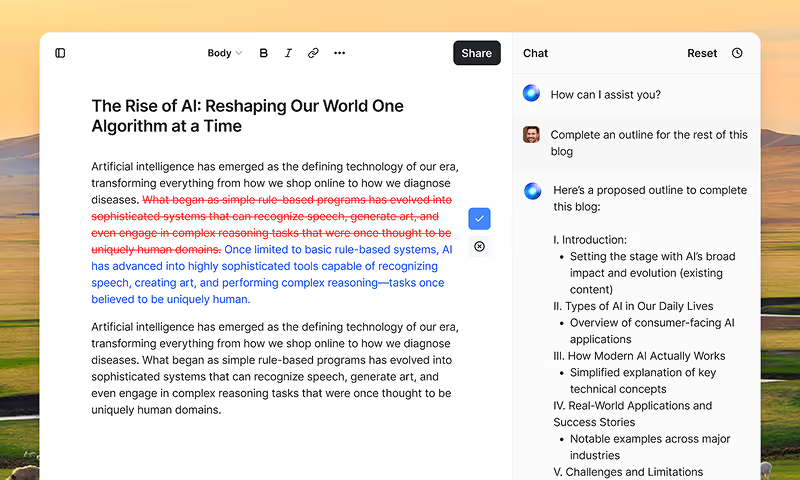
HyperWrite is the AI writing assistant that learns your style. It handles drafting, editing, and researching so you can focus on ideas.
- Autocompletes sentences as you type
- Works inside Google Docs & Gmail
- Adapts to your personal writing style
- 500+ AI tools for any writing task
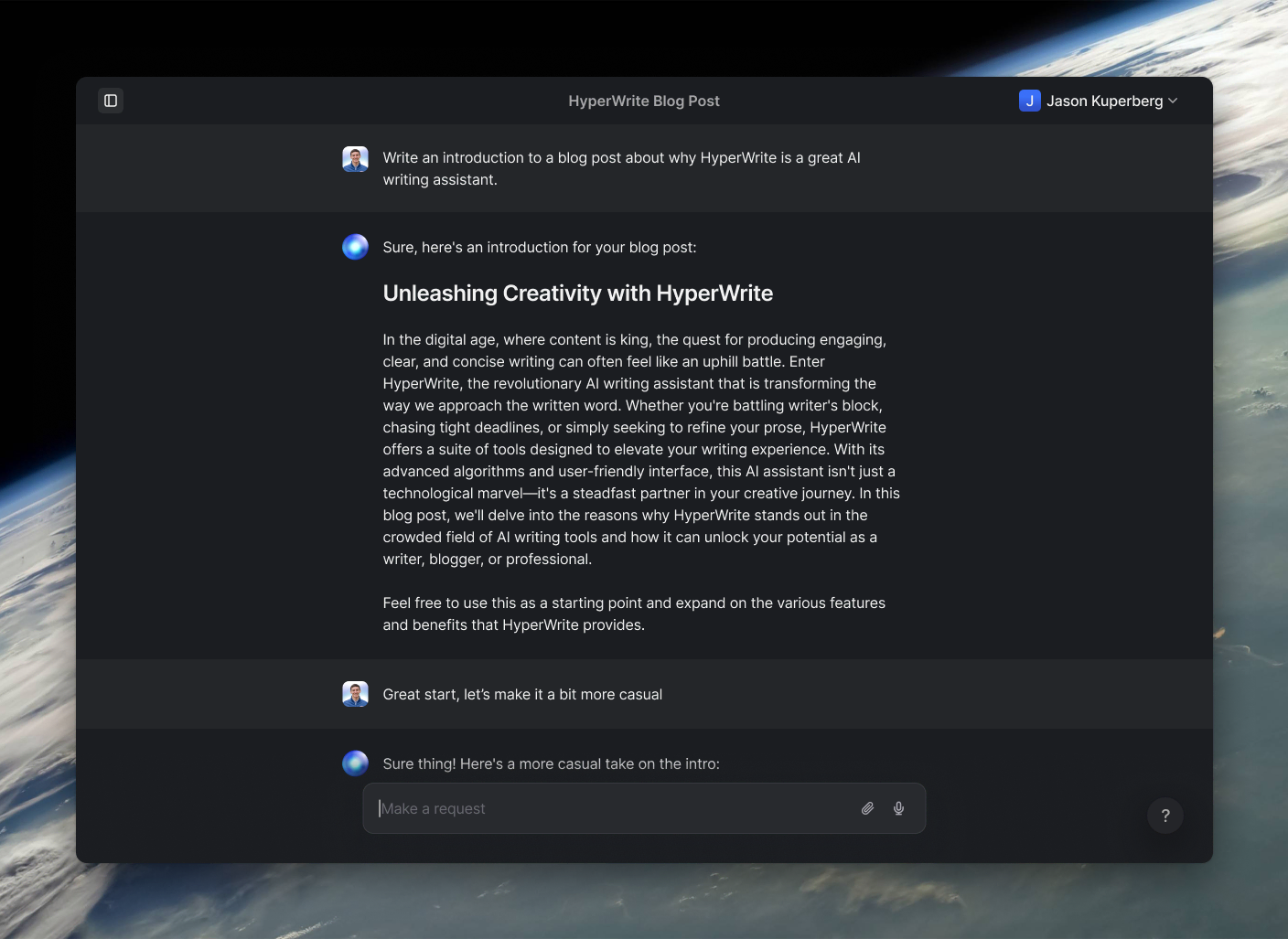
Powerful writing in seconds
Improve your existing writing or create high-quality content in seconds. From catchy headlines to persuasive emails, our tools are tailored to your unique needs.