
8 Hiring Email Templates: Copy, Customize, and Send Today


After refining recruiting emails across 50+ hiring cycles, I’ve developed these 8 templates to cover every stage: application acknowledgment, interview invites, offer letters, and everything in between.
Which hiring email template do you need?
- Application acknowledgment: Confirm receipt within 24 hours.
- Interview invitation: Invite a shortlisted candidate to interview.
- Interview confirmation: Lock in the time, format, and details.
- Post-interview follow-up: Keep candidates interested after they interview.
- Rejection (after application): Decline candidates who didn't make the shortlist.
- Rejection (after interview): Decline candidates who interviewed but weren't selected.
- Job offer email: Extend a formal offer.
- Follow-up after no response: Nudge a candidate who hasn't replied.
The 8 best hiring email templates
1. Application acknowledgment email
Send this within 24 hours of receiving an application. Most companies take days to acknowledge applications, or don't at all. That silence is the first thing that costs you candidates, and it's the easiest fix on this list.
Example:
Subject: We received your application: [Job Title] at [Company Name]
Hi [First Name],
Thanks for applying for the [Job Title] role at [Company Name]. We've received your application and will be reviewing submissions over the next [X weeks].
If your experience is a strong match, we'll be in touch to discuss next steps. Either way, we'll update you once our review is complete.
[Your Name] [Title] | [Company Name]
2. Interview invitation email
Keep this clear and direct. Strong candidates are usually running multiple processes at the same time. An email that leads with what the interview is, when it is, and what format it's in makes it easy to say yes without unnecessary back-and-forth.
Example:
Subject: Interview invitation: [Job Title] at [Company Name]
Hi [First Name],
We'd love to invite you to interview for the [Job Title] role. Based on your application, we think you could be a strong fit and want to learn more about your background.
- Format: [Phone / Video / In-person]
- Duration: [30 / 45 / 60 minutes]
- Proposed times: [Option 1], [Option 2], [Option 3]
Let me know which works best, or suggest a time that suits you.
[Your Name] [Title] | [Company Name]
3. Interview confirmation email
Once the time is locked, confirm every detail in writing. Date, time, time zone, format, and who they're speaking with. This is the email candidates screenshot and refer to on the day. Missing details here cause no-shows and last-minute panic on both sides.
Example:
Subject: Your interview is confirmed: [Job Title] at [Company Name]
Hi [First Name],
Your interview for the [Job Title] role is confirmed.
- Date: [Day, Date]
- Time: [Time + Time Zone]
- Format: [Video link / Address / Phone number]
- Interviewer(s): [Name(s) and title(s)]
If anything comes up, please reach out at [email or phone] as soon as possible.
Looking forward to speaking with you.
[Your Name] [Title] | [Company Name]
4. Post-interview follow-up email
This is the most skipped email in recruiting, and forgetting it costs you candidates. A short message within 24 hours sets expectations, keeps the candidate warm, and signals that your process is organized. That last point matters more than most hiring managers realize. Candidates are evaluating you, too.
Example:
Subject: Thank you for your time: [Job Title] at [Company Name]
Hi [First Name],
Thanks for taking the time to speak with us today. It was great to learn more about your background and [specific thing discussed in the interview].
We're continuing to interview candidates over the next [X days / week]. We'll be in touch once we've completed our review.
[Your Name] [Title] | [Company Name]
5. Rejection email (after application review)
Keep all application rejections short, direct, and respectful. As Forbes confirms, a poor candidate experience significantly damages the employer’s brand. For one thing, people who don't get the job talk about how they were treated. A clear rejection sent promptly does more for your reputation than silence.
Example:
Subject: Your application for [Job Title] at [Company Name]
Hi [First Name],
Thank you for applying for the [Job Title] role. After reviewing your application, we've decided to move forward with candidates whose experience more closely matches what we need right now.
We appreciate your time and wish you well in your search.
[Your Name] [Title] | [Company Name]
6. Rejection email (after interview)
This one needs more care, and most companies get it wrong. The most common mistake is being vague and overly apologetic: "We're sorry to share this difficult news, but unfortunately..." That combination reads as hollow.
The candidate invested real time. Be direct, be specific, and say something genuine.
Example:
Subject: Update on your [Job Title] application
Hi [First Name],
Thank you for taking the time to interview for the [Job Title] role. It was a genuine pleasure learning about your experience and how you approach [relevant area discussed].
After careful consideration, we've decided to move forward with another candidate whose background more closely fits the role at this stage.
This wasn't an easy decision. We were truly impressed by [specific quality or moment from the interview], and we'd encourage you to keep an eye on future openings at [Company Name].
Thank you again for your time.
[Your Name] [Title] | [Company Name]
7. Job offer email
Lead with the offer. Candidates waiting on a decision don't need a warm-up paragraph before the good news. State the role, the key terms, and what happens next, in that order.
Example:
Subject: Job offer: [Job Title] at [Company Name]
Hi [First Name],
We're pleased to offer you the [Job Title] position at [Company Name].
Here's a summary of the offer:
- Start date: [Date]
- Salary: [Amount] per [year / month]
- Benefits: [Brief summary or "see attached offer letter"]
- Reporting to: [Manager's name and title]
A formal offer letter with full details is attached. Please review it and let us know if you have any questions.
We look forward to welcoming you to the team.
[Your Name] [Title] | [Company Name]
8. Follow-up after no response
One follow-up is appropriate. More than one is too much. Keep it short, low-pressure, and easy to respond to, including if the answer is no.
Example:
Subject: Following up: [Job Title] at [Company Name]
Hi [First Name],
Just following up on my previous message about the [Job Title] role. If you have questions or need more time, I'm happy to help.
If your circumstances have changed, please let me know. No pressure either way.
[Your Name] [Title] | [Company Name]
What separates a good hiring email from a forgettable one
Most hiring emails have the same breakdown point: they look technically complete but feel like they came from a system, not a person.
Here's what actually makes a difference:
- Be specific about the candidate, not just the role. "We were impressed by your experience leading the product launch at [Company]" lands very differently than "we were impressed by your background." One takes 10 extra seconds to write, but it gets remembered.
- Don't apologize for doing your job. Rejections that open with "We're sorry to share this difficult news" are trying too hard. Respectful and direct is better. Candidates respect it more.
- Always name the next step. "We'll be in touch" is the minimum. "We'll be in touch by [specific date]" is better. Ambiguity at the end of an email is where candidates lose confidence in your process.
- Match your company's voice. If your team communicates casually and moves fast, write like that. Generic professionalism reads as indifference.
Write and personalize hiring emails faster with HyperWrite
Templates get you 80% of the way there. The last 20% is where time actually gets lost: personalizing each email quickly, adjusting tone for the situation, and making sure nothing reads like it was generated.
HyperWrite's AI Writing Assistant can take any of these templates and rewrite them to match your company's voice, soften a rejection, or tighten a stiff offer email in seconds.
The TypeAhead Chrome extension completes sentences in real time as you type, pulling context from all your open tabs, so every suggestion fits what you're actually writing, not a generic prompt.
You can even use the AI Document Editor to store and refine your full template library in one place. Set up Personas so every draft sounds like your team, not a template generator. You’ll write faster without losing your voice.
HR and recruiting professionals are some of HyperWrite's strongest clients and use cases. The free plan is a low-commitment way to test it against your current workflow.
Frequently asked questions
What should a hiring email template include?
A hiring email template should include direct specifics: a clear subject line, the candidate's name, the job title, the purpose of the email, relevant details (dates, interview format, next steps), and a professional sign-off.
How do you write a professional rejection email?
A professional rejection email should be brief, direct, and respectful. Thank the candidate for their time, state the decision clearly, and avoid vague or overly apologetic language.
When should you send an interview invitation email?
Send an interview invitation email within 48–72 hours of deciding to move a candidate forward. Waiting longer risks losing strong candidates to competing offers, especially in fast-moving hiring markets.
How do you personalize hiring email templates at scale?
You can personalize hiring email templates at scale by keeping one master template per stage, then adjusting one or two details per candidate. Add a line referencing their application, something they said in the interview, or a note about the specific role.
HyperWrite's AutoWrite handles those adjustments in seconds without letting any email feel automated.
What's the best subject line for a job offer email?
The best subject line for a job offer email is clear and direct: "Job Offer: [Job Title] at [Company Name]" works every time. Candidates waiting on an offer will open it immediately.
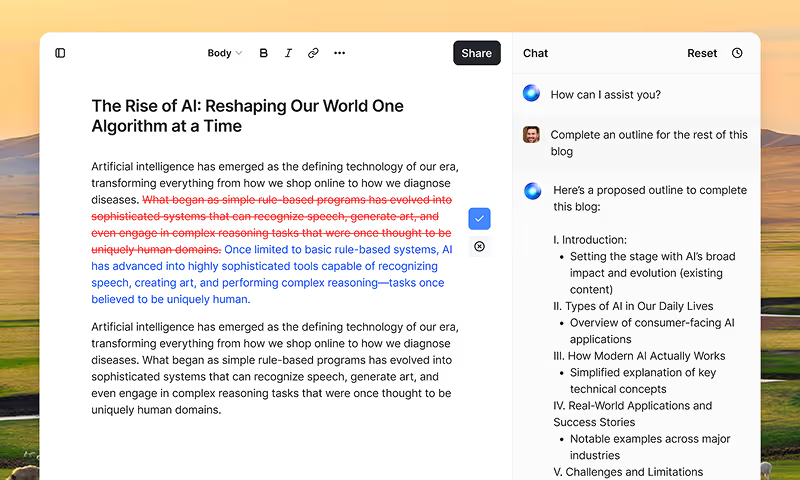
HyperWrite is the AI writing assistant that learns your style. It handles drafting, editing, and researching so you can focus on ideas.
- Autocompletes sentences as you type
- Works inside Google Docs & Gmail
- Adapts to your personal writing style
- 500+ AI tools for any writing task
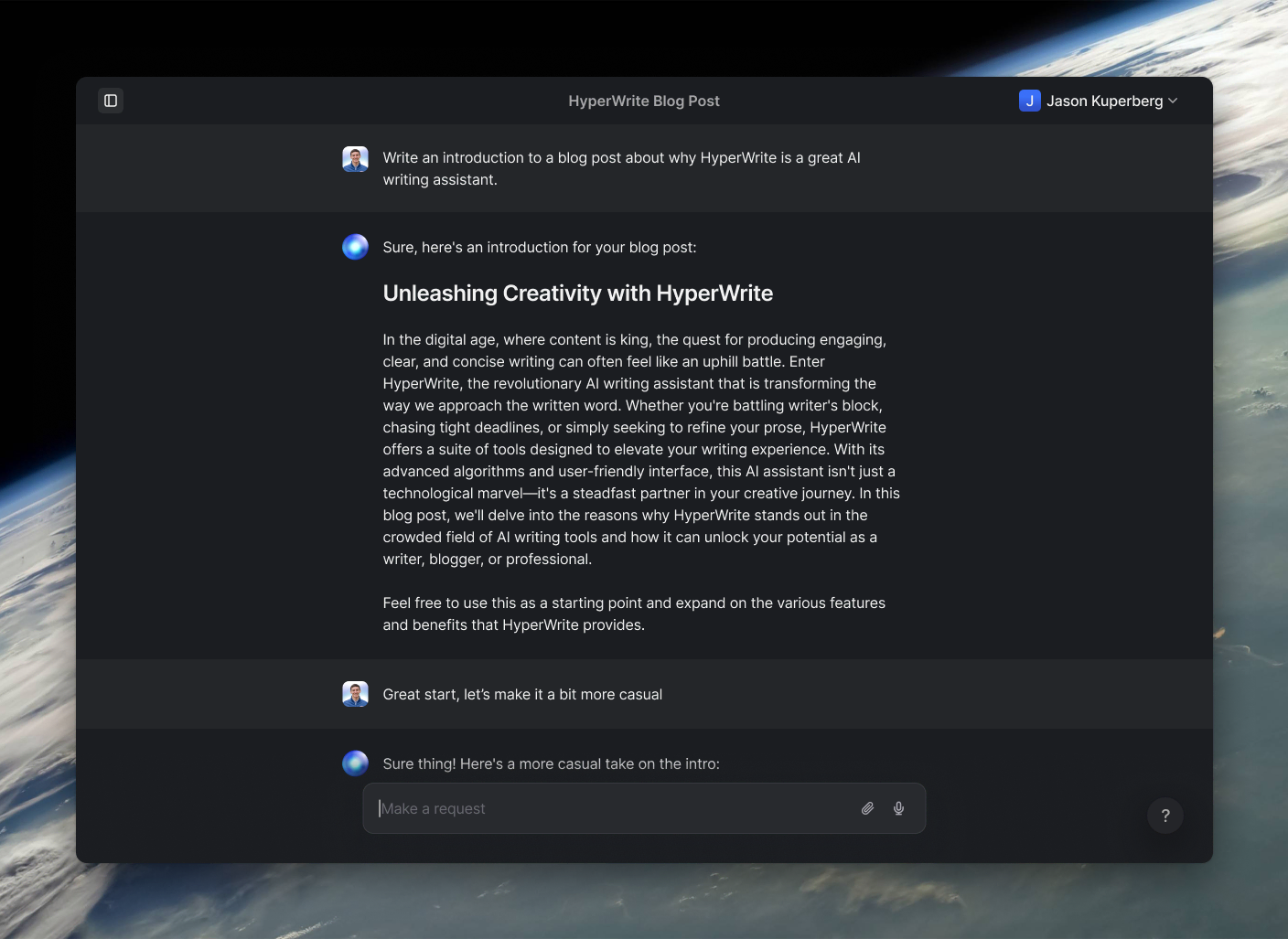
Powerful writing in seconds
Improve your existing writing or create high-quality content in seconds. From catchy headlines to persuasive emails, our tools are tailored to your unique needs.