


Most AI writers just generate text. Anyword also scores it and forecasts how well your copy will convert before you publish. Our Anyword review covers the pros, the cons, and who the platform is built for.
What is Anyword?
Anyword is an AI copywriting platform built for marketers. It generates ads, landing pages, emails, product descriptions, and social copy, and its defining feature is the Predictive Performance Score, which rates how copy will perform against a dataset of real marketing performance data.
Anyword features worth knowing
Data-driven editor and Predictive Performance Score
The Data-Driven Editor scores your copy in real time, using billions of marketing data points to flag which version is likeliest to convert. It's the feature users point to most, and the scores are the main reason they trust what they publish.
The catch is that the guidance leans mainstream, so niche or technical copy can score well without actually sounding specialized.
Templates and formats
More than 100 templates cover ads, subject lines, landing pages, product descriptions, and social captions, with unlimited generation on every paid plan. Fill in a few fields and you get a usable draft in seconds, which is where most people say the tool earns its keep.
Push it past short-form, though, and the same praise flips: longer pieces start repeating words and tone, and users regularly mention editing them back into shape.
Brand voice and custom AI models
Anyword learns a brand voice from samples and applies it across your copy, and Business and Enterprise tiers train custom models on your own data for tighter alignment. The tone tends to land well on short pieces, reading natural rather than robotic.
It holds less consistently across longer or multi-format work, so the more copy you feed the custom models, the better the voice sticks.
Blog Wizard
Blog Wizard drafts full-length posts from an editable outline and runs a built-in plagiarism check. It's a solid way to beat the blank page, and people who use it for outlines and first drafts rate it well for exactly that. What it won't do is hand you a finished article: longer drafts come back repetitive and thin, and need real editing before they're publish-ready.
Copy Intelligence and analytics
On higher tiers, Anyword connects to Meta and Google Ads, analyzes what you've published, and shows which messaging actually performed. It's the piece that turns Anyword from a writing tool into a feedback loop, and it's part of why data-focused teams accept the higher tiers. It only pays off once you plug in real campaign data, so lighter users rarely touch it.
Chrome extension
The Chrome extension brings scoring and generation into other web apps, so you can write and score closer to where the copy goes live.
In practice, it generates on demand rather than predicting as you type, so it works as a content generator you trigger in the browser rather than an always-on writing partner. Handy if you already work inside Anyword, less so if you want suggestions to surface as you type.
Anyword plans and pricing
Pricing verified from the Anyword pricing page as of July 2026.
Which plan should you choose?
- Starter ($39/mo annual): The solo tier, one seat, 50 performance predictions a month, and the full data-driven editor. Right for a freelancer or single marketer who wants performance scoring without team features.
- Data-Driven ($79/mo annual): Three seats, 100 predictions, and real-time scoring as you edit. Suited to small teams, though it's still capped at 50 data rows.
- Business (custom): Connects your own campaign data (5,000 rows), adds custom AI models, copy analytics, and A/B testing. Worth it once you're feeding it real performance history.
- Enterprise (custom): Adds a private LLM, SSO, full API access, and dedicated support for large, security-conscious teams.
Words are unlimited, so the real ceiling is predictions and seats: a team that scores every variation hits the prediction caps long before it runs out of copy.
What real users say about Anyword
Pros

- Quick to set up and integrate. Arnav P., an SDE, wrote on G2 that "setting it up was quick and straightforward," with the connections to his marketing platforms just as smooth.
- Speeds up everyday writing. Customer success manager Vijay S. reaches for it on emails and social posts and says that "it makes writing faster and helps me find better words."
- Predictive scores guide stronger copy. Software engineer Sidath P. drafts ads and product copy with it, and reports that "the platform's AI-driven suggestions are very accurate, saving me a lot of time."
Cons
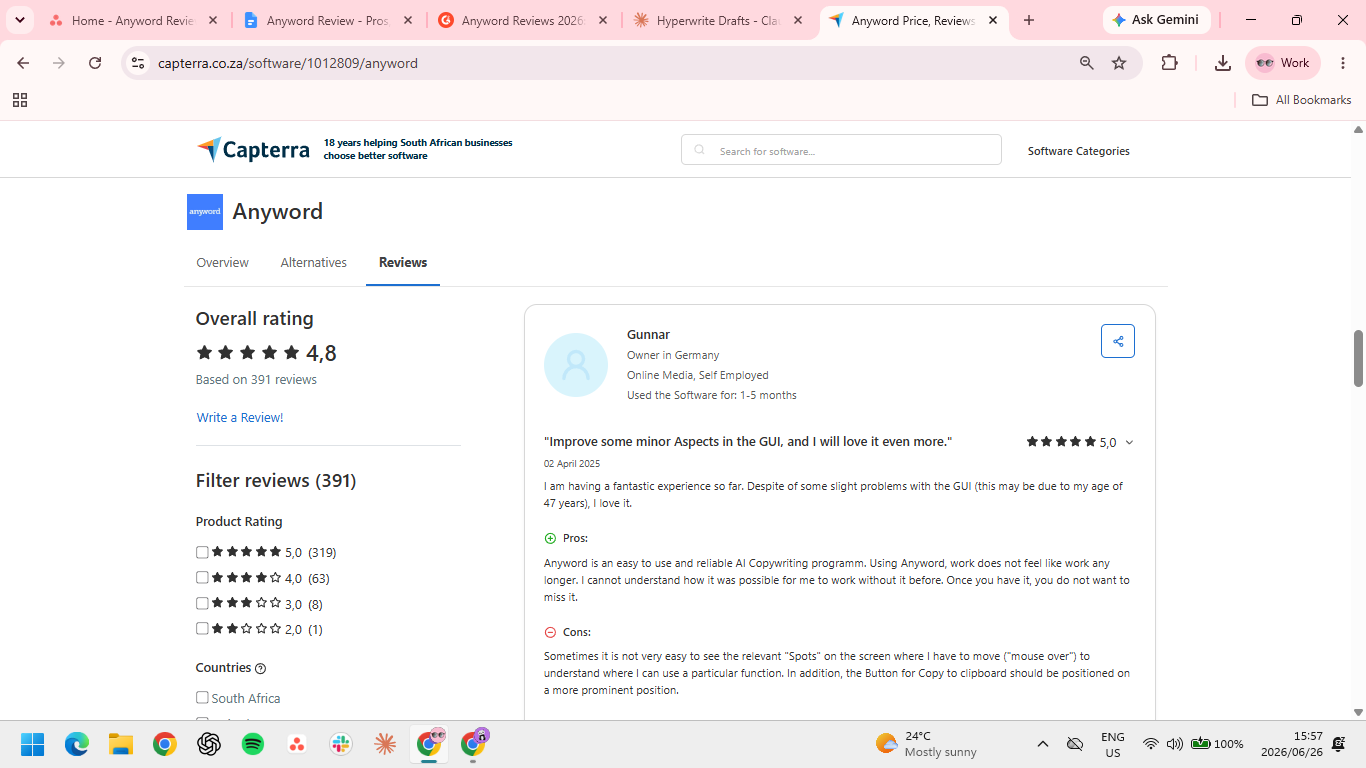
- Takes time to learn the dashboard. Mahe Z., who works in HR, notes on G2 that "the dashboard takes a bit of time to get used to at first," with more features than most people need on day one.
- Repetitive on long-form. Content creator Ishan S. found on G2 that "some suggestions can feel a little repetitive when working on longer content," so longer drafts need a closer edit.
- Advanced tools are gated. Adjunct instructor Nursalin A. points out that the strongest features sit behind higher tiers, and that "certain pieces of advice may appear quite general."
Anyword use cases: What it's best for
Anyword is built for short-form marketing copy where conversion matters, and a few use cases play to that strength:
- Paid ad copy. Generate multiple ad variations, then use the performance score to pick the one most likely to convert before you spend on it. This is Anyword's strongest use case.
- Landing pages. Write and test headline and CTA variations; higher tiers can optimize continuously and serve whichever version performs best.
- Email marketing. Draft subject lines and body copy scored for engagement, useful for teams running regular campaigns who want to lift open and click rates.
- Product descriptions at scale. Templates and bulk CSV generation let e-commerce teams produce consistent, on-brand descriptions across a large catalog.
- Social media copy. Produce captions and post variations in different tones, with engagement scoring to guide what to publish.
A few things fall outside its lane, though. Long-form blog content tends to thin out after a few paragraphs, technical or niche topics come out generic without heavy prompting, and everyday non-marketing writing leaves you paying for performance features you'll never open.
Is Anyword right for you?
Anyword works well for:
- Performance marketers who want conversion data before publishing
- Teams writing ads, landing pages, emails, and social copy at volume
- High-volume writers who want unlimited generation without per-word limits
- Marketers who treat A/B testing and conversion rates as real KPIs
Skip Anyword if you:
- Mainly need a general writing assistant for everyday work
- Write long-form content where the output thins out
- Want the cheapest option, since it's priced at the higher end
- Need native WordPress publishing or a mobile app
Anyword alternative for everyday writing
Anyword's main draw is the performance score. Without it, you're paying premium rates to write an email. And there's no mobile app or in-app publishing, so Anyword is a place you go to score copy, then carry it elsewhere.
HyperWrite works the other way: it meets you where you already write. Its TypeAhead extension finishes your sentences as you type inside Gmail, Docs, LinkedIn, or any other tab, taking its cues from whatever's open in your browser.
Personas let it match your own voice instead of a generic house style, so your replies and posts still sound like you. And when a job is bigger than a sentence, the AI Writing Assistant drafts, rewrites, and reworks tone in the same window. There's no score to chase and no analytics to feed.
It's free to start, and Premium runs $16/month billed annually, which covers the everyday writing that never needed a prediction.
Final verdict: Is Anyword worth it?
For performance marketers, Anyword is worth it. If you A/B test campaigns, the Predictive Performance Score ranks your copy against real conversion data before you spend on promotion, and that’s a real edge.
Every con here points to the same limit: it's built narrowly and well for short-form marketing copy, and pushing it past that lane means paying premium rates to fight its limits.
It splits by who's asking. Marketers running paid campaigns should shortlist it and start with Data-Driven. Everyone else will get more for less from something lighter.
Want a tool that keeps up with how you write? Try TypeAhead free with the Chrome extension. One workday is enough to feel the difference.
Frequently asked questions
Is Anyword worth it in 2026?
Anyword is worth it in 2026 for performance marketers who use predictive scoring. Forecasting how copy will convert before publishing is a genuine edge that general AI writers don't offer. It's less worth it for casual or general writing, because the price sits at the higher end of the category and the performance features would go largely unused.
Does Anyword have a free plan?
No, Anyword does not have a permanent free plan. It offers a free trial that runs 7 days or 2,500 credits, whichever comes first, so you can test the platform before paying. After the trial, paid plans start at $49/month, or $39/month on annual billing.
What is Anyword best used for?
Anyword is best used for short-form marketing copy that needs to convert: ads, email subject lines, landing pages, product descriptions, and social posts. Its performance scoring and A/B-test data make it strongest where conversion matters most. It's weaker for long-form articles and general everyday writing.
Is Anyword's performance score accurate?
Anyword's performance score works as a relative guide rather than a guarantee. It’s trained on billions of real marketing data points to rank which copy variation is most likely to convert. Its accuracy depends on how closely your audience matches that data, so marketers use it to prioritize what to test rather than to replace testing entirely.
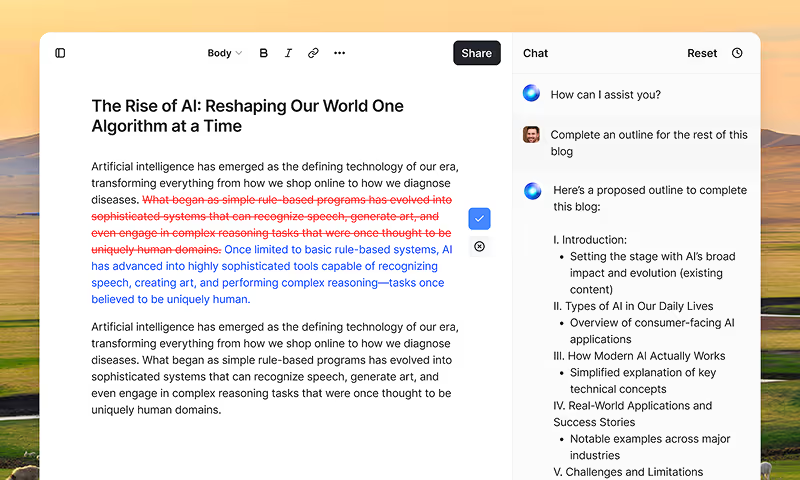
HyperWrite is the AI writing assistant that learns your style. It handles drafting, editing, and researching so you can focus on ideas.
- Autocompletes sentences as you type
- Works inside Google Docs & Gmail
- Adapts to your personal writing style
- 500+ AI tools for any writing task
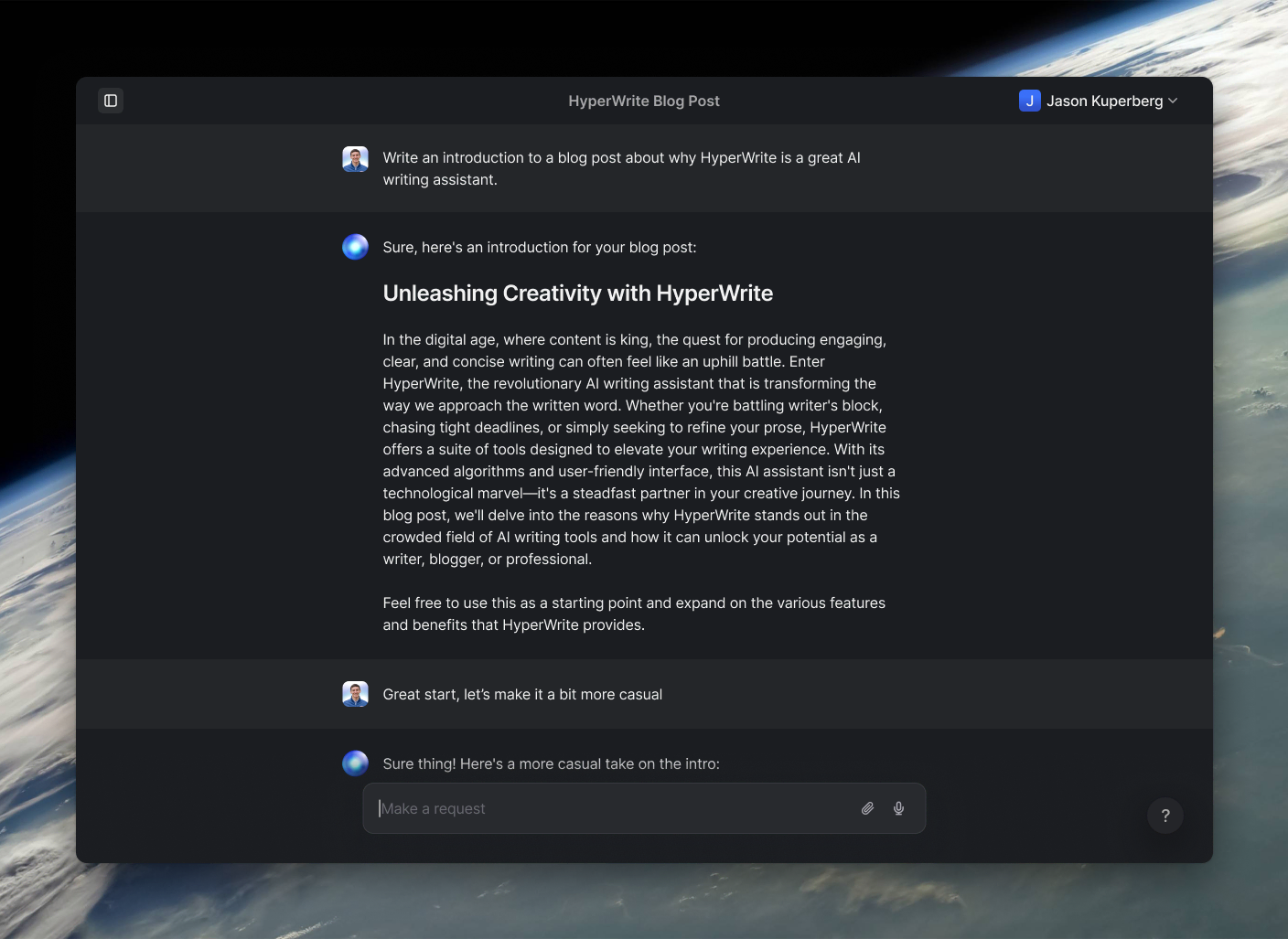
Powerful writing in seconds
Improve your existing writing or create high-quality content in seconds. From catchy headlines to persuasive emails, our tools are tailored to your unique needs.